
The Definitive 6G Technology Roadmap and Timeline: Navigating the Future of Connectivity
The dawn of a new era in wireless communication is rapidly approaching. As 5G continues its global rollout, the world's leading innovators are already sketching out the blueprint for what comes next: 6G technology. This isn't just about faster speeds; it's about a paradigm shift in how we interact with the digital and physical worlds. This comprehensive guide will delve deep into the projected 6G technology roadmap and timeline, exploring the ambitious vision, the foundational technologies, and the challenges that lie ahead. Prepare to understand how 6G will redefine connectivity, fostering a truly intelligent, immersive, and sustainable global infrastructure.
Understanding the Vision: What Will 6G Deliver?
While 5G brought enhanced mobile broadband, ultra-low latency, and massive machine-type communication, 6G is poised to push these boundaries exponentially and introduce entirely new capabilities. The vision for 6G extends far beyond mere data transfer, aiming for a future where communication networks are intrinsically integrated with artificial intelligence, sensing, and human-centric experiences. We're talking about a world of pervasive connectivity where every device, every surface, and even every human interaction can be enhanced by intelligent, real-time data.
Key pillars of the 6G vision include:
- Ubiquitous Intelligence: AI will not just be an application on the network; it will be an integral part of the network's design, operation, and optimization. This means an AI integration that allows networks to self-configure, self-heal, and predict user needs.
- Immersive Extended Reality (XR): 6G will enable truly seamless and realistic virtual and augmented reality experiences, including lifelike holographic communication. The current limitations of bandwidth and latency for XR will be a distant memory.
- Digital Twins of Everything: The creation of dynamic, real-time virtual replicas of physical objects, environments, and even people. This concept of the digital twin will revolutionize industries from manufacturing to healthcare, enabling precise simulations and remote control.
- Integrated Sensing and Communication (ISAC): Networks will not only transmit data but also sense their environment. This means 6G base stations and devices could act as radar systems, enabling applications like gesture recognition, presence detection, and even remote health monitoring.
- Global Coverage and Sustainability: Efforts are underway to ensure 6G provides truly global coverage, including remote and underserved areas, while also being significantly more energy-efficient than previous generations, promoting a sustainable 6G ecosystem.
The Core Technological Enablers of 6G
Achieving the ambitious goals of 6G requires breakthroughs in several key technological areas. These foundational technologies are currently in various stages of research and development, forming the backbone of the evolving 6G roadmap.
Spectrum Innovation: The Terahertz Frontier
One of the most critical enablers for the extreme data rates envisioned for 6G is the exploration of new frequency bands. While 5G pushed into millimeter-wave, 6G will venture into the terahertz (THz) communication range (0.1 THz to 10 THz). These frequencies offer vast swaths of unused bandwidth, promising speeds potentially up to 1 terabit per second (Tbps) – a thousand times faster than typical 5G. The challenges here include significant signal attenuation, short range, and the need for new material science for components.
AI-Native Network Architecture
Unlike previous generations where AI was often an overlay, 6G networks are being designed from the ground up with AI and machine learning at their core. This means AI will manage everything from resource allocation and network slicing to predictive maintenance and security. An AI-native approach ensures optimal performance, efficiency, and adaptability, crucial for managing the complexity of future networks.
Reconfigurable Intelligent Surfaces (RIS)
To overcome the signal attenuation challenges of higher frequencies and improve coverage, Reconfigurable Intelligent Surfaces (RIS) are emerging as a promising technology. These passive or semi-passive surfaces, composed of many small, tunable elements, can intelligently reflect, refract, or absorb radio waves, effectively shaping the wireless environment to extend coverage, reduce interference, and enhance signal strength. Imagine smart walls or billboards that actively improve your wireless connection.
Integrated Sensing, Communication, and Computing
The convergence of sensing, communication, and computation is a hallmark of 6G. Networks will not just transmit data but also collect vast amounts of environmental and contextual information. This integrated approach will enable highly precise localization, gesture recognition, and even environmental monitoring, creating a truly intelligent infrastructure that goes beyond simple connectivity. This also ties into the concept of a "network of intelligence" rather than just a "network of connections."
Quantum Technologies
While full-scale quantum computing is still some way off, its underlying principles are influencing 6G. Concepts like quantum key distribution (QKD) promise unprecedented levels of security for 6G communications. Furthermore, advancements in quantum sensing could lead to highly sensitive and accurate network-based sensors, enabling new applications in healthcare, industrial monitoring, and environmental protection. The long-term impact of quantum technologies on 6G remains a fascinating area of research.
The 6G Technology Roadmap and Timeline: A Phased Approach
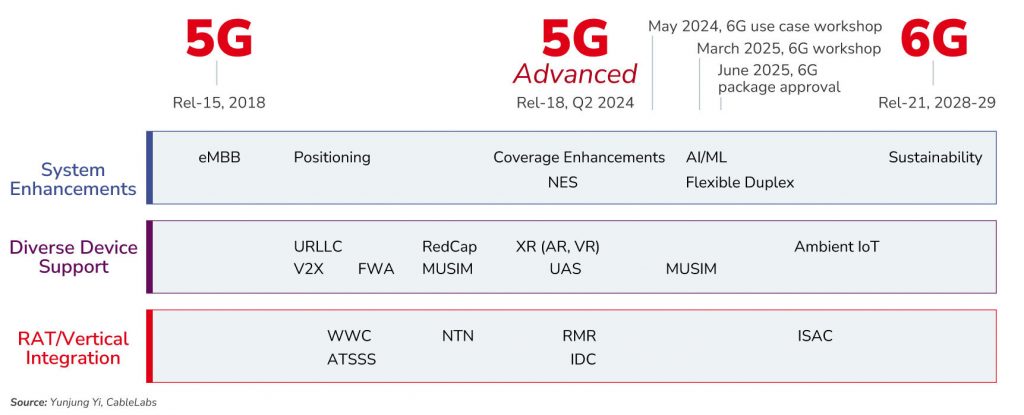
Developing a new generation of wireless technology is a monumental undertaking, involving global collaboration among governments, academia, and industry. The 6G roadmap is generally envisioned in several distinct phases, leading towards potential commercialization around the end of the decade.
Phase 1: Research and Vision Setting (~2020 - 2025)
- Key Activities: This initial phase is characterized by extensive academic research, the publication of white papers, and the formation of global research initiatives. Organizations like the ITU, 3GPP, and various national research bodies (e.g., EU's Hexa-X, China's IMT-2030 Promotion Group, US's Next G Alliance) are actively engaged in defining the core requirements, use cases, and foundational technologies for 6G.
- Focus: Identifying potential frequency bands, exploring novel waveforms, developing new antenna technologies, and conceptualizing AI-native architectures. Early proof-of-concept demonstrations in lab environments begin.
- Output: High-level vision documents, technical white papers, initial research prototypes. This phase is crucial for establishing a common understanding and direction for 6G development. Interested parties can already find numerous academic papers detailing early 6G development proposals.
Phase 2: Standardization and Prototyping (~2025 - 2028)
- Key Activities: As the research matures, formal standardization bodies, particularly 3GPP (3rd Generation Partnership Project), will begin to define the technical specifications for 6G. This involves rigorous discussions and agreements on air interface protocols, network architectures, and service capabilities. Concurrently, industry players will move from lab-based proofs-of-concept to more robust prototypes and field trials.
- Focus: Developing pre-commercial hardware and software, testing key technological enablers in more realistic environments, and refining use cases based on practical feasibility. International collaboration becomes even more critical to ensure global interoperability.
- Output: Draft standards, detailed technical specifications, early prototype deployments, and large-scale trials. This phase is where the theoretical concepts start taking tangible form, shaping the evolution of connectivity.
Phase 3: Early Deployment and Commercialization (~2029 - 2030+)
This phase marks the beginning of commercial 6G services. While specific dates can shift based on technological readiness and market demand, the general consensus points towards initial commercial deployments around 2030.
- Initial Rollout: Like previous generations, 6G will likely see initial deployments in densely populated urban areas or for specific high-value industrial applications that can leverage its unique capabilities (e.g., smart factories requiring ultra-low latency for real-time control, or highly immersive entertainment venues).
- Device Ecosystem: New 6G-enabled devices will emerge, ranging from smartphones and wearables to advanced IoT sensors and holographic display units. The proliferation of these devices will drive wider adoption.
- Scaling and Expansion: Over the subsequent years, 6G coverage will expand, and the ecosystem of applications and services will mature, much like the progression we've observed with 5G advancements. The impact on areas like massive IoT deployments will be transformative.
It's important to remember that this 6G timeline is an ambitious projection. Factors like global economic conditions, technological breakthroughs, and regulatory frameworks can influence the pace of development. However, the concerted effort from governments and major tech players indicates a strong commitment to this future mobile communication.
Key Challenges and Considerations on the Road to 6G
While the vision for 6G is inspiring, the journey is fraught with significant technical, economic, and societal challenges that must be addressed.
- Spectrum Management: Allocating and managing the vast terahertz spectrum globally is a complex task, requiring international agreement and innovative regulatory frameworks.
- Energy Efficiency: The sheer density and complexity of 6G networks, coupled with higher frequency use, demand extremely energy-efficient designs to achieve the goal of a sustainable 6G.
- Security and Privacy: With pervasive sensing and AI integration, ensuring the security and privacy of user data and critical infrastructure becomes paramount. New cryptographic methods and robust identity management systems will be essential.
- Interoperability: Ensuring seamless interoperability between different vendors' equipment and across various national networks is crucial for a truly global 6G experience.
- Cost and Deployment: The significant investment required for research, development, and infrastructure deployment will be immense. Innovative business models and government incentives will be necessary to facilitate widespread adoption.
- Digital Divide: There's a risk that the benefits of 6G could exacerbate the digital divide if equitable access and affordability are not prioritized during the planning and deployment phases. The goal should be true pervasive connectivity for all.
Addressing these challenges requires a collaborative, multi-stakeholder approach, involving policymakers, industry leaders, and research institutions worldwide. The lessons learned from the 5G rollout will undoubtedly inform the strategies for 6G.
Actionable Insights for Businesses and Innovators
For forward-thinking businesses and innovators, understanding the 6G roadmap isn't just an academic exercise; it's a strategic imperative. Preparing for the future of next-generation wireless can provide a significant competitive advantage.
- Monitor Research & Development: Stay abreast of white papers, industry consortia announcements, and academic breakthroughs related to 6G. Organizations like the Next G Alliance, O-RAN Alliance, and 3GPP are key sources.
- Invest in Foundational Technologies: Even if 6G is years away, investing in AI, machine learning, advanced sensing technologies, and cybersecurity expertise now will build a strong foundation for future adoption.
- Identify Potential Use Cases: Begin brainstorming how ultra-fast speeds, sub-millisecond latency, integrated sensing, and digital twins could transform your industry or create entirely new services. Think about immersive experiences, remote precision operations, or real-time environmental monitoring.
- Engage with Ecosystem Players: Form partnerships with universities, research labs, telecom operators, and technology vendors who are actively involved in 6G development. Collaboration can accelerate innovation.
- Prepare Your Infrastructure: While not immediate, consider the long-term implications for your IT infrastructure. Cloud-native architectures, edge computing capabilities, and robust data management systems will be crucial for leveraging 6G's full potential.
- Advocate for Responsible Development: Participate in discussions around ethical AI, data privacy, and environmental sustainability in the context of 6G. Shape the future responsibly.
The journey towards 6G is an opportunity for profound innovation, promising a future where technology is seamlessly integrated into every facet of human experience, fostering a truly human-centric communication paradigm.
Frequently Asked Questions
What is the expected speed of 6G technology?
While still in the research phase, 6G technology is envisioned to achieve peak data rates in the terabit per second (Tbps) range, potentially up to 1 Tbps. This is a significant leap from 5G's typical peak speeds of 10-20 Gbps, enabling truly immersive XR experiences, instant holographic communication, and rapid processing of massive datasets.
When will 6G be available for commercial use?
Based on current roadmaps and industry consensus, the earliest commercial deployments of 6G technology are anticipated around 2029 to 2030. This timeline allows for extensive research, standardization, prototyping, and trials to ensure the robust and reliable operation of this complex next-generation wireless system. Like previous generations, initial rollout will likely be in select areas before broader expansion.
How will 6G differ significantly from 5G?
6G will differ from 5G in several fundamental ways. While 5G focused on enhanced mobile broadband, ultra-low latency, and massive machine communication, 6G aims for a paradigm shift. Key differentiators include:
- Terahertz Frequencies: Utilizing much higher frequency bands for unprecedented speeds.
- AI-Native Design: AI integrated directly into the network architecture for autonomous operation and optimization.
- Integrated Sensing and Communication (ISAC): Networks that can "sense" their environment, enabling applications like precise localization and gesture recognition.
- Digital Twin Integration: Seamless support for real-time digital replicas of physical entities.
- Holographic Communication & Immersive XR: Enabling truly realistic and seamless virtual and augmented reality experiences.
- Sustainability: A strong emphasis on energy efficiency and environmental impact.
What are the main applications envisioned for 6G?
The applications for 6G are vast and transformative, extending across virtually every sector. They include:
- Immersive Extended Reality (XR): Ultra-realistic virtual reality, augmented reality, and mixed reality, including lifelike holographic communication for remote presence.
- Digital Twin Creation: Real-time virtual replicas of factories, cities, and even human bodies for simulation, monitoring, and control.
- Intelligent Robotics and Automation: Enabling highly precise and collaborative robots in manufacturing and logistics with ultra-low latency control.
- Advanced Healthcare: Remote surgery, personalized medicine, real-time health monitoring via integrated sensors, and AI-powered diagnostics.
- Smart Cities and Autonomous Vehicles: Enhancing traffic management, public safety, and enabling fully autonomous driving through integrated sensing and communication.
- Pervasive Sensing: Networks acting as sensors for environmental monitoring, gesture control, and security surveillance.
- Human-Machine Interfaces: Advanced interfaces that incorporate haptic feedback, brain-computer interfaces, and seamless integration of digital and physical worlds.

0 Komentar