
The Definitive Guide to a Cybersecurity Roles and Responsibilities Matrix: Building a Resilient Defense
In today's hyper-connected world, where digital threats evolve at an alarming pace, a robust cybersecurity strategy is no longer optional—it's a fundamental pillar of organizational resilience. Yet, even with advanced technologies and substantial investments, many organizations grapple with a critical blind spot: the lack of clear accountability. This is precisely where a well-defined cybersecurity roles and responsibilities matrix becomes indispensable. This comprehensive guide will delve deep into how such a matrix can transform your security posture, enhance operational efficiency, and ensure every aspect of your information security framework is covered with precision and clarity. We'll explore its core components, benefits, and provide actionable steps to implement one, ensuring your organization is not just reactive, but proactively secured against the modern threat landscape.
Understanding the Critical Need for Defined Cybersecurity Roles
The complexity of modern cyber threats necessitates a multi-layered defense, but even the best technologies falter without clear human oversight. Organizations often find themselves in a reactive stance, scrambling to assign tasks during a security incident or struggling with overlapping duties that lead to inefficiencies. This ambiguity can expose significant vulnerabilities, leaving critical security functions unattended or poorly executed. A clear delineation of cybersecurity responsibilities ensures that every aspect of your digital defense, from vulnerability management to incident response, is owned and managed by designated personnel with the right expertise.
Without a structured approach, organizations face:
- Accountability Gaps: Who is responsible for patching critical systems? Who approves access requests? Unanswered questions lead to critical lapses.
- Duplication of Effort: Multiple teams or individuals unknowingly performing the same task, wasting valuable resources.
- Inefficient Incident Response: During a breach, precious time is lost determining who should do what, escalating the impact.
- Compliance Challenges: Difficulty demonstrating adherence to regulatory requirements like GDPR, HIPAA, or ISO 27001 without clear ownership of controls.
- Burnout and Frustration: Teams feeling overwhelmed by undefined expectations or constantly stepping on each other's toes.
A cybersecurity roles and responsibilities matrix addresses these challenges head-on, providing a strategic roadmap for your entire security operations.
What Exactly is a Cybersecurity Roles and Responsibilities Matrix?
At its core, a cybersecurity roles and responsibilities matrix is a structured tool that maps specific cybersecurity functions and tasks to individual roles or departments within an organization. It provides a visual and textual representation of who is responsible for what, ensuring clarity, accountability, and efficient execution of security best practices. Think of it as a blueprint for your cyber defense team, outlining the architecture of human involvement in protecting digital assets.
Often, this matrix is based on a framework like RACI (Responsible, Accountable, Consulted, Informed), which helps to differentiate levels of involvement:
- R - Responsible: The person or team who does the work to complete the task. There can be multiple "R"s for a single task.
- A - Accountable: The person who is ultimately answerable for the correct and thorough completion of the deliverable or task. Only one "A" can be assigned per task.
- C - Consulted: Those whose opinions are sought, typically subject matter experts; they provide input and feedback. This is a two-way communication.
- I - Informed: Those who are kept up-to-date on progress or decisions, typically at the completion of a task; this is a one-way communication.
By applying this framework to cybersecurity tasks, organizations can prevent misunderstandings, streamline workflows, and significantly improve their overall security posture. It’s a dynamic document that should evolve with your organization’s growth and the changing threat landscape.
Key Components of an Effective Cybersecurity Matrix
Building a robust matrix requires careful consideration of several interconnected elements:
1. Clearly Defined Cybersecurity Functions and Tasks
This is the horizontal axis of your matrix. List every critical cybersecurity activity, from strategic governance to daily operational tasks. Examples include:
- Security Governance & Strategy
- Risk Assessment & Management
- Compliance & Audit Management
- Incident Response Planning & Execution
- Vulnerability Scanning & Patch Management
- Security Awareness Training
- Access Control Management
- Network Security Monitoring
- Cloud Security Management
- Data Loss Prevention (DLP)
- Business Continuity & Disaster Recovery (BCDR)
- Threat Intelligence Gathering
2. Identified Roles and Teams
This forms the vertical axis. Enumerate all relevant roles, departments, or even external vendors involved in cybersecurity. This goes beyond just the dedicated security team and should include IT, legal, HR, executive leadership, and business unit owners. Examples:
- Chief Information Security Officer (CISO)
- Security Architect
- Security Engineer
- Security Operations Center (SOC) Analyst
- Incident Response Specialist
- Governance, Risk, and Compliance (GRC) Analyst
- IT Operations Team
- Network Administrator
- Application Development Team
- Legal Department
- Human Resources
- Executive Leadership (CEO, Board)
3. The RACI Assignment
The intersection of a task and a role is where you assign R, A, C, or I. This is the core of the matrix. For instance, for "Incident Response Planning":
- Accountable: CISO
- Responsible: Incident Response Specialist, SOC Lead
- Consulted: Legal, IT Operations, PR (for external communication)
- Informed: Executive Leadership, Business Unit Heads
This granular assignment brings unparalleled clarity and ensures no critical task falls through the cracks.
Developing Your Cybersecurity Roles and Responsibilities Matrix: A Step-by-Step Guide
Implementing a comprehensive matrix requires a systematic approach. Here's how to build one:
Step 1: Identify All Cybersecurity Functions and Processes
Begin by brainstorming and documenting every cybersecurity-related activity within your organization. Think broadly, from policy creation to daily monitoring. Categorize them into logical groups (e.g., proactive security, reactive security, governance). Leverage existing frameworks like NIST Cybersecurity Framework or ISO 27001 to ensure comprehensive coverage.
Step 2: Define and Document Existing Roles and Teams
List all individuals, teams, or departments that currently have, or should have, involvement in cybersecurity. For each, document their current understanding of their responsibilities and their reporting structure. This baseline helps identify discrepancies later.
Step 3: Map Functions to Roles Using the RACI Framework
This is the most critical step. For each cybersecurity function identified in Step 1, assign R, A, C, and I to the roles from Step 2. Facilitate workshops with key stakeholders to ensure consensus and buy-in. Remember the "one A" rule per task to avoid diffusion of accountability. This collaborative process ensures that the matrix is practical and reflects real-world operations.
Step 4: Review, Refine, and Communicate
Once a draft matrix is complete, conduct a thorough review with all stakeholders. Look for:
- Gaps: Are any critical functions left without an "R" or "A"?
- Overlaps: Are too many "R"s assigned, potentially leading to confusion?
- Clarity: Is the language clear and unambiguous?
- Feasibility: Are the assignments realistic given team sizes and skill sets?
After refinement, formally communicate the matrix to everyone involved. Make it accessible and integrate it into job descriptions and performance reviews. Consider creating a centralized security knowledge base where this matrix resides.
Step 5: Implement and Continuously Monitor
The matrix is a living document. It's not a one-time project. As your organization evolves, new technologies emerge, and the threat landscape shifts, your cybersecurity roles and responsibilities matrix must be updated. Schedule regular reviews (e.g., quarterly or annually) and adapt it based on lessons learned from security incidents, audits, or changes in regulatory requirements. This continuous improvement ensures its ongoing relevance and effectiveness.
Benefits of a Well-Defined Cybersecurity Roles and Responsibilities Matrix
Implementing a comprehensive matrix yields significant advantages beyond just clarity:
- Enhanced Security Posture: By eliminating gaps and ensuring accountability, all aspects of your cyber defense are actively managed, leading to a stronger overall security stance.
- Improved Incident Response: During a breach, every second counts. A clear matrix ensures that roles are immediately understood, and the incident response plan is executed swiftly and effectively.
- Streamlined Compliance and Audit Readiness: Demonstrating adherence to various compliance standards (e.g., PCI DSS, ISO 27001, SOC 2) becomes significantly easier when responsibilities for controls are clearly documented. Audits become less painful.
- Better Resource Allocation: Avoids duplication of effort and highlights areas where resources might be overstretched or underutilized, allowing for more strategic staffing and training.
- Reduced Operational Risk: Minimizes the risk of critical security tasks being neglected due to ambiguity or lack of ownership.
- Increased Team Morale and Efficiency: When everyone understands their role and how it contributes to the larger security mission, frustration decreases, and productivity increases.
- Facilitates Growth and Scalability: As your organization grows, the matrix provides a scalable framework for integrating new roles and responsibilities without losing clarity.
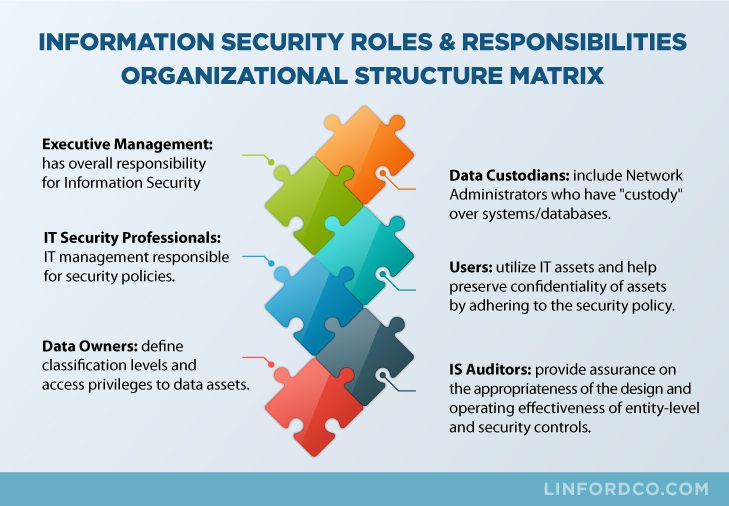
Common Cybersecurity Roles and Their Core Responsibilities
Understanding the typical responsibilities associated with common cybersecurity roles is crucial for populating your matrix effectively:
Chief Information Security Officer (CISO)
- Accountable For: Overall information security strategy, risk management, and compliance across the organization.
- Responsibilities: Developing and implementing the security program, budget management, reporting to executive leadership and the board, managing security incidents at a strategic level, ensuring regulatory compliance.
Security Architect
- Accountable For: Design and integrity of security systems and frameworks.
- Responsibilities: Designing secure network architectures, developing security standards, evaluating new security technologies, ensuring security is built into systems from the ground up (Security by Design).
Security Engineer
- Accountable For: Implementation and maintenance of security technologies.
- Responsibilities: Configuring and managing firewalls, intrusion detection/prevention systems (IDPS), security information and event management (SIEM) systems, deploying endpoint protection, implementing access controls.
Security Operations Center (SOC) Analyst
- Accountable For: Real-time monitoring and initial response to security incidents.
- Responsibilities: Monitoring security alerts, analyzing logs, identifying potential threats, performing initial threat intelligence correlation, escalating incidents to higher-tier responders.
Incident Response Specialist
- Accountable For: Containing, eradicating, and recovering from security incidents.
- Responsibilities: Leading incident investigations, forensic analysis, developing containment strategies, coordinating recovery efforts, post-incident analysis, and reporting.
Vulnerability Management Specialist
- Accountable For: Identifying, assessing, and tracking vulnerabilities.
- Responsibilities: Conducting regular vulnerability scans, penetration testing coordination, risk assessment of vulnerabilities, tracking remediation efforts, providing recommendations for patching and configuration hardening.
GRC (Governance, Risk, and Compliance) Analyst
- Accountable For: Ensuring the organization adheres to internal policies and external regulations.
- Responsibilities: Developing and maintaining security policies, conducting risk assessments, ensuring compliance with legal and regulatory requirements, managing audits, security awareness training coordination.
Integrating the Matrix with Organizational Structure and Culture
A matrix is only as effective as its integration into the daily operations and organizational culture. Consider these integration strategies:
- Cross-Functional Collaboration: Foster a culture where cybersecurity is everyone's responsibility. The matrix highlights interdependencies and encourages collaboration between security, IT, legal, HR, and business units.
- Training and Awareness: Use the matrix as a foundation for targeted training. Ensure that everyone understands their specific security responsibilities and has the necessary skills. Regular security awareness training for all employees is paramount.
- Performance Management: Incorporate cybersecurity responsibilities into job descriptions and performance reviews. This reinforces accountability and ensures that individuals are evaluated on their adherence to security duties.
- Tooling and Automation: Leverage security tools (e.g., GRC platforms, incident response orchestration tools) that can support the documented roles and workflows, automating handoffs and notifications based on the matrix.
Actionable Tips for Matrix Success
- Start Simple, Then Expand: Don't try to create a perfect, exhaustive matrix on day one. Start with the most critical security functions and roles, then gradually add more detail and scope.
- Involve Stakeholders Early and Often: Buy-in is crucial. Involve representatives from all affected departments in the creation and review process. This ensures the matrix is practical and accepted.
- Communicate Clearly and Consistently: Once the matrix is finalized, ensure it's widely communicated and easily accessible. Regular reminders and training sessions can reinforce its importance.
- Focus on Outcomes, Not Just Tasks: While the matrix defines tasks, emphasize the desired security outcomes. This helps individuals understand the "why" behind their responsibilities.
- Leverage Technology: Consider using dedicated software or even simple spreadsheets to manage and visualize your matrix, making it easier to update and share.
- Review Post-Incident: After any security incident or audit, review the matrix to see if roles and responsibilities were clear and effective. Adjust as needed based on lessons learned.
Frequently Asked Questions
What is the primary purpose of a cybersecurity roles and responsibilities matrix?
The primary purpose of a cybersecurity roles and responsibilities matrix is to establish clear accountability and reduce ambiguity regarding who is responsible for specific cybersecurity tasks and functions within an organization. It helps prevent critical security gaps, avoid duplication of effort, streamline operations, and enhance the overall security posture by ensuring that every aspect of the organization's cyber defense is owned and managed effectively.
How often should a cybersecurity matrix be reviewed and updated?
A cybersecurity roles and responsibilities matrix should be treated as a living document, requiring regular review and updates. It's recommended to formally review it at least annually, or more frequently (e.g., quarterly) if the organization undergoes significant changes, such as new technology adoption, shifts in team structure, major security incidents, or changes in regulatory compliance requirements. Continuous monitoring and adaptation ensure its ongoing relevance and effectiveness in managing cyber risk.
What is the difference between "Responsible" and "Accountable" in a RACI matrix for cybersecurity?
In a RACI matrix, "Responsible" (R) refers to the person or team who performs the work or task. There can be multiple individuals or teams responsible for completing a task. "Accountable" (A), on the other hand, refers to the single person who is ultimately answerable for the completion of the task or deliverable and has the authority to approve or reject the work. While many can be "Responsible," there can only be one "Accountable" person per task, ensuring clear ownership and decision-making for that specific aspect of information security management.
Can a small business benefit from a cybersecurity roles matrix?
Absolutely. Even small businesses, despite having fewer dedicated security personnel, face the same, if not greater, cyber threats as larger organizations. A cybersecurity roles and responsibilities matrix provides critical clarity, ensuring that essential tasks like patch management, backup verification, and access control reviews are assigned and completed. It helps small teams maximize their limited resources, understand their shared cyber defense duties, and build a foundational level of security resilience.
What are the top challenges in implementing a cybersecurity responsibility matrix?
Implementing a cybersecurity responsibility matrix often faces several challenges, including initial resistance to change, difficulty in accurately defining all cybersecurity tasks, lack of clear understanding of existing roles, and the complexity of gaining consensus across different departments. Maintaining the matrix as a living document also presents a challenge, requiring ongoing commitment to regular reviews and updates as the organization and threat landscape evolve. Overcoming these requires strong leadership buy-in, clear communication, and a collaborative approach.

0 Komentar