
Unlocking the Quantum Enigma: Shor's Algorithm Explained for a New Era of Computing
Dive deep into the fascinating world where the principles of quantum mechanics converge with computational power. This comprehensive guide explores Shor's Algorithm, a groundbreaking quantum algorithm that promises to redefine the landscape of digital security and computation itself. Understand its intricate workings, from the fundamental concepts of quantum superposition and entanglement to its profound implications for prime factorization and the very foundations of modern quantum cryptography. Discover why this algorithm is considered one of the most significant breakthroughs in quantum computing, posing a formidable challenge to widely used encryption standards like RSA encryption.
The Quantum Leap: Why Shor's Algorithm Matters
For centuries, mathematicians have grappled with the challenge of factoring large numbers into their constituent prime factors. This task, deceptively simple for small numbers, becomes astronomically difficult as numbers grow larger. The inherent complexity of this problem forms the bedrock of much of our modern digital security infrastructure, particularly asymmetric encryption schemes like RSA encryption. Classical computers, even the most powerful supercomputers, would require an unfathomable amount of time – potentially longer than the age of the universe – to factor sufficiently large numbers. This is where classical computing limits become glaringly apparent.
Enter Shor's Algorithm, conceived by mathematician Peter Shor in 1994. Unlike classical algorithms which tackle factorization using trial and error or advanced number sieves, Shor's leverages the unique properties of quantum mechanics to find factors exponentially faster. This dramatic acceleration, if realized on a large-scale, fault-tolerant quantum computer, would render current public-key cryptosystems vulnerable, necessitating a complete overhaul of our digital security protocols. The potential for quantum supremacy in this domain is not just theoretical; it's a driving force behind global research efforts in quantum technology.
The Existential Threat to RSA Encryption
RSA encryption relies on the computational difficulty of factoring the product of two large prime numbers. When you encrypt data with RSA, you use a public key that's essentially this large composite number. Decrypting it requires knowing the two prime factors, which is considered computationally infeasible for classical computers. Shor's Algorithm shatters this assumption by providing an efficient method for quantum factoring. This isn't just an academic exercise; it has immense practical implications for secure communications, financial transactions, and national security.
Deconstructing Shor's Algorithm: A High-Level Overview
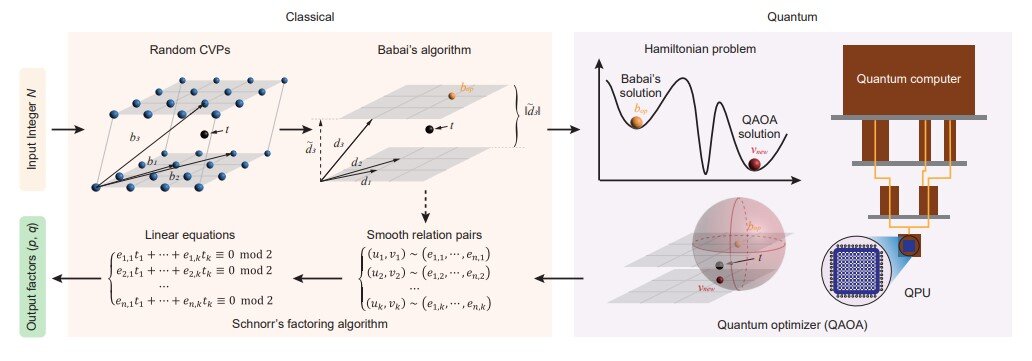
At its core, Shor's Algorithm is not directly a factoring algorithm. Instead, it's an algorithm that efficiently solves a related problem known as the period-finding problem. The genius lies in how Peter Shor connected this period-finding capability to the problem of integer factorization. The algorithm can be broadly divided into two main parts: a classical pre-processing stage and a quantum computation stage.
The Classical Pre-Processing Stage
Before any quantum bits (qubits) are manipulated, a classical computer performs several crucial steps:
- Input Selection: We want to factor a large composite number, N.
- Random Base Selection: A random integer 'a' is chosen, where 1 < a < N.
- Greatest Common Divisor (GCD) Check: The classical computer checks if the greatest common divisor of 'a' and N is not equal to 1 (i.e., GCD(a, N) ≠ 1). If it's not 1, then we've already found a factor of N (the GCD itself), and the algorithm terminates successfully. This happens rarely but is a quick win.
- Modular Exponentiation Setup: The problem then boils down to finding the period 'r' of the function f(x) = ax mod N. That is, we need to find the smallest positive integer 'r' such that ar ≡ 1 (mod N). This is where the quantum part comes in.
The Quantum Core: Harnessing Quantum Mechanics
The quantum part of Shor's Algorithm is where the exponential speedup occurs. It leverages the principles of superposition, entanglement, and the Quantum Fourier Transform (QFT) to efficiently find the period 'r'.
- Initialization of Qubits: Two registers of qubits are prepared. The first register (input register) is put into an equal superposition of all possible states. This means it simultaneously represents all possible values of 'x' needed for the modular exponentiation. The second register (output register) is initialized to |0⟩.
- Modular Exponentiation Circuit: A series of quantum gates are applied to perform the modular exponentiation: |x⟩|0⟩ → |x⟩|ax mod N⟩. Due to superposition, this operation is performed simultaneously for all possible 'x' values, creating an entangled state between the input and output registers. The output register now holds the results of ax mod N for all 'x' in superposition.
- Measurement of Output Register: The output register is measured. This measurement collapses the superposition in the output register to a single value, say 'k'. Crucially, because of entanglement, the input register is now also in a superposition, but only of those 'x' values that produced the measured 'k'. These 'x' values are separated by the period 'r'.
- Quantum Fourier Transform (QFT): The heart of the quantum speedup for period-finding. The Quantum Fourier Transform is applied to the first (input) register. This operation efficiently transforms the periodic pattern encoded in the superposition of the input register into a set of peaks that reveal the period 'r'. It effectively amplifies the probability of measuring states that are multiples of 1/r.
- Measurement of Input Register: The first register is measured. The result of this measurement will be a value 's' that is highly likely to be a multiple of P/r, where P is the size of the quantum register (typically 2n for n qubits).
The Mathematical Magic Behind Shor's: A Deeper Dive
Once the quantum computer provides the value 's' (which is approximately k (2n / r) for some integer k), the classical computer takes over again to extract the period 'r' and subsequently the factors of N. This transition from 's' to 'r' relies on a classical algorithm called the continued fraction algorithm. The measured 's' value allows us to deduce 'r' with high probability. This is where the beauty of number theory intertwines with quantum mechanics.
Once the period 'r' is found, the classical computer checks two conditions:
- Is 'r' even? If 'r' is odd, the algorithm usually fails, and we must restart with a different random 'a'.
- Is ar/2 ≡ -1 (mod N)? If it is, the algorithm fails, and we restart.
If both conditions are met (r is even and ar/2 ≠ -1 (mod N)), then we can proceed. The key insight from number theory is that if these conditions are met, then N must divide (ar/2 - 1)(ar/2 + 1). Since N does not divide (ar/2 - 1) and N does not divide (ar/2 + 1), it implies that GCD(ar/2 - 1, N) and GCD(ar/2 + 1, N) will yield non-trivial factors of N.
Example (Conceptual): Imagine we want to factor N=15.
1. Classical picks a=7. GCD(7,15)=1.
2. Quantum part finds the period 'r' of f(x) = 7x mod 15.
- 71 mod 15 = 7
- 72 mod 15 = 49 mod 15 = 4
- 73 mod 15 = 4 7 mod 15 = 28 mod 15 = 13
- 74 mod 15 = 13 7 mod 15 = 91 mod 15 = 1
3. Classical checks: 'r' (4) is even. 74/2 mod 15 = 72 mod 15 = 4. Is 4 ≡ -1 (mod 15)? No (4 ≠ 14).
4. Factors are found using GCD(74/2 - 1, 15) and GCD(74/2 + 1, 15).
- GCD(72 - 1, 15) = GCD(49 - 1, 15) = GCD(48, 15) = 3.
- GCD(72 + 1, 15) = GCD(49 + 1, 15) = GCD(50, 15) = 5.
Practical Implications and Future Landscape
The successful implementation of Shor's Algorithm on a large scale has profound implications. Its primary impact will be on public-key cryptography, particularly RSA encryption and elliptic curve cryptography (ECC), which are foundational for secure online transactions, digital signatures, and encrypted communications. The threat is not immediate, as current quantum computers lack the necessary stability and number of qubits to factor numbers large enough to break today's encryption. However, the ongoing advancements in quantum circuits and quantum gates suggest this is a matter of "when," not "if."
This impending paradigm shift has spurred intense research into post-quantum cryptography (PQC), which involves developing new cryptographic algorithms that are resistant to attacks from both classical and quantum computers. Organizations like NIST (National Institute of Standards and Technology) are actively standardizing these new algorithms to prepare for the quantum era.
Actionable Tips for Businesses and Individuals:
- Monitor Developments: Stay informed about the progress in quantum computing and the standardization of post-quantum cryptography. Resources from NIST or major tech companies are excellent starting points.
- Crypto Agility: Develop a strategy for "crypto agility" – the ability to quickly and efficiently update cryptographic algorithms and protocols. This will be crucial for migrating to quantum-resistant standards when they become available and mature.
- Inventory Critical Assets: Identify systems and data that rely on current public-key cryptography and assess their exposure to future quantum attacks. Prioritize the protection of long-lived data that needs to remain secure for decades.
- Invest in Research: For organizations with significant R&D budgets, consider investing in quantum-safe solutions or collaborating with quantum security experts.
Challenges and the Road Ahead for Quantum Factoring
While Shor's Algorithm is theoretically powerful, its practical implementation faces significant hurdles. Building a quantum computer capable of running Shor's Algorithm for cryptographically relevant key sizes (e.g., 2048-bit RSA) requires a vast number of stable, high-quality qubits. Current quantum machines typically have tens or hundreds of noisy qubits, far short of the millions or billions of fault-tolerant qubits estimated to be necessary for breaking widely used encryption.
Key challenges include:
- Qubit Stability and Coherence: Qubits are incredibly fragile and prone to decoherence, losing their quantum properties due to environmental interference. Maintaining their coherence for the duration of complex computations is a monumental engineering feat.
- Error Correction: Quantum computers are inherently noisy. Developing robust quantum error correction codes is essential to mitigate these errors and enable reliable computation.
- Scalability: Physically building and interconnecting millions of qubits is an immense engineering and manufacturing challenge.
- Algorithm Optimization: While Shor's Algorithm is efficient in theory, optimizing its implementation on real-world quantum hardware is an ongoing area of research.
Despite these challenges, the progress in quantum hardware and software development is rapid. Governments, academic institutions, and private companies are pouring resources into accelerating this progress. The ultimate goal is not just to break existing encryption, but to harness the power of quantum computing for solving other intractable problems in medicine, materials science, and artificial intelligence. The journey to a fully functional, large-scale quantum computer running Shor's Algorithm effectively is a testament to human ingenuity and perseverance.
Frequently Asked Questions about Shor's Algorithm
What is Shor's Algorithm used for?
Shor's Algorithm is a quantum algorithm primarily used for efficiently finding the prime factors of large composite numbers. Its most significant application is the potential to break widely used public-key cryptographic systems, such as RSA encryption, which rely on the computational difficulty of prime factorization for their security. Beyond cryptography, the underlying principles of its period-finding subroutine could be applied to other number theory problems.
How does Shor's Algorithm break RSA encryption?
Shor's Algorithm breaks RSA encryption by efficiently factoring the large composite number (the public key's modulus) into its two prime factors. RSA's security is predicated on the fact that classical computers cannot perform this prime factorization in a reasonable amount of time for sufficiently large numbers. By leveraging quantum phenomena like superposition and the Quantum Fourier Transform, Shor's Algorithm can find these factors exponentially faster, thereby revealing the private key and compromising encrypted communications.
Is Shor's Algorithm practical today?
While Shor's Algorithm has been successfully demonstrated on very small numbers using early-stage quantum computers, it is not practical today for breaking real-world cryptographic keys (e.g., 2048-bit RSA). Current quantum machines lack the necessary number of stable, high-quality, and fault-tolerant qubits required to factor numbers of cryptographic relevance. Significant engineering and scientific breakthroughs are still needed to overcome challenges like qubit decoherence and error rates before Shor's Algorithm can pose an immediate threat to modern encryption.
What is the role of the Quantum Fourier Transform in Shor's Algorithm?
The Quantum Fourier Transform (QFT) is a critical component of Shor's Algorithm, enabling its exponential speedup for the period-finding problem. After the quantum computer creates a superposition of states reflecting the periodic function (ax mod N), the QFT is applied. This operation efficiently transforms the periodic pattern into a frequency spectrum, amplifying the probability of measuring states that directly reveal the period 'r'. In essence, the QFT allows the quantum computer to "see" the underlying periodicity in the data much faster than any classical algorithm could.
How does Shor's Algorithm differ from classical factoring algorithms?
Shor's Algorithm differs fundamentally from classical factoring algorithms in its approach to computation. Classical algorithms, like the General Number Field Sieve (GNFS), rely on clever mathematical techniques that still scale exponentially with the size of the number being factored. They operate on bits in a deterministic or probabilistic manner. In contrast, Shor's Algorithm leverages quantum mechanical phenomena such as superposition (allowing a qubit to be 0 and 1 simultaneously) and entanglement (linking the states of multiple qubits) to explore many possibilities concurrently. This allows it to perform the crucial period-finding step in polynomial time, leading to an exponential speedup over the best-known classical algorithms for integer factorization. This is why it represents a true paradigm shift in computational power for this specific problem.

0 Komentar