
5G SA vs NSA: Unpacking the Core Network Architecture Differences for True 5G Potential
The promise of 5G extends far beyond just faster smartphone speeds. It’s about transforming industries, enabling smart cities, and powering the next generation of connectivity. However, not all 5G is created equal. As a professional SEO expert and content writer specializing in telecommunications, I frequently encounter a critical distinction that often confuses businesses and consumers alike: the fundamental
Understanding the 5G Evolution: From NSA to SA
The rollout of 5G has been a phased journey, driven by the immense infrastructure investments required. To accelerate initial deployment and provide immediate benefits, the industry adopted a pragmatic approach, beginning with Non-Standalone 5G. This served as a crucial stepping stone, allowing operators to leverage existing assets while progressively building out the more advanced infrastructure for
What is 5G NSA (Non-Standalone Architecture)?
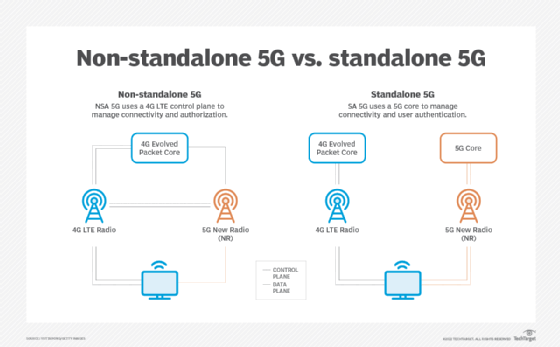
When 5G first started appearing on our devices, it was predominantly 5G NSA. This architecture is characterized by its reliance on the existing 4G LTE core network, specifically the
- Dual Connectivity (EN-DC): The cornerstone of 5G NSA is E-UTRA-NR Dual Connectivity (EN-DC). This allows a device to simultaneously connect to both a 4G LTE base station (eNodeB) and a 5G NR base station (gNodeB). The 4G LTE connection acts as the anchor, handling control plane functions, while the 5G NR provides the supplementary data plane capacity, boosting speeds and reducing latency to some extent.
- Benefits:
- Faster Deployment: Operators could rapidly deploy 5G NR radios without having to overhaul their entire core network, making for quicker market entry.
- Cost Efficiency: Leveraging existing 4G infrastructure minimized initial capital expenditure.
- Enhanced Mobile Broadband (eMBB): NSA significantly improves data speeds and capacity, offering a noticeable upgrade over 4G for applications like streaming, gaming, and large file downloads.
- Limitations: Despite its benefits, 5G NSA is inherently limited by its reliance on the 4G EPC. It cannot fully deliver on the promises of ultra-low latency, massive device connectivity, or advanced network slicing, which are integral to many next-generation
5G use cases beyond just speed.
The Leap to 5G SA (Standalone Architecture)
The true vision of 5G materializes with
- New 5G Core Network: The NGC is built on a service-based architecture (SBA), leveraging cloud-native principles, virtualization (NFV), and software-defined networking (SDN). This makes it inherently more flexible, scalable, and programmable than the monolithic 4G EPC.
- Pure 5G NR Connectivity: In 5G SA, devices connect directly to the 5G NR, with no reliance on a 4G anchor. This streamlines the connection and eliminates the overhead associated with dual connectivity.
- Key Enablers: The NGC is designed from the ground up to support the advanced features of 5G, including:
- Network Slicing: The ability to create multiple virtual, isolated logical networks on a common physical infrastructure, each tailored to specific application requirements (e.g., a slice for autonomous vehicles, another for smart factory IoT).
- Ultra-Reliable Low-Latency Communication (URLLC): Critical for applications requiring near real-time responsiveness, such as industrial automation, remote surgery, and vehicle-to-everything (V2X) communication.
- Massive Machine Type Communication (mMTC): Designed to efficiently support billions of connected IoT devices with low power consumption and infrequent data transmission.
- Mobile Edge Computing (MEC): Bringing computing power closer to the data source, further reducing latency and enabling new distributed applications.
The transition from
Core Architectural Differences: A Deep Dive
To truly appreciate the
The Core Network: EPC vs. NextGen Core (NGC)
The core network is the brain of the mobile network, handling user authentication, mobility management, session management, and routing data to and from the internet. This is where the most significant architectural divergence lies.
- 5G NSA and the EPC: In the NSA model, the existing 4G
Evolved Packet Core (EPC) remains the central control point. While the 5G New Radio (NR) provides faster air interface speeds, all traffic still routes through the EPC. This means that features like network slicing, which require intelligent routing and resource allocation at the core level, are either impossible or severely limited. The EPC was not designed with the flexibility or scalability required for the diverse demands of 5G. - 5G SA and the NextGen Core (NGC): The
NextGen Core (NGC) (also known as 5G Core or 5GC) is purpose-built for 5G. It is a cloud-native, service-based architecture (SBA) that utilizes principles of Network Function Virtualization (NFV) and Software-Defined Networking (SDN). This allows network functions to be deployed as virtualized software components, offering unprecedented agility.- Service-Based Architecture (SBA): Instead of monolithic elements, the NGC consists of loosely coupled, modular network functions that communicate via well-defined APIs. This modularity enables rapid deployment of new services, easier upgrades, and enhanced resilience.
- Control Plane and User Plane Separation (CUPS): The NGC fully separates the control plane (signaling, session management) from the user plane (data traffic). This allows operators to place user plane functions closer to the network edge, significantly reducing latency and optimizing traffic paths, a critical enabler for
edge computing and URLLC. - Programmability: The NGC's cloud-native design makes it highly programmable, allowing operators and even enterprises to dynamically provision and manage network resources, which is fundamental to
network slicing .
Radio Access Network (RAN) Integration
The RAN is the part of the network that connects end-user devices to the core network via radio waves.
- 5G NSA RAN: In an NSA setup, the 5G New Radio (gNodeB) works in conjunction with a 4G LTE eNodeB. Your device maintains a primary connection to the 4G LTE anchor, which handles the control plane, while simultaneously using the 5G NR for enhanced data speeds via EN-DC. This means that even if you see a "5G" indicator on your phone, the underlying connection is still deeply intertwined with 4G.
- 5G SA RAN: With 5G SA, the 5G NR operates independently. The gNodeB connects directly to the 5G NextGen Core, eliminating the need for a 4G anchor. This pure 5G connectivity simplifies the network architecture, reduces signaling overhead, and ensures that all network capabilities, including the ultra-low latency and advanced features, are fully delivered end-to-end. This is crucial for applications that demand the absolute lowest latency and highest reliability.
Control Plane and User Plane Separation (CUPS)
CUPS is a foundational concept that 5G SA fully embraces, whereas NSA cannot. It is a game-changer for network efficiency and performance.
- NSA and CUPS: While 4G LTE introduced some forms of CUPS, the EPC's architecture still tightly couples control and user plane functions. In an NSA deployment, even with 5G NR, the user plane traffic might still be routed back to a centralized EPC user plane function, introducing latency and inefficiency, especially for
edge applications . - SA and CUPS: The
5G NextGen Core is designed with CUPS as a core principle. This allows the user plane function (UPF) to be deployed at the very edge of the network, close to the end-user or IoT devices. This drastically minimizes the distance data needs to travel, resulting inlatency reduction to unprecedented levels (potentially sub-1ms end-to-end), which is vital for use cases like haptic feedback in remote surgery or real-time control of industrial robots. The control plane, meanwhile, can remain centralized, providing efficient network management.
Unlocking the Full Potential: Use Cases and Benefits
The architectural differences between 5G SA and NSA directly translate into vastly different capabilities and benefits. While NSA provides a significant boost in
Performance Metrics: Latency, Speed, and Capacity
- Speed: Both NSA and SA offer higher speeds than 4G LTE. However, SA, with its streamlined architecture and dedicated 5G core, can often achieve more consistent and higher peak speeds due to reduced overhead and optimized resource management.
- Latency: This is where 5G SA truly shines. By eliminating the 4G anchor and leveraging CUPS, 5G SA can deliver
ultra-low latency (as low as 1 millisecond end-to-end). NSA, still relying on the 4G EPC for control functions, typically has latency in the 20-30ms range, which, while good, isn't sufficient for mission-critical applications. - Capacity: While 5G NR provides increased air interface capacity for both, SA's ability to natively support
Massive Machine Type Communication (mMTC) and highly efficient resource allocation within the core network allows for connection densities far beyond what NSA can manage.
Advanced 5G Capabilities Exclusive to SA
Many of the most anticipated and impactful 5G features are only fully realized with a
- Network Slicing: This is arguably one of the most powerful features of 5G SA. It allows operators to create isolated, end-to-end virtual networks, or "slices," each with its own dedicated resources, quality of service (QoS) parameters, and security policies. For instance, an automotive manufacturer could have a dedicated slice for their connected vehicles with ultra-low latency, while a streaming service uses a different slice optimized for high bandwidth. NSA cannot support true network slicing due to the limitations of the 4G EPC.
- Ultra-Reliable Low-Latency Communication (URLLC): Critical for applications where even a momentary delay or loss of connection can have severe consequences. Think of autonomous vehicles, remote-controlled robots in factories, or augmented reality applications that require instant feedback. The sub-1ms latency and high reliability of SA are indispensable here.
- Massive Machine Type Communication (mMTC): Designed for connecting a vast number of low-power, low-cost IoT devices. Examples include smart city sensors, agricultural monitoring, and asset tracking. SA's optimized signaling and resource management are key to efficiently handling billions of such devices.
- Enhanced Mobile Edge Computing (MEC): By deploying computing resources and application servers at the network edge, closer to users and devices, MEC significantly reduces latency and conserves backhaul bandwidth. This is intrinsically linked to SA's CUPS capability, allowing user plane traffic to be processed locally without traversing the entire core network.
Strategic Implications for Enterprises and Operators
For enterprises, understanding the
Navigating the Transition: Practical Considerations for Businesses
The journey to full 5G SA adoption is ongoing for many operators globally. For businesses looking to capitalize on 5G, understanding the practical implications of this transition is vital.
Deployment Challenges and Opportunities
- Infrastructure Upgrades: Deploying a
NextGen Core is a complex undertaking, requiring significant investment in cloud infrastructure, software, and integration. This is a primary reason why NSA was deployed first. - Device Compatibility: Not all 5G-enabled devices are immediately compatible with 5G SA. Newer devices are increasingly supporting SA, but older "5G" phones might only work with NSA. Businesses planning large-scale IoT deployments or specialized 5G devices must ensure SA compatibility.
- Spectrum Availability: The effective deployment of SA often relies on dedicated mid-band and millimeter-wave spectrum, which can offer broader coverage and higher capacity.
- Opportunities: Despite challenges, the move to SA opens up massive opportunities for businesses to innovate. Industries such as manufacturing, logistics, healthcare, and public safety can fundamentally transform their operations with
ultra-low latency and dedicated network slices.
Choosing the Right Path: When Does SA Matter Most?
Consider your specific use case requirements:
- For basic consumer mobile broadband (eMBB): 5G NSA offers a significant speed boost and is widely available. It's perfectly adequate for streaming, browsing, and general mobile use.
- For advanced enterprise applications: If your business requires sub-10ms latency, guaranteed quality of service, dedicated network isolation (network slicing), or the ability to connect millions of IoT devices, then
Standalone 5G is indispensable. This includes applications like real-time industrial control, augmented reality/virtual reality (AR/VR) for training or design, autonomous guided vehicles (AGVs), and critical infrastructure monitoring. - For private 5G networks: Many enterprises are exploring private 5G deployments for their campuses or factories. These are almost exclusively built on 5G SA architecture to ensure complete control, security, and the ability to tailor network parameters precisely to their operational needs.
Actionable Tips for Leveraging 5G Architecture
- Assess Your Needs: Clearly define the specific benefits your business expects from 5G. Do you need just faster downloads, or are you looking for transformative capabilities like real-time automation or massive IoT deployments? This will guide your architectural preference.
- Engage with Operators: Understand their
5G SA deployment roadmap in your region. Inquire about their plans for network slicing, edge computing, and URLLC services. - Future-Proof Your Investments: When procuring 5G-enabled devices or designing solutions, prioritize those that are 5G SA compatible. This ensures your investments are ready for the full potential of 5G as the network evolves.
- Explore Private 5G: For mission-critical applications within a confined area (e.g., factory, port, campus), consider deploying a private 5G network based on SA architecture. This gives you unparalleled control over network performance and security.
- Pilot and Iterate: Start with pilot projects to test 5G SA capabilities in a controlled environment. Learn from these trials and iterate your solutions before full-scale deployment.
Frequently Asked Questions
What is the primary difference between 5G SA and NSA?
The primary difference lies in the core network.
Why are mobile operators deploying 5G NSA first?
Mobile operators deployed 5G NSA first as a pragmatic and cost-effective approach to accelerate 5G rollout. By leveraging

0 Komentar