
How to Calculate Cryptocurrency Capital Gains Tax: An Expert's Comprehensive Guide
Navigating the complex world of cryptocurrency taxation can feel like deciphering an ancient scroll, especially when it comes to understanding and calculating your cryptocurrency capital gains tax. As a professional SEO expert and content writer deeply immersed in the financial and digital asset landscape, I understand the critical need for clarity, accuracy, and actionable insights. This comprehensive guide will demystify the process, providing you with the essential knowledge and practical steps required to accurately calculate your crypto gains and ensure compliance. Whether you're a seasoned trader or a new investor, understanding your taxable events and the intricacies of cost basis is paramount to avoiding costly mistakes and optimizing your tax position.
Understanding Cryptocurrency Capital Gains Tax
At its core, cryptocurrency is generally treated as property for tax purposes in many major jurisdictions, including the United States, Canada, the UK, and Australia. This classification means that when you sell, trade, or otherwise dispose of your digital assets, you trigger a capital gains or losses event, similar to selling stocks or real estate. A capital gain occurs when you sell a cryptocurrency for more than its original purchase price (your cost basis), while a capital loss occurs when you sell it for less. The tax you owe on these gains is known as cryptocurrency capital gains tax.
It's crucial to understand that this isn't just about cashing out your crypto for fiat currency. Many common cryptocurrency activities can be considered a disposition and therefore a taxable event. The goal of calculation is to determine the precise profit or loss generated from each such event, which collectively forms your total taxable capital gains or losses for the fiscal year.
Identifying Taxable Events in Crypto
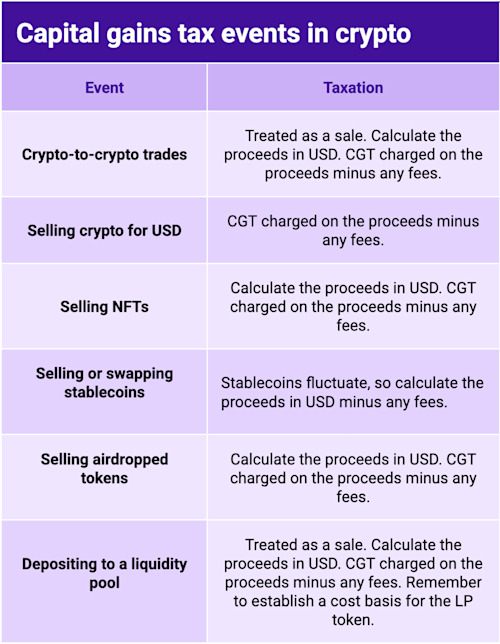
Before you can calculate your gains, you must first identify every instance where a taxable event occurred. This is often where many crypto users stumble, underestimating the breadth of activities that trigger tax implications. Here are the most common taxable events:
- Selling Cryptocurrency for Fiat Currency: This is the most straightforward taxable event. When you convert Bitcoin to USD, Ethereum to EUR, etc., you realize a gain or loss.
- Trading One Cryptocurrency for Another: This is a frequently overlooked taxable event. If you trade BTC for ETH, you are effectively selling your BTC and using the proceeds to buy ETH. Both sides of this transaction must be recorded, and the "sale" of BTC triggers a capital gain or loss. This is a critical point for many active traders.
- Spending Cryptocurrency on Goods or Services: Using crypto to purchase anything, from a cup of coffee to a car, is considered a disposition. The fair market value of the crypto at the time of the transaction determines your gain or loss against its cost basis.
- Gifting Cryptocurrency (Above a Certain Threshold): While a gift itself might not be a capital gains event for the giver, exceeding certain annual gift tax exclusion limits can have implications. For the recipient, the original cost basis of the giver usually carries over.
- Receiving Airdrops, Staking Rewards, or Mining Income: While these are generally treated as ordinary income at the time of receipt (based on their fair market value), any subsequent sale or trade of these newly acquired assets will then trigger a capital gain or loss event against that initial income value as their new cost basis. It's vital to differentiate income from capital gains.
The Core Principle: Capital Gains = Sale Price - Cost Basis
The fundamental formula for calculating capital gains or losses is deceptively simple: Capital Gain/Loss = Fair Market Value (FMV) at Disposition - Cost Basis. However, accurately determining both the Fair Market Value and the Cost Basis for every single transaction is where the complexity lies.
Defining "Cost Basis"
Your cost basis is essentially the original value of your cryptocurrency for tax purposes. It includes the price you paid to acquire the asset plus any associated transaction fees. Think of it as the total amount of money you invested to own that specific unit of cryptocurrency.
- Purchase Price: This is the price per unit (e.g., USD per BTC) at the exact moment you acquired the cryptocurrency.
- Transaction Fees: Any fees paid to exchanges or networks (e.g., gas fees on Ethereum) to acquire or transfer the asset should generally be added to your cost basis, as they are part of the cost of acquisition.
Example: If you bought 0.1 BTC for $3,000 and paid $10 in trading fees, your total cost basis for that 0.1 BTC is $3,010. If you later sell that 0.1 BTC, your gain or loss will be calculated against this $3,010.
Defining "Sale Price" (or Fair Market Value)
The sale price (or Fair Market Value - FMV) is the value of the cryptocurrency at the exact moment it was disposed of. This is usually the price at which you sold it for fiat, or the market value of the crypto you traded it for, or the market value of the goods/services you purchased with it.
- Selling for Fiat: The actual fiat amount received.
- Trading Crypto-to-Crypto: The Fair Market Value (FMV) of the cryptocurrency you received at the time of the trade. This FMV is used as the "sale price" of the crypto you disposed of, and also becomes the new cost basis for the crypto you acquired.
- Spending Crypto: The Fair Market Value (FMV) of the crypto at the moment you spent it, usually equivalent to the price of the goods or services purchased.
Example: If you spent 0.05 BTC to buy a $2,000 laptop, the FMV of that 0.05 BTC at the time of the transaction is $2,000. Your gain or loss will be calculated against this $2,000, minus the cost basis of that 0.05 BTC.
Choosing Your Cost Basis Accounting Method
This is arguably the most critical decision when calculating your cryptocurrency capital gains tax, as it directly impacts your total taxable income. When you acquire multiple units of the same cryptocurrency over time at different prices, you need a method to determine which specific "lot" of crypto you are disposing of. The most common methods are:
Specific Identification (Spec ID)
The Specific Identification (Spec ID) method allows you to choose which specific units of cryptocurrency you are selling. For instance, if you bought 1 BTC in January for $10,000 and another 1 BTC in March for $15,000, and then you sell 1 BTC in July for $20,000, you can choose to sell the BTC you bought in January (for a $10,000 gain) or the BTC you bought in March (for a $5,000 gain). This method offers the most flexibility for tax optimization, allowing you to minimize gains or maximize losses, but it requires meticulous record-keeping for each individual unit or "lot" of crypto.
First-In, First-Out (FIFO)
The First-In, First-Out (FIFO) method assumes that the first cryptocurrency units you acquired are the first ones you sell. Using the previous example, if you sell 1 BTC in July, FIFO would dictate that you sold the BTC you acquired in January for $10,000. This is often the default method if you don't specify or cannot use Specific Identification. While simpler to implement, it might not always be the most tax-efficient, especially in a bull market where older coins typically have a lower cost basis, leading to higher gains.
Average Cost (AVG) and Last-In, First-Out (LIFO)
While commonly used for stocks or other assets, Average Cost (AVG) and Last-In, First-Out (LIFO) are generally not permitted for cryptocurrency in the United States, for example. Always consult with a qualified tax professional or refer to your specific country's tax authority guidelines to confirm which methods are permissible for digital assets. The vast majority of crypto tax calculations will rely on FIFO or Specific Identification.
Actionable Tip: Before the end of the tax year, review your transactions. If you have significant unrealized losses, consider selling those specific lots using the Spec ID method to offset gains. This is a key strategy for tax loss harvesting.
Differentiating Short-Term vs. Long-Term Capital Gains
The holding period of your cryptocurrency significantly impacts its tax treatment. This is a critical distinction that can lead to substantial differences in your tax liability.
- Short-Term Capital Gains: These apply to cryptocurrency held for one year or less before disposition. Short-term capital gains are typically taxed at your ordinary income tax rates, which can be considerably higher than long-term rates.
- Long-Term Capital Gains: These apply to cryptocurrency held for more than one year before disposition. Long-term capital gains are usually taxed at preferential rates, which are often lower than ordinary income tax rates. This is a major incentive for investors to hold their assets for longer periods.
Example: If you bought BTC on January 15, 2023, and sold it on December 1, 2023, any gain would be short-term. If you sold it on January 16, 2024, any gain would be long-term, potentially subject to a lower tax rate.
Practical Steps to Calculate Your Crypto Capital Gains
Now, let's break down the calculation process into manageable steps:
Step 1: Gather All Transaction Data
This is the foundational step. You need a complete, accurate record of every single cryptocurrency transaction you've made. This includes:
- Purchase Dates and Times: Exact timestamps for when you acquired crypto.
- Purchase Prices: The price per unit at acquisition.
- Acquisition Sources: Which exchange, wallet, or platform you used.
- Sale Dates and Times: Exact timestamps for when you disposed of crypto.
- Sale Prices: The price per unit at disposition.
- Disposition Types: Was it a sale for fiat, a crypto-to-crypto trade, or a spend?
- Transaction Fees: All fees associated with both purchases and dispositions.
- Wallet Addresses: Keep track of transfers between your own wallets (these are generally not taxable events themselves, but tracking helps maintain a clear audit trail of your assets).
You can typically download your transaction history from exchanges (e.g., Coinbase, Binance, Kraken) and wallet services. For DeFi activities, this can be more challenging and might require blockchain explorers.
Step 2: Identify Taxable Events
Go through your gathered data and highlight every transaction that constitutes a taxable event (selling, trading, spending crypto). Ignore transfers between your own wallets, unless they involve a conversion or swap.
Step 3: Determine Cost Basis for Each Disposition
For each taxable event identified in Step 2, you must match the disposed cryptocurrency with its original acquisition. This is where your chosen accounting method (FIFO or Specific ID) comes into play. If you sold 0.5 ETH, you need to know which specific 0.5 ETH you are selling and what its original cost basis (purchase price + fees) was.
Step 4: Calculate Gain or Loss for Each Event
For every taxable event, apply the formula: Gain/Loss = Sale Price - Cost Basis. Keep a running tally of each individual gain or loss.
Example:
- Acquired 1 ETH on 03/01/2023 for $1,500 (Cost Basis).
- Sold 1 ETH on 06/15/2023 for $2,000 (Sale Price).
- Gain = $2,000 - $1,500 = $500.
Step 5: Categorize as Short-Term or Long-Term
For each calculated gain or loss, determine the holding period. If the time between acquisition and disposition is 365 days or less, it's short-term. If it's 366 days or more, it's long-term. Keep separate totals for short-term gains/losses and long-term gains/losses.
Step 6: Net Your Gains and Losses
At the end of the tax year, you will net your gains and losses within each category. Short-term losses first offset short-term gains. Long-term losses first offset long-term gains. If there are remaining losses, they can then offset gains from the other category. If you have a net capital loss for the year (after offsetting all gains), you can typically deduct a certain amount (e.g., $3,000 in the US) against your ordinary income, and carry forward any remaining loss to future tax years. This strategy is known as capital loss harvesting.
Tools and Software for Crypto Tax Calculation
Manually tracking and calculating every single crypto transaction can be an overwhelming, error-prone task, especially for active traders with hundreds or thousands of transactions. This is where specialized crypto tax software becomes invaluable.
These platforms integrate with major crypto exchanges and wallets via API keys or CSV imports, automatically pulling your transaction history. They then apply the correct cost basis accounting method (FIFO, Spec ID, etc., depending on your preference and jurisdiction's rules) and generate comprehensive tax reports (like IRS Form 8949 in the US) that you can directly use for filing or hand over to your accountant. Popular options include CoinLedger, Koinly, Accointing, and TaxBit. Utilizing these tax reporting tools significantly reduces manual effort and improves accuracy.
Important Considerations and Advanced Scenarios
DeFi and NFTs
The rise of Decentralized Finance (DeFi) and Non-Fungible Tokens (NFTs) introduces additional layers of complexity. Lending, borrowing, providing liquidity, yield farming, and minting/selling NFTs all have unique tax implications. Income generated from DeFi protocols (e.g., interest from lending) is typically treated as ordinary income. Selling an NFT will trigger capital gains or losses, often subject to collector's item tax rates in some jurisdictions, which can be higher than standard long-term capital gains rates. Tracking these transactions often requires more advanced tools or manual input from blockchain explorers.
Gifts, Donations, and Hard Forks
- Gifts: Generally, gifting crypto does not trigger a capital gain or loss for the giver unless the gift exceeds certain thresholds. The recipient typically inherits the giver's cost basis.
- Donations to Charity: Donating crypto directly to a qualified charity can be a highly tax-efficient strategy. You typically avoid capital gains tax on the appreciation and can deduct the fair market value of the donation.
- Hard Forks: When a blockchain undergoes a hard fork and creates a new coin (e.g., Bitcoin Cash from Bitcoin), the receipt of the new coin is usually considered ordinary income at its Fair Market Value (FMV) at the time you gain dominion and control over it. Any subsequent sale of these forked coins would then trigger a capital gain or loss against that initial income value.
Wash Sale Rules (US-Specific but Important)
In the United States, unlike traditional securities, wash sale rules currently do not apply to cryptocurrency. This means you can sell crypto at a loss to realize a capital loss for tax purposes and immediately buy back the same cryptocurrency without violating a wash sale rule. This loophole allows for aggressive tax loss harvesting strategies, but always consult with a tax professional as tax laws can change rapidly.
Calculating your cryptocurrency capital gains tax accurately is not just a legal obligation; it's an opportunity to optimize your financial position. By understanding taxable events, mastering cost basis methods, differentiating holding periods, and leveraging the right tools, you can confidently navigate the crypto tax landscape. Remember, tax laws are dynamic and can vary significantly by jurisdiction. For personalized advice, always consult with a qualified tax professional who specializes in digital assets.

0 Komentar