
How to Use Machine Learning for Drug Discovery and Development: An AI-Driven Revolution
The pharmaceutical industry stands at the precipice of a profound transformation, driven by the unparalleled capabilities of artificial intelligence and, more specifically, machine learning for drug discovery and development. In an era where bringing a new drug to market can cost billions and take over a decade, the need for efficiency, accuracy, and speed has never been more critical. This comprehensive guide will delve into how machine learning is not just augmenting, but fundamentally reshaping every stage of the drug development pipeline, from initial target identification to post-market surveillance. Discover the actionable strategies, cutting-edge applications, and the immense potential of integrating advanced AI into your pharmaceutical research and development processes.
The Paradigm Shift: Why Machine Learning in Drug Discovery?
Traditional drug discovery is a notoriously long, expensive, and often failure-prone endeavor. It relies heavily on empirical methods, high-throughput screening, and a significant degree of trial and error. The sheer volume of biological and chemical data generated today, combined with the complexity of disease mechanisms, far exceeds human capacity for analysis. This is precisely where machine learning for drug discovery emerges as a game-changer.
Overcoming Bottlenecks with AI
One of the primary reasons for the slow pace in drug development is the inherent bottlenecks at various stages. From identifying viable therapeutic targets to predicting a compound's efficacy and safety, each step is fraught with challenges. AI in drug discovery offers solutions by:
- Accelerating Research: Machine learning algorithms can process vast datasets exponentially faster than human researchers, quickly identifying patterns and insights that would otherwise remain hidden.
- Reducing Costs: By minimizing the need for extensive wet-lab experiments and failed clinical trials, ML can significantly cut down the financial burden of R&D.
- Improving Success Rates: Predictive modeling capabilities enhance the likelihood of identifying promising drug candidates early on, thereby increasing the success rate of compounds entering clinical trials.
- Personalizing Medicine: Leveraging patient-specific data, ML can pave the way for more targeted and effective treatments, moving towards true precision medicine.
The Data Goldmine and ML's Role
The pharmaceutical sector is awash with diverse datasets: genomic and proteomic data, electronic health records, chemical compound libraries, clinical trial results, scientific literature, and much more. This data, however, is often unstructured, disparate, and overwhelming. Machine learning excels at extracting meaningful insights from such complex, high-dimensional data. This includes everything from analyzing gene expression patterns to predicting molecular interactions, forming the backbone of modern biomedical data science initiatives.
Key Stages Where Machine Learning Transforms Drug Development
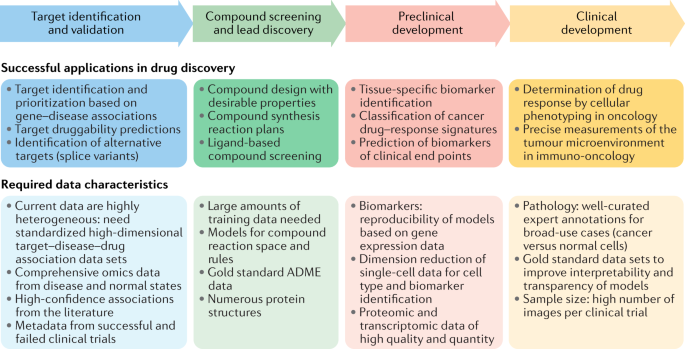
The application of machine learning in drug discovery and development spans the entire value chain, offering transformative capabilities at each critical juncture.
Target Identification and Validation
Before a drug can be developed, a specific biological target (e.g., a protein, gene, or pathway) implicated in a disease must be identified and validated. This is a foundational step where ML provides immense value.
- Omics Data Analysis: ML algorithms can analyze vast genomic, proteomic, metabolomic, and transcriptomic datasets to identify disease-associated biomarkers and pathways. Techniques like deep learning can uncover subtle patterns in gene expression that indicate a potential therapeutic target.
- Network Analysis: Graph neural networks can model complex biological networks (protein-protein interaction networks, gene regulatory networks) to pinpoint central nodes or pathways that, when modulated, could impact disease progression.
- Literature Mining: Natural Language Processing (NLP), a subset of ML, can sift through millions of scientific articles, patents, and clinical reports to identify novel drug targets and associations that might be missed by manual review.
Virtual Screening and Lead Discovery
Once targets are identified, the next step is to find chemical compounds that can interact with them. Traditionally, this involves high-throughput screening of millions of compounds. ML significantly streamlines this process through virtual screening.
- Computational Chemistry and Docking: ML models can predict how well a compound will bind to a target protein based on its chemical structure and the protein's 3D structure. This allows researchers to virtually "dock" compounds into target sites, prioritizing only the most promising ones for experimental validation.
- Quantitative Structure-Activity Relationship (QSAR) Models: These models use ML to predict the biological activity of new compounds based on their chemical features. By learning from existing data, QSAR models can efficiently design and prioritize compounds with desired properties, reducing the need for synthesizing and testing every possible molecule.
- Generative Models: Advanced ML techniques like Generative Adversarial Networks (GANs) and variational autoencoders can even design novel chemical structures from scratch, optimizing for specific desired properties, rather than just screening existing libraries. This pushes the boundaries of traditional lead discovery.
Lead Optimization and Preclinical Development
After identifying initial lead compounds, they need to be optimized for potency, selectivity, and most importantly, safety and pharmacokinetic properties. This is where predictive modeling becomes crucial.
- ADMET Prediction: ML models can accurately predict Absorption, Distribution, Metabolism, Excretion, and Toxicity (ADMET) properties of compounds. This helps filter out molecules likely to fail in later stages due to poor bioavailability or adverse effects, saving significant time and resources. Understanding pharmacokinetics and pharmacodynamics (PK/PD) is critical here.
- Synthesis Prediction: Retrosynthesis tools powered by ML can predict the most efficient chemical routes to synthesize a desired molecule, guiding chemists in the lab.
- Toxicity Prediction: ML algorithms trained on vast toxicological datasets can predict potential adverse drug reactions, helping to design safer compounds.
Clinical Trial Design and Patient Stratification
Clinical trials are the most expensive and time-consuming phase of drug development, with high failure rates. Machine learning offers powerful tools to optimize this critical stage.
- Patient Stratification: ML can analyze patient data (genomic, clinical, lifestyle) to identify subgroups of patients most likely to respond to a particular treatment, leading to more efficient trials and the development of targeted therapies. This is a cornerstone of precision medicine.
- Biomarker Identification: ML helps discover novel biomarkers that can predict drug response, disease progression, or adverse events, enabling better monitoring and decision-making during trials.
- Clinical Trial Optimization: ML models can predict recruitment rates, optimize trial sites, and even simulate trial outcomes, leading to faster and more successful trials. They can also help in monitoring patient adherence and identifying potential risks in real-time.
Drug Repurposing and Combination Therapies
Beyond novel drug development, ML is a powerful tool for finding new uses for existing drugs (drug repurposing) or identifying optimal drug combinations.
- Disease-Drug Association: ML algorithms can analyze vast networks of drug-target interactions, disease pathways, and clinical data to identify existing drugs that could be effective for new indications. This significantly reduces development time and risk, as the safety profile of the drug is already known.
- Synergistic Combinations: By predicting how different drugs interact at a molecular level, ML can identify synergistic combinations that offer enhanced therapeutic effects or reduce side effects compared to monotherapy.
Actionable Strategies for Integrating ML into Pharma R&D
For pharmaceutical companies looking to harness the power of AI-driven drug discovery, a strategic approach is essential.
Building a Robust Data Infrastructure
The success of any ML initiative hinges on the quality and accessibility of data. Pharmaceutical companies must invest in:
- Data Curation and Standardization: Establish rigorous protocols for collecting, cleaning, and standardizing diverse datasets (chemical, biological, clinical). This often involves integrating data from disparate sources into a unified, accessible platform.
- Cloud Computing and HPC: Leverage cloud infrastructure or high-performance computing (HPC) environments to store and process the massive volumes of data required for ML models. This provides scalability and computational power.
- Data Governance and Security: Implement robust data governance frameworks to ensure data privacy, security, and compliance with regulatory requirements (e.g., GDPR, HIPAA).
Choosing the Right ML Models and Algorithms
The choice of ML model depends on the specific problem being addressed:
- Supervised Learning: For tasks like predicting drug toxicity or efficacy, where labeled data (known outcomes) is available, regression or classification algorithms (e.g., Random Forests, Support Vector Machines, Neural Networks) are ideal.
- Unsupervised Learning: For identifying hidden patterns in large biological datasets or clustering patient populations, techniques like K-means clustering or principal component analysis are valuable.
- Deep Learning: Particularly effective for analyzing complex, high-dimensional data such as images (histopathology), sequences (genomics), or graph structures (molecular networks). Convolutional Neural Networks (CNNs) and Graph Neural Networks (GNNs) are powerful here.
- Reinforcement Learning: Emerging as a tool for optimizing drug design processes, allowing algorithms to learn optimal strategies through trial and error in a simulated environment.
It's crucial to work with data scientists and domain experts to select, train, and validate models effectively. Consider exploring open-source ML libraries and frameworks to accelerate development.
Fostering Interdisciplinary Collaboration
The true power of machine learning in drug discovery is unlocked when diverse expertise converges. Encourage collaboration between:
- Chemists and Biologists: To provide domain-specific knowledge for feature engineering and interpreting model outputs.
- Data Scientists and ML Engineers: To develop, implement, and maintain robust ML pipelines.
- Clinical Researchers: To validate findings and integrate ML insights into trial design.
- IT and Infrastructure Teams: To ensure the necessary computational resources and data management systems are in place.
Building cross-functional teams and promoting a data-driven culture are paramount for successful ML integration.
Challenges and Future Outlook
While the promise of ML in drug discovery is immense, challenges remain that require careful navigation.
Data Quality and Interpretability
The "garbage in, garbage out" principle applies strongly to ML. Poor quality, biased, or incomplete data can lead to flawed models. Furthermore, many powerful deep learning models are "black boxes," making it difficult to understand why a particular prediction was made. Developing explainable AI (XAI) techniques is crucial for gaining trust and regulatory acceptance, especially in sensitive areas like drug development. Ensuring data provenance and maintaining high standards for data annotation are ongoing efforts.
Regulatory Considerations
As ML algorithms become more integral to drug development, regulatory bodies like the FDA are grappling with how to assess and approve AI-driven discoveries. Clear guidelines for validation, transparency, and ongoing monitoring of ML models will be essential for their widespread adoption and regulatory approval. This includes robust validation of predictive modeling outputs.
Looking ahead, the future of machine learning for drug discovery and development is incredibly bright. We can anticipate more sophisticated generative models, deeper integration with robotic automation for autonomous labs, and the continued rise of precision medicine enabled by patient-specific AI models. The synergy between human ingenuity and artificial intelligence promises to usher in an era of faster, safer, and more effective therapies for humanity. To stay competitive, pharmaceutical companies must embrace this technological wave and proactively integrate these advanced capabilities into their core R&D strategies. Explore more about AI's impact on healthcare.
Frequently Asked Questions
What is the primary role of machine learning in drug discovery?
The primary role of machine learning in drug discovery is to significantly accelerate and de-risk the entire process by leveraging computational power to analyze vast, complex datasets. It helps in identifying promising drug targets, designing and optimizing novel compounds, predicting their efficacy and safety, and streamlining clinical trials. Essentially, ML reduces the need for extensive physical experimentation and enhances the probability of success by making data-driven predictions, thereby cutting down both time and cost in pharmaceutical R&D.
How does machine learning help in target identification?
Machine learning aids in target identification by analyzing high-dimensional biological data, such as genomic, proteomic, and transcriptomic (omics data analysis) datasets. Algorithms can uncover subtle patterns, gene mutations, or protein interactions associated with diseases that are difficult for human researchers to spot. Techniques like network analysis can identify critical pathways, while Natural Language Processing (NLP) can mine scientific literature to find novel associations, leading to the identification of viable therapeutic targets for drug development.
Can machine learning predict drug toxicity?
Yes, machine learning for drug discovery is highly effective in predicting drug toxicity. By training on extensive datasets of chemical structures and their known toxicity profiles, ML models can learn to identify molecular features that are associated with adverse effects. These predictive modeling capabilities allow researchers to screen out potentially toxic compounds early in the lead optimization phase, significantly reducing the likelihood of late-stage failures and improving the safety profile of drug candidates, thereby optimizing pharmacokinetics and pharmacodynamics.
What are the benefits of using AI in clinical trials?
Using AI in clinical trials offers numerous benefits, primarily through clinical trial optimization. AI can help in precise patient stratification by identifying subgroups most likely to respond to a drug, leading to smaller, more efficient trials. It also aids in biomarker discovery for monitoring drug response, predicting recruitment rates, optimizing trial site selection, and even identifying potential risks or deviations in real-time. This leads to faster trial completion, reduced costs, and improved success rates for new therapies.

0 Komentar