
Complete Guide
Unexpected equipment failure is the silent, pervasive enemy of manufacturing productivity, costing industries billions annually in lost production, emergency repairs, and safety hazards. In today's hyper-competitive global landscape, the ability to anticipate and prevent these disruptions is no longer a luxury but a strategic imperative. This is where machine learning for predicting equipment failure emerges as a transformative force, fundamentally reshaping traditional maintenance strategies from reactive fixes to proactive, data-driven interventions. By leveraging advanced algorithms and vast datasets, manufacturers can now gain unprecedented foresight into the health of their machinery, moving beyond mere guesswork to precise, actionable insights. This comprehensive guide will delve deep into how cutting-edge machine learning (ML) technologies are revolutionizing industrial operations, enhancing operational efficiency, and ensuring uninterrupted production flows, ultimately securing a significant competitive advantage for businesses embracing the era of smart manufacturing.
The Critical Need for Predictive Maintenance in Modern Manufacturing
For decades, manufacturing relied on two primary maintenance philosophies: reactive (fix it when it breaks) and preventive (scheduled maintenance regardless of actual need). Both approaches, while serving their purpose, are inherently inefficient and costly. Reactive maintenance leads to sudden, catastrophic failures, significant downtime, missed deadlines, and often, higher repair costs due to secondary damage. Preventive maintenance, on the other hand, can result in unnecessary part replacements, over-maintenance, and the waste of valuable resources, as components are serviced or replaced before their actual end of life. The limitations of these traditional methods highlight a glaring gap: the lack of real-time, accurate insight into an asset's true condition and its remaining useful life (RUL).
The imperative for a more intelligent approach stems from several factors: increasing complexity of machinery, rising energy costs, global supply chain pressures, and the demand for higher product quality with minimal waste. This confluence of challenges has propelled predictive maintenance (PdM) to the forefront of industrial strategy. Unlike its predecessors, PdM focuses on predicting when a piece of equipment is likely to fail, allowing maintenance to be scheduled precisely when needed, just before a breakdown occurs. This optimizes maintenance schedules, minimizes downtime, reduces spare parts inventory, and extends asset lifespan. The true power of PdM, however, is unleashed when integrated with the analytical capabilities of machine learning.
Understanding Machine Learning in Predictive Maintenance
At its core, machine learning for predicting equipment failure involves teaching computer algorithms to identify complex patterns and relationships within vast amounts of operational data. Instead of being explicitly programmed with rules, ML models learn from historical data to make predictions or decisions. In the context of industrial assets, this means feeding algorithms data points like temperature fluctuations, vibration signatures, pressure readings, current consumption, historical repair logs, and environmental conditions. The ML model then processes this information to recognize "normal" operating behavior and detect subtle deviations that signify impending failure.
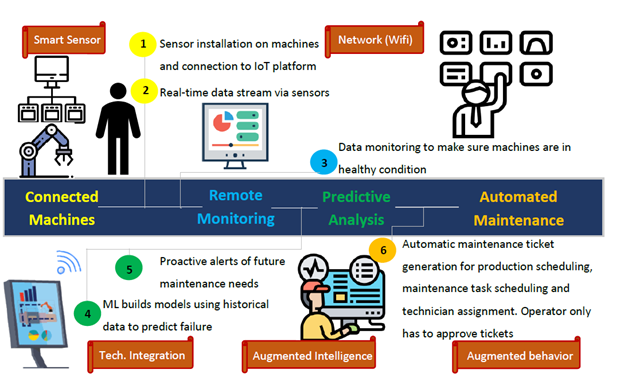
The process typically begins with data collection, often facilitated by the proliferation of Industrial Internet of Things (IIoT) sensors embedded within machinery. These sensors continuously stream real-time data, providing a digital pulse of the equipment's health. This raw data is then preprocessed – cleaned, transformed, and enriched – to make it suitable for ML algorithms. Feature engineering, a critical step, involves extracting meaningful features or indicators from the raw data that are highly correlated with equipment degradation or failure modes. For instance, instead of just raw vibration readings, a feature might be the root mean square (RMS) of vibration over time, which can indicate bearing wear.
Once features are engineered, the ML model is trained on a dataset that ideally includes both normal operation data and data leading up to known failures. This training phase allows the model to learn the intricate patterns that precede a breakdown. After training, the model can then be deployed to monitor live equipment data. When the model detects patterns indicative of a potential failure, it generates an alert, enabling maintenance teams to intervene proactively. This shift from reactive or time-based maintenance to condition-based, data-driven insights represents a paradigm leap in asset performance management (APM).
Key Machine Learning Algorithms for Failure Prediction
The choice of machine learning algorithm depends heavily on the type of data available, the specific failure mode to predict, and the desired output (e.g., predicting exact time to failure vs. classifying healthy/unhealthy). Several categories of ML algorithms are commonly employed:
Supervised Learning for Predicting RUL and Classification
- Classification Algorithms: These models learn to categorize data into predefined classes. For equipment failure, this might involve classifying a machine's state as "healthy," "at-risk," or "failing." Examples include:
- Random Forests: An ensemble method that builds multiple decision trees and merges their predictions to improve accuracy and control overfitting. Excellent for handling diverse data types and identifying feature importance.
- Support Vector Machines (SVMs): Effective for classification tasks, especially when dealing with complex, non-linear relationships in data. They find the optimal hyperplane that separates different classes.
- Gradient Boosting Machines (GBMs) / XGBoost: Powerful ensemble techniques that build models sequentially, where each new model corrects errors of the previous one. Highly effective for tabular data and predictive accuracy.
- Regression Algorithms: Used when the goal is to predict a continuous value, such as the Remaining Useful Life (RUL) of an asset in hours or days. Examples include Linear Regression, Ridge Regression, and also tree-based models like Random Forests and GBMs adapted for regression tasks.
Unsupervised Learning for Anomaly Detection
- Clustering Algorithms (e.g., K-Means): These algorithms group similar data points together. In PdM, they can identify clusters of "normal" operation and then flag any data points that fall outside these clusters as potential anomalies or precursors to failure.
- Isolation Forest: Specifically designed for anomaly detection. It works by isolating anomalies rather than profiling normal data points, making it very efficient for large datasets with few anomalies.
- Autoencoders (Deep Learning): Neural networks that learn to compress data into a lower-dimensional representation and then reconstruct it. Anomalies, which deviate from learned patterns, will have a high reconstruction error, signaling potential issues.
Deep Learning for Complex Data
- Recurrent Neural Networks (RNNs) / Long Short-Term Memory (LSTM) Networks: Ideal for sequential data like time series sensor readings. LSTMs can learn long-term dependencies in data, making them excellent for predicting trends and deviations over time in vibration or temperature profiles.
- Convolutional Neural Networks (CNNs): Primarily used for image processing but can be adapted for time series data by converting sensor signals into "images" (e.g., spectrograms of vibration data) to detect spatial patterns indicative of specific failure modes.
The selection of the right algorithm is a nuanced decision, often requiring experimentation and domain expertise. Many successful implementations utilize a hybrid approach, combining different algorithms or techniques to achieve robust and accurate predictions.
The Data Foundation: Fueling ML Models for Reliability
The adage "garbage in, garbage out" holds profoundly true for machine learning. The success of any machine learning for predicting equipment failure initiative hinges critically on the quality, quantity, and variety of data collected. Without a robust data foundation, even the most sophisticated algorithms will yield unreliable predictions. Manufacturers must focus on acquiring comprehensive datasets that capture the full operational lifecycle and environmental context of their assets.
Crucial Data Types for Predictive Maintenance:
- Sensor Data (Time Series Data): This is the backbone of PdM. It includes continuous measurements from sensors monitoring:
- Vibration: Often the earliest indicator of mechanical issues (bearings, misalignment, imbalance).
- Temperature: Overheating can signify friction, electrical issues, or insufficient cooling.
- Pressure: Critical for hydraulic systems, pumps, and pipelines.
- Current/Voltage: Indicators of electrical load, motor health, and efficiency.
- Acoustic Emissions: Subtle sounds can indicate crack propagation or internal wear.
- Flow Rates: For pumps, valves, and fluid systems.
- Historical Maintenance Records: This non-sensor data is invaluable. It includes:
- Work Orders: Details of repairs, replacements, and routine maintenance performed.
- Failure Logs: Records of past breakdowns, including date, type of failure, root cause, and associated costs.
- Spare Parts Consumption: Indicates which components fail most frequently.
- Operational Data: Parameters related to how the equipment is being used:
- Production Schedules: Load, speed, throughput.
- Operating Hours/Cycles: Cumulative usage.
- Product Specifications: Types of materials processed.
- Environmental Data: External factors that can influence equipment health:
- Ambient Temperature and Humidity: Can affect electronics, lubrication, and material properties.
- Dust/Particulate Levels: Can lead to clogging or wear.
Data Preprocessing and Feature Engineering:
Raw data is rarely ready for direct consumption by ML models. It typically requires significant preprocessing:
- Data Cleaning: Handling missing values, outliers, and noise.
- Normalization/Scaling: Ensuring all features are on a comparable scale to prevent certain features from dominating the learning process.
- Feature Engineering: This is where domain expertise shines. It involves creating new, more informative features from existing raw data. Examples include:
- Calculating statistical aggregates (mean, variance, RMS, peak-to-peak) over specific time windows.
- Deriving rates of change (e.g., temperature rise per hour).
- Creating lag features (past values of a sensor reading).
- Combining features (e.g., power consumption divided by throughput).
The quality of these engineered features directly impacts the accuracy and interpretability of the ML model. Investing in robust IIoT platforms and data pipelines is paramount for capturing, storing, and processing this vast influx of information, transforming raw numbers into actionable data-driven insights.
Implementing Machine Learning for Equipment Failure Prediction: A Practical Roadmap
Adopting machine learning for predicting equipment failure is a strategic journey that requires careful planning and execution. It's not merely a technological upgrade but a transformation of maintenance culture and processes. Here's a practical roadmap for successful implementation:
Step-by-Step Approach for Deployment:
- Define Clear Objectives and Scope: Start by identifying the most critical assets whose failure would cause significant disruption or cost. Define specific, measurable goals (e.g., "reduce unplanned downtime on CNC machine X by 20%").
- Data Collection and Integration Strategy: Assess existing data sources (SCADA, CMMS, ERP). Identify gaps and plan for the deployment of new IIoT sensors. Establish robust data pipelines to collect, store, and integrate data from disparate systems into a centralized platform (e.g., a data lake or cloud-based analytics platform).
- Data Preprocessing and Feature Engineering: This iterative phase involves cleaning, transforming, and enriching the raw data. Work closely with domain experts (maintenance engineers) to identify relevant features that indicate asset health and potential degradation.
- Model Selection, Training, and Validation: Experiment with various ML algorithms based on your data type and prediction goals. Train models on historical data, then rigorously validate their performance using unseen data. Metrics like precision, recall, F1-score, and RUL prediction accuracy are crucial.
- Pilot Project and Deployment: Begin with a pilot project on a single critical asset or a small group of similar assets. This allows for fine-tuning the model, validating its predictions in a real-world setting, and demonstrating value. Once successful, integrate the ML model's outputs into your existing maintenance management system (CMMS) or a dedicated asset performance management (APM) dashboard.
- Continuous Monitoring, Feedback, and Improvement: ML models are not static. Equipment behavior can change, and new failure modes may emerge. Continuously monitor model performance, collect feedback from maintenance teams, and retrain models with new data to maintain accuracy and relevance.
Actionable Tips for Success:
- Start Small, Scale Smart: Don't try to implement PdM across your entire factory at once. Choose a high-impact, manageable pilot project to build confidence and gather lessons learned.
- Foster Cross-Functional Collaboration: Success requires close cooperation between IT, operations, maintenance, and data science teams. Maintenance engineers provide invaluable domain expertise, while data scientists handle the algorithms.
- Focus on Business Value: Always tie your ML initiatives back to clear business outcomes – reduced downtime, cost savings, improved safety, or extended asset life. This helps secure buy-in and funding.
- Invest in Robust IIoT Infrastructure: Reliable sensors, secure data transmission, and scalable data storage are non-negotiable. Poor data quality will undermine any ML effort.
- Don't Overlook Change Management: Introducing new technologies impacts people and processes. Provide adequate training, communicate benefits clearly, and involve maintenance technicians early in the process to ensure adoption.
Benefits Beyond Downtime Reduction: The Holistic Impact of ML-Driven Maintenance
While the primary driver for adopting machine learning for predicting equipment failure is often the reduction of unplanned downtime, the ripple effects of this technology extend far beyond a mere increase in uptime. The holistic benefits contribute significantly to overall operational efficiency, profitability, and competitive advantage in manufacturing:
- Reduced Maintenance Costs: By shifting from reactive or time-based maintenance to predictive, companies can significantly cut costs associated with emergency repairs, overtime pay for technicians, and the need for large spare parts inventories. Maintenance is performed only when truly necessary, optimizing resource allocation.
- Optimized Spare Parts Inventory: Accurate failure predictions allow manufacturers to transition from a "just-in-case" to a "just-in-time" spare parts strategy. This reduces capital tied up in inventory, minimizes storage costs, and prevents obsolescence of parts.
- Improved Safety: Equipment failures can lead to dangerous situations, injuries, or even fatalities. Predicting and preventing breakdowns enhances workplace safety by addressing potential hazards before they escalate.
- Enhanced Product Quality: Malfunctioning equipment can lead to defects, rework, and scrap. By maintaining machinery in optimal condition, ML-driven PdM contributes directly to consistent product quality and reduced waste.
- Extended Asset Lifespan: Proactive maintenance, based on actual asset condition, prevents minor issues from escalating into major damage, thereby extending the operational life of expensive machinery and delaying capital expenditure on replacements.
- Increased Production Throughput and Efficiency: Reliable equipment ensures consistent production flow, allowing manufacturers to meet demand, optimize scheduling, and improve overall equipment effectiveness (OEE).
- Better Decision-Making and Strategic Planning: The rich data-driven insights provided by ML models offer a clearer understanding of asset health, performance trends, and failure patterns. This information is invaluable for capital planning, asset replacement strategies, and process optimization.
- Competitive Advantage: Manufacturers who effectively leverage ML for predictive maintenance gain a significant edge through lower operational costs, higher product quality, and greater agility in responding to market demands. This positions them as leaders in the era of smart manufacturing.
- Shift to Prescriptive Maintenance: Beyond just predicting failure, the ultimate goal is often prescriptive maintenance, where the system not only predicts when a failure will occur but also recommends the optimal action to prevent it, including detailed repair instructions or operational adjustments.
Challenges and Considerations in ML-Powered Predictive Maintenance
While the benefits are compelling, implementing machine learning for predicting equipment failure is not without its hurdles. Manufacturers must be aware of these challenges to plan effectively and mitigate risks:
- Data Availability and Quality: This is often the biggest bottleneck. Many older machines lack sensors, and historical data might be incomplete, inconsistent, or stored in disparate, incompatible systems. Dirty data (noise, errors, missing values) can severely degrade model performance.
- Lack of Labeled Failure Data: ML models, especially supervised ones, learn from examples. If equipment rarely fails, or if failure events aren't meticulously logged with corresponding sensor data, training robust models becomes challenging. This is where anomaly detection (unsupervised learning) becomes particularly useful.
- Model Interpretability (The "Black Box" Problem): Some advanced ML models (e.g., deep learning) can be difficult to interpret, making it hard for engineers to understand why a particular prediction was made. This can hinder trust and adoption by maintenance teams. Explainable AI (XAI) techniques are emerging to address this.
- Integration Complexity: Integrating new ML platforms with existing legacy systems like CMMS (Computerized Maintenance Management Systems), ERP (Enterprise Resource Planning), and SCADA (Supervisory Control and Data Acquisition) can be complex and time-consuming.
- Skills Gap: Implementing and maintaining these systems requires a blend of data science expertise, machine learning engineering, and deep domain knowledge in industrial machinery. Finding individuals with this combined skillset can be challenging.
- Initial Investment: The upfront costs for sensors, IIoT infrastructure, data storage, analytics platforms, and expert personnel can be substantial. Justifying the ROI requires clear strategic planning.
- Change Management and Adoption: Resistance to change from maintenance personnel accustomed to traditional methods can impede adoption. Effective communication, training, and demonstrating tangible benefits are crucial for buy-in.
- False Positives/Negatives: No model is 100% accurate. Too many false positives (predicting failure when none occurs) can lead to "alarm fatigue" and erode trust. False negatives (missing an impending failure) can be costly. Continuous model refinement is essential.
Addressing these challenges requires a strategic approach that combines technological investment with organizational readiness, strong leadership, and a commitment to continuous improvement. Focusing on incremental wins and demonstrating clear value can help overcome initial skepticism and pave the way for widespread adoption.
Future Trends and Advanced Applications
The field of machine learning for predicting equipment failure is rapidly evolving, driven by advancements in AI, IIoT, and computing power. Several exciting trends are poised to further revolutionize industrial maintenance:
- Edge AI: Processing ML models directly on edge devices (sensors or gateways) near the equipment. This reduces latency, minimizes data transmission costs, and enhances real-time anomaly detection, especially critical for high-speed machinery.
- Digital Twins: Creating virtual replicas of physical assets, processes, or systems. These digital twins are fed real-time data from their physical counterparts, allowing for

0 Komentar