
Machine Learning for Predicting Customer Credit Risk: Revolutionizing Financial Assessment
In today's dynamic financial landscape, accurately predicting customer credit risk is paramount for the sustainability and profitability of any lending institution. Traditional credit scoring methods, while foundational, often struggle to keep pace with the sheer volume and complexity of modern financial data. This is where machine learning for predicting customer credit risk emerges as a transformative force, offering unparalleled accuracy, efficiency, and depth in assessing an applicant's true creditworthiness. By leveraging advanced algorithms and vast datasets, financial institutions can move beyond static models, gaining a predictive edge that minimizes losses from borrower default and enhances strategic decision-making.
The Evolving Landscape of Credit Risk Assessment
For decades, credit bureaus and lending institutions have relied on conventional credit scoring models, primarily based on an applicant's payment history, outstanding debt, credit length, and new credit inquiries. While these methods provide a solid baseline, they often present significant limitations. They are retrospective, relying on past behavior, and may not fully capture the nuanced, evolving financial situation of an individual or business. Furthermore, they can be rigid, potentially excluding a segment of creditworthy individuals who lack a traditional credit history – a challenge particularly prevalent in emerging markets or among younger demographics.
The digital age has ushered in an explosion of data, from transactional histories and online behavior to alternative data sources. Traditional models are ill-equipped to process and derive meaningful insights from such high-dimensional, often unstructured data. This inability to harness comprehensive data leads to suboptimal risk assessments, potentially resulting in both missed opportunities for responsible lending and increased exposure to high-risk applicants. The imperative for more sophisticated, adaptable, and granular risk assessment tools has never been clearer, paving the way for the adoption of machine learning in this critical domain.
Why Machine Learning Excels in Credit Risk Prediction
Machine learning (ML) algorithms possess a unique ability to identify intricate patterns and non-linear relationships within vast datasets that are invisible to human analysts or simpler statistical models. This capability is precisely what makes them so powerful for predicting customer credit risk. Unlike rule-based systems, ML models learn and adapt from data, continuously refining their predictive power.
- Superior Predictive Accuracy: ML models, particularly ensemble methods, can process a multitude of features, including both traditional and alternative data points, to build a more holistic picture of an applicant's risk profile. This leads to significantly higher accuracy in predicting the likelihood of borrower default.
- Handling Big Data & Complexity: Machine learning thrives on big data. It can ingest and process enormous volumes of information from diverse sources, including bank statements, utility payments, social media activity (with ethical considerations), and even web browsing behavior (again, with strict privacy adherence). This allows for a much richer understanding of an applicant's financial stability and behavioral patterns.
- Identifying Non-Linear Relationships: Real-world financial behavior is rarely linear. ML algorithms are adept at uncovering complex, non-linear correlations between various factors and credit risk, leading to more nuanced and precise predictions.
- Dynamic Adaptation: As economic conditions change or new data becomes available, ML models can be retrained and updated, ensuring their predictions remain relevant and accurate over time. This continuous learning capability is crucial for effective risk management in a volatile market.
- Enhanced Granularity: ML can segment customers into highly specific risk categories, enabling lenders to tailor products, interest rates, and loan terms more precisely, optimizing both risk and reward.
Key Machine Learning Algorithms for Credit Scoring
The choice of machine learning algorithm is critical and often depends on the specific data characteristics, desired interpretability, and performance requirements. Here are some of the most commonly used and effective algorithms in predictive analytics for credit risk:
Logistic Regression: The Interpretability Baseline
Often considered the workhorse of classification problems, logistic regression remains popular due to its simplicity and high interpretability. It models the probability of a binary outcome (e.g., default or no default) based on a set of independent variables. While linear in nature, its output is a probability, making it easy to understand the impact of each feature on the final risk score. It serves as an excellent baseline for comparison with more complex models.
Decision Trees and Random Forests: Intuitive & Robust
Decision trees are intuitive, flow-chart like models that make decisions by splitting data based on feature values. They are easy to visualize and understand. However, individual decision trees can be prone to overfitting. This is where Random Forests come in. A Random Forest is an ensemble method that builds multiple decision trees and combines their predictions. This ensemble approach significantly reduces overfitting and improves predictive accuracy, making them highly robust for credit scoring.
Gradient Boosting Machines (GBM): State-of-the-Art Performance
Algorithms like XGBoost, LightGBM, and CatBoost are powerful gradient boosting machines that have dominated many machine learning competitions. They build trees sequentially, with each new tree correcting the errors of the previous ones. GBMs are known for their exceptional predictive performance, often outperforming other algorithms on structured datasets. While more complex, their accuracy makes them a top choice for high-stakes applications like credit risk prediction.
Support Vector Machines (SVM): High-Dimensional Classification
SVMs work by finding the optimal hyperplane that best separates different classes in a high-dimensional feature space. They are particularly effective when dealing with complex, non-linear decision boundaries and can handle a large number of features. SVMs are robust to overfitting and can be very powerful, though their interpretability can be lower than tree-based models.
Neural Networks and Deep Learning: Unlocking Deeper Patterns
For highly complex and unstructured data (e.g., text from loan applications, voice patterns), deep learning models, a subset of neural networks, can uncover incredibly intricate patterns. While offering immense potential, their "black box" nature can make model interpretability challenging, which is a significant concern in regulated industries like finance due to the need for explainable decisions for regulatory compliance.
The Critical Role of Data in ML-Driven Credit Risk
The adage "garbage in, garbage out" holds especially true for machine learning. The quality, variety, and relevance of data are paramount to the success of any ML-powered credit risk model. This involves several crucial steps:
Data Collection and Sourcing
Beyond traditional credit bureau data, modern ML models can incorporate a wealth of information. This includes internal bank data (transaction history, savings patterns), alternative data (utility bill payments, rent payments, mobile phone usage, educational background, employment history), and even psychometric data (with proper ethical considerations and consent). The goal is to build a comprehensive view of an applicant's financial behavior and stability.
Feature Engineering: Transforming Raw Data into Insights
This is arguably the most crucial step in building effective ML models. Feature engineering involves transforming raw data into meaningful features that the machine learning algorithm can understand and learn from. Examples include:
- Debt-to-income ratio: A classic financial metric.
- Payment consistency: Number of on-time payments, late payments.
- Spending patterns: Categorizing transactions to identify risky behaviors or stability.
- Volatility of income: Analyzing income streams over time.
- Number of recent credit inquiries: Indicative of potential financial distress.
- Geographic location: Correlation with economic stability.
Expert domain knowledge combined with advanced data science techniques is essential for creating powerful features that accurately represent an individual's risk profile.
Data Preprocessing and Cleansing
Raw data is often messy. It may contain missing values, outliers, inconsistencies, and errors. Robust data preprocessing techniques are vital:
- Handling Missing Values: Imputation strategies (mean, median, mode, predictive modeling).
- Outlier Detection and Treatment: Identifying and managing extreme data points that could skew the model.
- Data Normalization/Standardization: Scaling features to a common range to prevent certain features from dominating the learning process.
- Encoding Categorical Variables: Converting non-numeric data (e.g., marital status) into numerical formats.
Implementing Machine Learning for Robust Credit Risk Models
Deploying a machine learning solution for credit risk is a multi-stage process that requires careful planning, execution, and continuous monitoring.
- Problem Definition: Clearly define the objective (e.g., predict default within 12 months), target population, and key performance indicators (e.g., accuracy, precision, recall, AUC).
- Data Acquisition & Exploration: Gather all relevant data sources. Perform exploratory data analysis (EDA) to understand data distributions, relationships, and identify initial insights.
- Feature Engineering & Selection: As discussed, create powerful features. Feature selection involves choosing the most relevant features to improve model performance and reduce complexity.
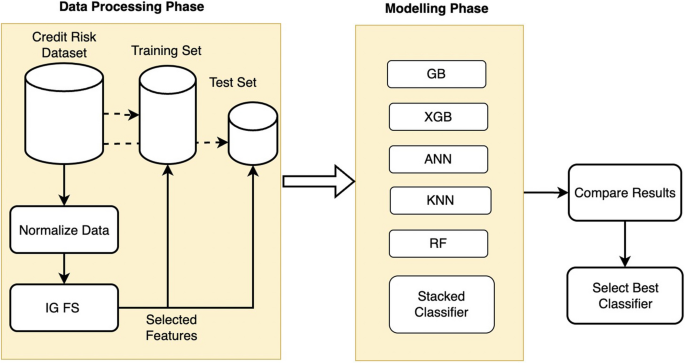
- Model Selection & Training: Choose appropriate ML algorithms based on data characteristics and business objectives. Train models on historical data, splitting it into training, validation, and test sets.
- Model Validation & Evaluation: Rigorously test the model's performance on unseen data. Evaluate against KPIs and business metrics. Conduct stress tests and sensitivity analyses.
- Model Interpretability & Explainability: For regulated industries, understanding why a model makes a certain prediction is crucial. Techniques like SHAP (SHapley Additive exPlanations) and LIME (Local Interpretable Model-agnostic Explanations) help provide insights into model decisions, aiding in regulatory compliance and fairness assessments.
- Deployment & Integration: Integrate the validated model into existing loan origination systems or decision engines. This often involves creating APIs for real-time scoring.
- Monitoring & Maintenance: ML models can degrade over time due to concept drift (changes in underlying data patterns). Continuous monitoring of model performance, data drift, and regular retraining are essential to maintain accuracy and prevent unforeseen risks.
Actionable Tip: Establish a clear governance framework for model development, validation, and deployment to ensure transparency and accountability, particularly within financial institutions.
Beyond Accuracy: Strategic Advantages of ML in Credit Risk
While improved accuracy in predicting customer credit risk is a primary driver for adopting machine learning, the benefits extend far beyond just reducing losses. ML empowers financial institutions with strategic advantages that can redefine their market position and enhance their overall business operations.
- Faster Decision-Making: Automated, ML-driven credit assessments can provide near real-time decisions on loan applications. This significantly speeds up the lending process, improving customer satisfaction and allowing lenders to capture more market share.
- Enhanced Customer Experience: Quicker approvals, personalized loan offers, and a more seamless application process contribute to a superior customer journey. This can lead to increased customer loyalty and a higher customer lifetime value.
- Personalized Lending Products: With granular insights into individual risk profiles, lenders can design and offer highly customized loan products, interest rates, and repayment schedules, catering to diverse customer needs while managing risk effectively.
- Proactive Risk Management: ML models can identify emerging risk patterns or early warning signs of potential default before they escalate. This enables proactive interventions, such as offering repayment restructuring or financial counseling, to prevent losses.
- Operational Efficiency: Automating large parts of the credit assessment process reduces manual effort, processing costs, and the likelihood of human error, leading to significant operational efficiencies.
- Improved Fraud Detection: The same ML techniques used for credit risk can be adapted for fraud detection, identifying suspicious patterns in applications or transactions that might indicate fraudulent activity, further protecting the institution.
Navigating Challenges and Ethical Considerations
Despite its immense potential, implementing machine learning for credit risk comes with its own set of challenges and ethical considerations that demand careful attention.
Data Bias and Fairness
ML models learn from historical data, and if that data contains societal biases (e.g., historical lending practices that discriminated against certain groups), the model can inadvertently perpetuate or even amplify those biases. This can lead to unfair or discriminatory lending decisions, raising serious ethical and legal concerns. Ensuring data diversity and employing fairness-aware ML techniques are crucial.
Explainability and Trust (The "Black Box" Problem)
Complex ML models, especially deep neural networks, can be difficult to interpret. Understanding why a loan application was approved or rejected is vital for both the financial institution (for internal validation and auditing) and the applicant (for transparency and recourse). The lack of model interpretability can hinder trust and complicate adherence to regulations that require clear explanations for credit decisions.
Data Privacy and Security
Collecting and processing vast amounts of sensitive customer data for ML models necessitates robust data privacy and security measures. Compliance with regulations like GDPR, CCPA, and other local data protection laws is non-negotiable. Protecting against data breaches and ensuring responsible data governance are paramount.
Regulatory Hurdles
The financial industry is heavily regulated. Regulators are keen on ensuring fairness, transparency, and accountability in AI-driven decision-making. Financial institutions must demonstrate that their ML models are fair, robust, and auditable, aligning with existing and evolving regulatory compliance frameworks.
Need for Human Oversight
While ML automates decisions, human oversight remains critical. Models can make errors, encounter novel situations, or be influenced by unforeseen data shifts. A robust system includes human review mechanisms, especially for edge cases or high-value decisions, to ensure responsible and ethical outcomes.
Frequently Asked Questions
What are the main benefits of using machine learning for credit risk?
The primary benefits include significantly improved accuracy in predicting customer credit risk, enabling faster and more consistent decision-making, better identification of borrower default risks, the ability to process vast amounts of diverse data, and the potential for offering more personalized financial products. It leads to reduced losses, increased operational efficiency, and an enhanced customer experience.
How does machine learning improve upon traditional credit scoring?
Machine learning surpasses traditional credit scoring by moving beyond linear relationships and limited data sets. It can uncover complex, non-linear patterns in much larger and more diverse datasets, including alternative data. This allows for a more nuanced and dynamic assessment of creditworthiness, adapting to changing financial behaviors and market conditions, unlike static, retrospective traditional models.
What kind of data is used in ML credit risk models?
ML credit risk models utilize a broad spectrum of data. This includes traditional financial data (credit bureau scores, payment history, debt-to-income ratios), as well as internal bank data (transaction history, savings patterns). Increasingly, alternative data sources like utility bill payments, rent payments, mobile phone usage data, educational background, and employment history are incorporated to build a more comprehensive risk profile, enhancing predictive analytics.
Are there ethical concerns with using AI in credit decisions?
Yes, significant ethical concerns exist. The main challenge is algorithmic bias, where historical biases in training data can lead ML models to make unfair or discriminatory lending decisions against certain demographic groups. Other concerns include the "black box" problem (lack of model interpretability), data privacy, and the need for robust regulatory compliance to ensure fairness and transparency in AI-driven credit assessments.

0 Komentar