
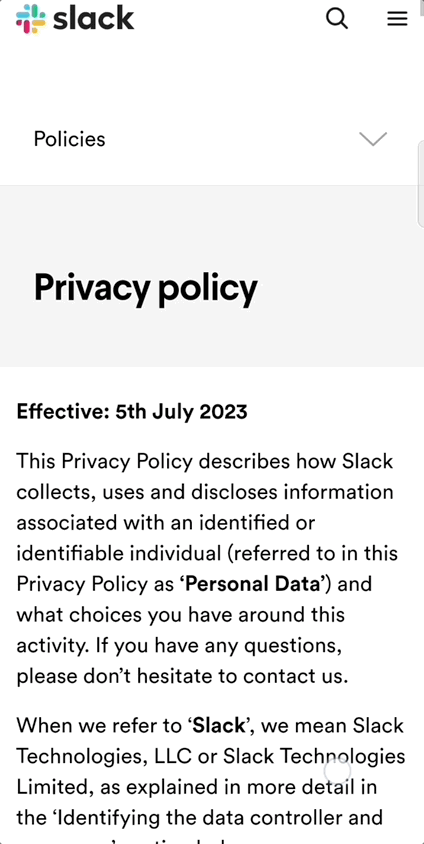
Mastering Mobile App Data Privacy Policies: Essential Examples & Best Practices for Developers
In today's hyper-connected digital landscape, a robust and transparent data privacy policy for mobile apps is not merely a legal formality; it's a foundational pillar of user trust, regulatory compliance, and sustainable growth. As a seasoned SEO expert and content strategist, I understand the critical importance of clearly articulating how your mobile application handles sensitive user data. This comprehensive guide delves into the nuances of crafting effective privacy policies, offering concrete examples and actionable advice to help developers and businesses navigate the complex world of personal information protection, satisfy stringent legal requirements like GDPR and CCPA, and ultimately enhance their app's reputation and search visibility.
Why a Robust Data Privacy Policy is Non-Negotiable for Mobile Apps
The proliferation of mobile applications has brought unprecedented convenience, but also heightened scrutiny regarding data collection practices. Users are increasingly aware of their digital rights, and regulatory bodies worldwide are enforcing strict guidelines on how their personal data is processed. Without a clear, accessible, and compliant privacy policy, mobile apps face severe risks, including hefty fines, reputational damage, and a significant erosion of user trust. A well-crafted policy demonstrates your commitment to user privacy, which is a powerful signal to both your audience and search engines that you prioritize ethical data handling.
Navigating the Regulatory Landscape: GDPR, CCPA, and Beyond
The global regulatory environment for data privacy is dynamic and ever-evolving. Key legislations such as the European Union's General Data Protection Regulation (GDPR) and California's Consumer Privacy Act (CCPA) have set high benchmarks for privacy standards. These regulations mandate specific disclosures, require explicit consent management, and grant users substantial rights over their data. Beyond these, other regional laws like Brazil's LGPD, Canada's PIPEDA, and emerging state-specific privacy laws in the U.S. further complicate the compliance landscape. A comprehensive privacy policy must consider these diverse requirements, ensuring your app adheres to the strictest applicable standards.
Building User Trust and Transparency Through Privacy Notices
In an age where data breaches are common news, users are more hesitant than ever to share their personal information. A transparent privacy notice is your app's opportunity to build trust. By clearly explaining what data you collect, why you collect it, how it's used, and with whom it's shared, you empower users to make informed decisions. This transparency fosters a sense of security and reliability, encouraging greater user adoption and retention. Remember, a user who trusts your app is more likely to engage with it, provide valuable feedback, and become a loyal advocate.
Core Components: What a Comprehensive Mobile App Privacy Policy Must Include
A truly effective mobile app privacy policy is a living document that addresses every facet of your app's data handling. It should be easily accessible within the app itself and on your website, written in plain, understandable language, and regularly updated. Here are the essential sections that every robust policy must contain, complete with semantic keyword variations to ensure comprehensive coverage:
Data Collection and Usage
- Types of Data Collected: Clearly enumerate all categories of personal information and non-personal data your app gathers. This includes, but is not limited to, device identifiers, location data, usage analytics, contact information, user-generated content, and payment details.
- Methods of Collection: Explain how data is collected (e.g., directly from user input, automatically via SDKs, from third-party services).
- Purpose of Use: Articulate the specific, legitimate reasons for collecting each type of data. Examples include providing app functionality, personalization, analytics, advertising, customer support, and security.
Consent and User Control
- Opt-in/Opt-out Mechanisms: Detail how users provide and withdraw consent for data processing, especially for sensitive data or non-essential purposes.
- User Rights: Inform users of their rights under applicable laws, such as the right to access their user data, rectify inaccuracies, request deletion (right to be forgotten), restrict processing, and data portability.
- How to Exercise Rights: Provide clear instructions and contact points for users to exercise these rights (e.g., via in-app settings, email, or a dedicated privacy portal).
Data Sharing and Third Parties
- Who Data is Shared With: List all categories of third parties with whom personal information may be shared (e.g., analytics providers, advertising partners, payment processors, cloud hosting services, legal authorities).
- Purpose of Sharing: Explain the specific reasons for sharing data with each third party.
- Legal Basis for Sharing: State the legal grounds for such sharing (e.g., user consent, contractual necessity, legitimate interests). Emphasize that your app does not sell user data unless explicitly stated and consented to.
Data Security Measures
- Safeguards Implemented: Describe the technical and organizational measures your app employs to protect personal information from unauthorized access, alteration, disclosure, or destruction. This could include encryption, pseudonymization, access controls, and regular security audits.
- Breach Notification: Briefly outline your procedure for notifying users and authorities in the event of a data breach, in compliance with relevant regulations.
Data Retention Policy
- How Long Data is Kept: Specify the criteria used to determine how long user data is retained. This is often based on the purpose of collection, legal obligations, or user consent.
- Criteria for Deletion: Explain when and how data is securely deleted or anonymized once it's no longer needed for its original purpose.
Children's Privacy (COPPA, etc.)
- Age Restrictions: If your app is directed at children or may collect data from minors, outline your compliance with laws like COPPA (Children's Online Privacy Protection Act) in the U.S. or similar international regulations.
- Parental Consent: Describe mechanisms for obtaining verifiable parental consent for children's data collection.
International Data Transfers
- Mechanisms for Cross-Border Data Flow: If your app transfers user data across international borders (e.g., from the EU to the US), explain the legal mechanisms in place to ensure adequate protection, such as Standard Contractual Clauses (SCCs), Privacy Shield frameworks (if applicable), or Binding Corporate Rules (BCRs).
Updates to the Policy and Contact Information
- Notification Process: Explain how users will be informed of any significant changes to the data privacy policy. This often involves in-app notifications, email, or prominent website announcements.
- Contact Information: Provide clear contact details (email, physical address, or dedicated privacy officer) for users to ask questions or raise concerns about their privacy.
Practical Examples: Crafting Key Sections of Your Mobile App Privacy Policy
Understanding the components is one thing; articulating them clearly and concisely within your policy is another. Here are practical examples of how key sections can be worded, providing a foundation for your own app privacy statement:
Example 1: Data Collection & Usage Clause
"We collect various types of personal information and non-personal data to provide, improve, and personalize your experience with [Your App Name].
- Information You Provide: When you register or use our app, you may provide us with your name, email address, phone number, payment information, and demographic details. This data is essential for account creation, processing transactions, and delivering specific app features.
- Automatically Collected Information: We automatically collect certain information about your device and usage patterns. This includes your IP address, device ID, operating system, browser type, mobile network information, and app usage data (e.g., features used, time spent in app). This data helps us optimize app performance, troubleshoot issues, and understand user engagement.
- Purpose of Use: Your data is used to:
- Deliver and maintain the functionality of [Your App Name].
- Personalize your experience and content.
- Process transactions and manage your account.
- Analyze app usage to improve our services and features.
- Communicate with you about updates, offers, and support.
- Ensure the security and integrity of our app.
Example 2: Third-Party Sharing Disclosure
"We may share your user data with certain third parties under specific circumstances and only when necessary for the purposes outlined in this policy. We do not sell your personal information.
- Service Providers: We engage trusted third-party service providers to perform functions on our behalf, such as hosting, analytics, payment processing, and customer support. These providers have access to your personal information only to perform their services and are contractually obligated to protect it and use it solely for the purposes for which it was disclosed. Examples include [e.g., AWS for hosting, Stripe for payments, Google Analytics for app analytics].
- Advertising Partners: With your explicit consent, we may share non-personally identifiable information or anonymized data with advertising partners to deliver relevant advertisements within or outside our app. You can manage your ad preferences via your device settings or within the app's privacy settings.
- Legal Requirements: We may disclose your information if required to do so by law or in response to valid requests by public authorities (e.g., a court order or government agency request).
Example 3: User Rights & Control Clause
"You have significant rights regarding your personal information collected by [Your App Name]. We are committed to facilitating the exercise of these rights.
- Right to Access: You have the right to request a copy of the user data we hold about you.
- Right to Rectification: You can request that any inaccurate or incomplete personal information we hold about you be corrected.
- Right to Erasure (Right to Be Forgotten): You have the right to request the deletion of your user data under certain conditions, such as when the data is no longer necessary for the purposes for which it was collected.
- Right to Restrict Processing: You can request that we limit the way we use your personal information under certain circumstances.
- Right to Data Portability: You have the right to receive your user data in a structured, commonly used, and machine-readable format and to transmit that data to another controller.
- Right to Object: You have the right to object to the processing of your personal information for direct marketing purposes or based on legitimate interests.
Actionable Tips for Optimizing Your Mobile App Privacy Policy for Users and SEO
Beyond the legal necessities, optimizing your privacy policy for readability and search engine visibility is crucial. A well-structured, user-friendly policy not only builds trust but also contributes positively to your overall SEO strategy.
- Use Plain Language: Avoid legal jargon. Write your policy in clear, concise, and easy-to-understand language. Tools like the Flesch-Kincaid readability test can help ensure your content is accessible to a broad audience.
- Make it Scannable: Utilize headings (H2, H3), bullet points, and numbered lists to break up text and make it easy for users to find specific information quickly. Bold important terms like data retention or app permissions.
- Ensure Accessibility: Your privacy policy should be easily accessible from multiple points within your app (e.g., settings menu, onboarding screens) and on your website. A direct link in your app store listing is also critical.
- Regularly Review and Update: Laws change, and your app's features evolve. Commit to reviewing and updating your policy at least annually, or whenever there are significant changes to your data collection practices or regulatory landscape. Clearly state the "Last Updated" date.
- Link Strategically: Use internal links within your policy to relevant sections (e.g., "For more details on your rights, see the 'User Rights' section above"). Consider external links to official regulatory websites (e.g., `[link to GDPR official website]`) to add authority, but use sparingly. You could also link internally to other relevant pages on your site, such as `[link to our app security measures page]`.
- Consider Multi-Language Support: If your app targets a global audience, providing your privacy policy in multiple languages can significantly enhance user experience and compliance.
- Implement a Consent Banner: For new users, especially those in GDPR-regulated regions, an initial consent banner or pop-up that links directly to your privacy policy is essential for obtaining explicit consent for data collection and cookie usage.
- Transparency in App Store Listings: Leverage the privacy labels required by app stores (like Apple's App Store Privacy Labels) to provide a concise summary of your data practices directly on your product page. This often pulls information directly from your detailed policy.
Frequently Asked Questions
What is a mobile app data privacy policy?
A mobile app data privacy policy is a legally binding document that informs users about how a mobile application collects, uses, stores, shares, and protects their personal information and other data. It serves as a transparency tool, detailing the app's data collection practices, user rights, and the measures taken for data security. Essentially, it's a declaration of how your app handles sensitive user information.
Why is a data privacy policy crucial for mobile app developers?
A data privacy policy is crucial for mobile app developers for several reasons: it ensures compliance with global regulations like GDPR compliance and CCPA regulations, avoiding hefty fines and legal repercussions. It builds user trust and transparency by clearly outlining data handling practices, which is vital for user adoption and retention. Furthermore, it safeguards the app's reputation, demonstrates ethical business practices, and can even positively influence app store rankings and user reviews by signaling a commitment to privacy.
What are the key elements of an effective mobile app privacy policy?
An effective mobile app privacy policy should clearly articulate several key elements. These include a detailed explanation of the types of user data collected and the purposes for which it is used, how user consent is obtained and managed (consent management), details on third-party sharing and any data transfers, the data security measures in place to protect information, the data retention period, and specific provisions for children's privacy if applicable. It must also provide clear instructions on how users can exercise their data rights and contact the app developer with privacy concerns.
How often should a mobile app's data privacy policy be updated?
A mobile app's data privacy policy should be reviewed and updated regularly, ideally at least once a year, or immediately whenever there are significant changes to the app's data collection practices, the introduction of new features that handle data differently, or updates to relevant privacy laws and regulations (e.g., new state-specific privacy laws). Transparency about these updates, including notifying users, is also a critical part of maintaining trust and compliance.

0 Komentar