
Quantum Computing Trapped Ion Qits Explained: A Deep Dive into Quantum Hardware
Embark on a fascinating journey into the heart of quantum computing as we meticulously unravel the intricacies of trapped ion qubits. Widely recognized as one of the most promising and mature architectures for building fault-tolerant quantum computers, these microscopic charged atoms offer unparalleled precision and coherence. This comprehensive guide will explain the fundamental principles, operational mechanisms, and significant advantages that position ion-trap quantum systems at the forefront of the quantum revolution. Prepare to gain a deep understanding of how these delicate quantum bits are manipulated, measured, and harnessed to tackle computational problems far beyond the reach of even the most powerful classical supercomputers.
The Fundamental Concept of Trapped Ion Qubits
At its core, a trapped ion qubit leverages individual charged atoms (ions) as the fundamental carriers of quantum information. Unlike classical bits that exist in a state of either 0 or 1, a qubit can exist in a superposition of both states simultaneously, thanks to the principles of quantum mechanics. For trapped ions, this quantum information is typically encoded in the internal electronic states of the ion, such as two distinct energy levels of an electron orbiting the nucleus. These ions are isolated from their environment to preserve their delicate quantum properties, making them exceptional candidates for robust quantum computation.
The Anatomy of an Ion Trap
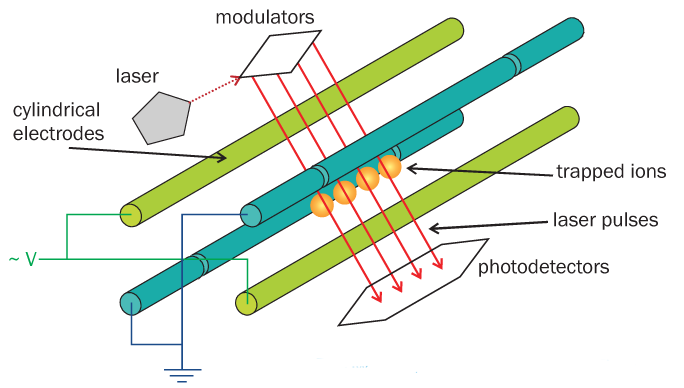
To manipulate and control these individual ions, a specialized device known as an ion trap is essential. These traps use electromagnetic fields to suspend ions in a precisely defined vacuum environment, preventing them from colliding with each other or the surrounding air molecules. The most common type is the radio-frequency (RF) Paul trap, which utilizes oscillating electric fields to create a dynamic potential well that confines the ions. Key components include:
- Vacuum Chamber: A crucial element, maintaining an ultra-high vacuum (UHV) is paramount. This minimizes collisions between the ions and residual gas molecules, significantly extending the coherence time of the qubits.
- Electrodes: Precisely engineered electrodes generate the electric fields necessary to trap the ions. These electrodes can be macroscopic or, increasingly, fabricated on microchips (micro-fabricated ion traps) for enhanced scalability.
- Ion Source: A mechanism to generate ions, often involving a neutral atomic beam that is then ionized (e.g., via electron bombardment or photoionization) before being introduced into the trap.
The ability to precisely control the environment and position of each ion within the trap is a significant advantage, allowing for high-fidelity operations on individual qubits.
Laser Cooling: Taming the Ions
Even in a vacuum, ions retain thermal energy, causing them to jiggle. This thermal motion can introduce errors and reduce the fidelity of quantum operations. To counteract this, laser cooling techniques are employed to bring the ions to near absolute zero temperatures. This process, often involving Doppler cooling and later sideband cooling, reduces the kinetic energy of the ions, effectively "freezing" them into place. Cooling is critical because:
- Minimizes Motion-Induced Errors: Reduced thermal motion ensures the ions are precisely positioned, allowing for accurate laser targeting and minimizing dephasing.
- Enables Ground State Cooling: For certain quantum operations, ions must be cooled to their vibrational ground state, where their motion is purely quantum mechanical.
- Increases Coherence: A colder, more stable ion is less susceptible to environmental noise, preserving its quantum state for longer durations.
The precision achieved through laser cooling is a testament to the exquisite control possible with trapped ion systems, underpinning their high-fidelity quantum gate operations.
Encoding Quantum Information in Trapped Ions
Once trapped and cooled, the ions are ready to serve as qubits. Quantum information is typically encoded in two distinct internal energy levels of the ion's outermost electron. For example, the "0" state might correspond to a lower energy level, and the "1" state to a higher energy level. These energy levels are incredibly stable and well-isolated, contributing to the long coherence times characteristic of ion-based qubits.
Superposition and Entanglement with Ions
The magic of quantum computing lies in superposition and entanglement. In trapped ion systems, these states are created and manipulated using precisely tuned lasers:
- Creating Superposition: A single laser pulse, carefully tuned to the energy difference between the "0" and "1" states, can drive the ion into a superposition, existing as both 0 and 1 simultaneously. The duration and intensity of the laser pulse determine the exact superposition state. This is analogous to a quantum gate operation, specifically a single-qubit rotation.
- Achieving Entanglement: Entanglement, where the states of multiple qubits become inextricably linked, is achieved by coupling the internal electronic states of the ions to their shared collective vibrational motion within the trap. When a laser addresses two ions simultaneously, it can mediate an interaction that entangles their internal states. This is a crucial step for multi-qubit gates, such as a Controlled-NOT (CNOT) gate, which is a building block for most quantum algorithms.
The ability to perform high-fidelity single-qubit and two-qubit gates is a hallmark of trapped ion technology, crucial for building powerful quantum processors. Researchers are constantly refining these laser manipulation techniques to achieve even higher gate fidelities, inching closer to the thresholds required for robust quantum error correction.
The Role of Photons in Ion-Based Qubits
While lasers are used for manipulation, photons also play a vital role in reading out the state of a qubit and, critically, for creating entanglement between spatially separated ion traps. When measuring a qubit, a laser tuned to a specific transition will cause the ion to fluoresce (emit photons) if it's in one state (e.g., "1") but not in the other ("0"). By detecting these emitted photons, the state of the qubit can be determined without disturbing the other qubits. This non-demolition measurement is crucial for quantum algorithms.
Furthermore, emitting photons can serve as a conduit for creating entanglement between distant ions, potentially in different trap modules. This technique, known as photon-mediated entanglement, is a key strategy for scaling up quantum computers beyond a single trap, addressing the challenge of the "interconnect problem" in larger quantum architectures. Learn more about the challenges of scaling quantum computers.
Advantages of Trapped Ion Qubits for Quantum Computing
Trapped ion qubits boast several inherent advantages that make them a leading contender in the race for practical quantum computation:
High Fidelity and Long Coherence Times
One of the most significant strengths of trapped ion qubits is their exceptional coherence. Because ions are isolated in a vacuum and manipulated with precise lasers, they interact minimally with their environment. This isolation leads to:
- Long Coherence Times: Trapped ions can maintain their quantum superposition and entanglement for milliseconds to even seconds, significantly longer than many other qubit modalities. This extended coherence allows for more complex quantum operations and deeper quantum circuits before decoherence sets in.
- High Gate Fidelity: The precise control afforded by laser manipulation enables very accurate single-qubit and two-qubit gate operations. Gate fidelities exceeding 99.9% for single-qubit gates and 99% for two-qubit gates are routinely demonstrated, approaching the thresholds needed for fault-tolerant quantum computing.
These impressive figures highlight the intrinsic quality of trapped ions as fundamental quantum bits, offering a robust foundation for building reliable quantum information processors.
All-to-All Connectivity
In a linear chain of trapped ions, every ion can potentially interact with every other ion. This "all-to-all" connectivity is a powerful architectural advantage. Unlike some other qubit platforms where qubits only interact with their nearest neighbors, trapped ions allow any qubit to be entangled with any other qubit in the trap. This simplifies the design of quantum algorithms, as complex interactions can be implemented directly without the need for additional "swap" operations to bring distant qubits into proximity. This intrinsic connectivity streamlines the execution of quantum algorithms, making them more efficient and reducing the number of gates required.
Intrinsic Identicality
All ions of the same isotope (e.g., Ytterbium-171 or Calcium-40) are fundamentally identical. This natural uniformity is a massive advantage for quantum computing. There is no need for complex calibration routines to make one qubit behave like another, as they are inherently indistinguishable. This intrinsic identicality simplifies manufacturing, improves scalability, and ensures consistent performance across all qubits within a system, a critical factor for building large-scale, reliable quantum technology.
Navigating the Challenges: Scaling and Engineering
While trapped ions offer remarkable performance at small scales, scaling them up to thousands or millions of qubits, as required for universal quantum computers, presents significant engineering challenges.
The Interconnect Problem
As the number of ions in a single linear trap increases, the complexity of precisely addressing each ion with individual lasers grows exponentially. Furthermore, the collective vibrational modes become more complex, making precise entanglement operations harder. To overcome this, researchers are exploring modular architectures, often referred to as "quantum CCDs" (charge-coupled devices). In these designs, ions are shuttled between different trap zones for storage, processing, and entanglement with other modules. This requires:
- Ion Shuttling: Precisely moving ions between different trap segments without losing their quantum information.
- Modular Entanglement: Creating entanglement between ions located in different modules, often via photon-mediated interactions, to build a distributed quantum network.
Developing robust and low-loss methods for ion shuttling and inter-module entanglement is a key area of research for achieving truly scalable quantum computation.
Thermal Management and Vibrations
Despite laser cooling, maintaining ultra-low temperatures and isolating the system from external vibrations remains a challenge. Even minute vibrations or temperature fluctuations can introduce noise and lead to decoherence. Advanced cryogenic systems and vibration isolation platforms are crucial for operating large-scale trapped ion systems. The need for a pristine, stable environment adds to the complexity and cost of building these machines.
Towards Modular Architectures
The future of trapped ion quantum computing likely lies in highly modular, interconnected systems. Instead of one large trap, networks of smaller, specialized ion trap modules will communicate to form a larger quantum processor. This approach leverages the strengths of trapped ions in small, highly coherent arrays while providing a pathway to scale. Developing robust quantum interconnects and efficient control electronics for these distributed systems is a critical frontier in quantum hardware development.
Practical Applications and Future Outlook
The advancements in trapped ion qubit technology are not merely academic exercises; they pave the way for transformative applications across various fields.
Building Scalable Quantum Processors
Companies and research institutions worldwide are actively building and refining trapped ion quantum computers. These machines are already demonstrating their capability in running small-scale quantum algorithms. As the technology matures, we can expect trapped ion systems to be among the first to achieve fault tolerance, enabling them to tackle problems like:
- Drug Discovery and Materials Science: Simulating complex molecular interactions with unprecedented accuracy, leading to new pharmaceuticals and advanced materials.
- Financial Modeling: Optimizing portfolios, risk assessment, and complex financial simulations.
- Cryptography: Developing new, unbreakable encryption methods and breaking existing ones (e.g., Shor's algorithm).
The precision and stability of ion-trap quantum computers make them ideal candidates for these demanding computational tasks.
Quantum Simulation and Sensing
Beyond universal quantum computation, trapped ion systems are exceptional platforms for quantum simulation. Their high degree of control allows physicists to precisely engineer interactions between ions, effectively creating "designer" quantum systems to study complex physical phenomena that are intractable for classical computers. This capability is invaluable for fundamental research in condensed matter physics and high-energy physics.
Furthermore, trapped ions are at the heart of the world's most accurate atomic clocks, demonstrating their exquisite sensitivity as quantum sensors. This precision can be extended to other forms of sensing, such as ultra-sensitive magnetometers or gravimeters, with potential applications in navigation, medical diagnostics, and fundamental physics experiments. The versatility of trapped ions underscores their importance not just for computing, but for the broader field of quantum technology.
Frequently Asked Questions
What are the primary advantages of trapped ion qubits?
The primary advantages of trapped ion qubits include their exceptionally long coherence times, very high gate fidelities (meaning low error rates during operations), inherent identicality (all ions of the same isotope are identical), and all-to-all connectivity within a single trap, which simplifies algorithm implementation. These attributes make them highly robust and precise quantum bits.
How do trapped ion qubits achieve entanglement?
Trapped ion qubits achieve entanglement by coupling their internal electronic states to their shared collective vibrational motion within the ion trap. Lasers are precisely tuned to mediate an interaction where the internal states of two or more ions become correlated through this shared motion. This creates an entangled state, crucial for multi-qubit operations and complex quantum algorithms.
What are the main challenges in scaling trapped ion quantum computers?
The main challenges in scaling trapped ion quantum computers involve managing the complexity of individual laser addressing for many ions, overcoming the "interconnect problem" to link multiple trap modules, and maintaining the ultra-high vacuum and cryogenic temperatures required for large systems. Researchers are developing modular architectures and photon-mediated entanglement to address these scaling hurdles.
How do trapped ions compare to superconducting qubits?
Trapped ion qubits generally offer longer coherence times and higher gate fidelities compared to superconducting qubits, and they benefit from all-to-all connectivity. However, superconducting qubits typically operate at faster gate speeds and are more amenable to conventional semiconductor manufacturing techniques, potentially offering easier large-scale integration. Both are leading contenders, each with distinct strengths and challenges for different applications in quantum hardware.
Can trapped ion qubits be used for quantum error correction?
Yes, trapped ion qubits are considered highly promising for quantum error correction due to their high gate fidelities and long coherence times. These properties mean they have lower intrinsic error rates, which reduces the overhead required for error correction codes. Their all-to-all connectivity also facilitates the implementation of complex error correction circuits. This makes them a strong candidate for building fault-tolerant quantum computers, which will be essential for solving the most challenging problems in the future of quantum technology.

0 Komentar