
Quantum Computing vs Classical Computing Explained: A Deep Dive into the Future of Computation
Embark on a fascinating journey to understand the fundamental differences and groundbreaking potential of two vastly distinct computational paradigms: quantum computing vs classical computing. While classical computers have powered our digital age for decades, a new frontier is emerging, promising to solve problems currently intractable for even the most powerful supercomputers. This comprehensive guide will demystify the core principles, compare their capabilities, and explore the transformative applications that set these two computational titans apart, offering insights crucial for anyone looking to grasp the future of technology.
Understanding Classical Computing: The Foundation of Our Digital World
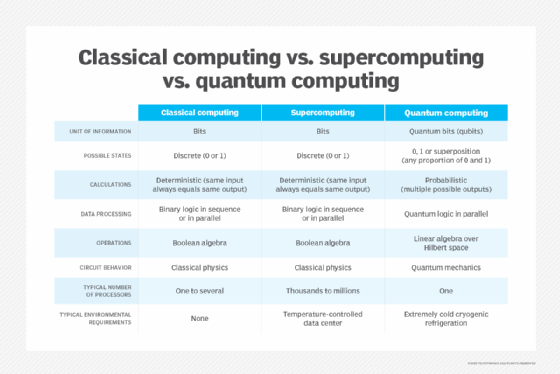
For the past century, classical computing has been the bedrock of technological advancement, driving everything from the internet and smartphones to complex scientific simulations. At its core, a classical computer operates on the principles of classical physics, processing information in a straightforward, deterministic manner. Information is encoded in bits, which can exist in one of two distinct states: 0 or 1. These binary states represent electrical signals, on or off, allowing for logical operations to be performed sequentially.
The power of classical computers stems from their ability to perform billions of these operations per second, executing instructions one after another. This sequential processing, while incredibly fast, has inherent limitations when faced with problems that grow exponentially in complexity. As problems scale, the number of possible states or variables becomes astronomically large, making it computationally impossible for even the fastest traditional computers to find a solution within a reasonable timeframe.
Key Characteristics of Classical Computers
- Binary Bits: Information is stored and processed as bits, always in a definite state of 0 or 1.
- Deterministic Operations: Given the same input, a classical computer will always produce the same output, following a predictable path of logic gates.
- Sequential Processing: Calculations are performed one step at a time, in a linear fashion.
- Transistors: The fundamental building blocks are transistors, acting as tiny on/off switches, enabling the manipulation of bits.
- Reliability: Highly stable and less susceptible to environmental noise due to their deterministic nature.
Unveiling Quantum Computing: A Paradigm Shift in Processing
In stark contrast to its classical counterpart, quantum computing harnesses the mind-bending principles of quantum mechanics to process information. Instead of classical bits, quantum computers utilize qubits (quantum bits). What makes qubits revolutionary is their ability to exist in multiple states simultaneously, a phenomenon known as superposition. This means a single qubit can be 0, 1, or a combination of both 0 and 1 at the same time, significantly increasing the information density.
Beyond superposition, quantum computing leverages another counter-intuitive quantum phenomenon: entanglement. When two or more qubits become entangled, they become intrinsically linked, regardless of the distance separating them. The state of one entangled qubit instantaneously influences the state of the others. This interconnectedness allows quantum computers to perform complex calculations on multiple variables simultaneously, opening doors to parallel processing capabilities far beyond anything classical computers can achieve.
Fundamental Principles of Quantum Mechanics in Computing
- Qubits: The basic unit of quantum information, capable of representing 0, 1, or a superposition of both.
- Superposition: A qubit can exist in multiple states simultaneously until measured, dramatically increasing the amount of information it can hold.
- Entanglement: Two or more qubits become linked, such that the state of one instantly affects the others, enabling complex correlations and parallel computations.
- Quantum Gates: Operations performed on qubits to manipulate their quantum states, analogous to logic gates in classical computing but operating on probabilistic outcomes.
- Decoherence: The fragility of quantum states, where interaction with the environment causes them to lose their quantum properties, posing a significant challenge for quantum computer development.
Quantum Computing vs Classical Computing: A Direct Comparison
The true distinction between these two computational paradigms becomes apparent when we directly compare their fundamental operational models and capabilities. Understanding these differences is key to appreciating why quantum computational power holds such immense promise for specific, complex problems.
Processing Power and Data Representation
The most striking difference lies in how they represent and process data. Classical computers process bits sequentially. For a problem involving 'n' bits, a classical computer must evaluate each of the 2^n possible states one by one (or through clever algorithms that still operate sequentially). This leads to an exponential increase in computation time as 'n' grows.
Conversely, due to superposition, 'n' qubits can represent all 2^n possible states simultaneously. This means a quantum computer can explore a vast number of potential solutions in parallel, rather than sequentially. While a classical computer would need to run 2^n calculations, a quantum computer, in theory, can perform a single calculation that encompasses all these possibilities. This inherent parallelism, stemming from quantum mechanics, is the source of quantum computing's potential for exponential speedup in certain types of problems.
Problem-Solving Capabilities and Algorithms
The types of problems each excels at highlight their fundamental differences. Classical computers are superb at tasks that are sequential, involve precise calculations, or require large-scale data storage and retrieval. This includes running operating systems, processing transactions, rendering graphics, and managing databases.
Quantum computers, however, are not general-purpose machines designed to replace classical ones. Their advantage lies in tackling problems that are intractable for classical computers due to their immense complexity. Examples include:
- Factorization of Large Numbers: Shor's algorithm, a quantum algorithm, can factor large numbers exponentially faster than the best-known classical algorithms. This has profound implications for modern encryption methods like RSA.
- Database Searching: Grover's algorithm can search an unsorted database quadratically faster than classical algorithms.
- Simulation of Molecular Structures: Accurately simulating the behavior of molecules for drug discovery or materials science requires understanding complex quantum interactions, a task uniquely suited for quantum computers.
- Optimization Problems: Finding the optimal solution among a vast number of possibilities (e.g., logistics, financial modeling).
Scalability and Error Correction
While classical computing has matured to incredible levels of scalability (think of massive data centers), quantum computing is still in its nascent stages. Building and maintaining quantum computers presents immense engineering challenges. Qubits are fragile; they are highly susceptible to environmental interference (noise, temperature fluctuations) which causes decoherence, leading to errors. Maintaining their quantum states requires extremely low temperatures (near absolute zero) and precise isolation.
Error correction in quantum computing is significantly more complex than in classical systems. Classical error correction typically involves redundancy (e.g., having three bits, and if one flips, you know it's the minority). In quantum computing, you cannot simply copy a qubit (due to the no-cloning theorem), making error correction a major research area. Achieving fault-tolerant quantum computers with a sufficient number of stable qubits is a critical hurdle for widespread practical application.
Where Quantum Computing Shines: Transformative Applications
The unique capabilities of quantum computers mean they aren't merely faster versions of classical machines; they open up entirely new avenues for problem-solving across various sectors. Their ability to simulate complex systems and explore vast solution spaces makes them ideal for:
- Drug Discovery and Materials Science: Simulating molecular interactions with unprecedented accuracy can accelerate the development of new drugs, catalysts, and advanced materials with novel properties. This could revolutionize industries from pharmaceuticals to aerospace.
- Financial Modeling: Quantum algorithms can optimize complex portfolios, predict market fluctuations with greater precision, and perform risk analysis much faster, leading to more efficient financial strategies.
- Artificial Intelligence and Machine Learning: Quantum machine learning could enable the training of more powerful AI models, enhance pattern recognition, and improve optimization for complex AI algorithms, potentially leading to breakthroughs in areas like natural language processing and computer vision.
- Cybersecurity: While Shor's algorithm poses a threat to current public-key encryption, quantum computing also offers solutions. Quantum cryptography (like Quantum Key Distribution) provides inherently secure communication channels, and quantum-resistant algorithms are being developed to safeguard against future quantum attacks.
- Logistics and Optimization: Solving highly complex optimization problems, such as efficient routing for delivery networks, supply chain management, and traffic flow optimization, can lead to significant cost savings and improved efficiency.
The Future Landscape: Coexistence and Collaboration
It's crucial to understand that quantum computers are unlikely to replace classical computers entirely. Instead, the future of computation will likely involve a symbiotic relationship, often referred to as hybrid computing. Classical computers will continue to handle the vast majority of tasks – from running operating systems and managing networks to processing everyday applications. Quantum computers will act as powerful accelerators, specializing in specific, computationally intensive sub-problems that classical machines cannot efficiently solve.
For example, a classical computer might manage the overall workflow of a drug discovery project, while a quantum computer performs the highly precise molecular simulations. The results from the quantum computation would then be fed back into the classical system for further analysis and integration. This collaborative approach leverages the strengths of both paradigms, maximizing efficiency and unlocking previously unattainable insights.
Actionable Tips for Businesses and Researchers
As the field of quantum computing matures, organizations and individuals should consider the following steps to prepare for and potentially leverage this transformative technology:
- Stay Informed: Regularly follow developments in quantum computing research and industry announcements. Understanding the pace of progress is crucial.
- Educate Your Team: Invest in training for key personnel on the basics of quantum mechanics and its computational implications. Consider online courses or specialized workshops.
- Identify Potential Use Cases: Analyze your organization's most challenging computational problems. Are there optimization, simulation, or machine learning tasks that are currently intractable? These could be prime candidates for quantum acceleration.
- Explore Quantum Cloud Services: Many leading tech companies offer access to quantum processors via cloud platforms. Experimenting with these services can provide hands-on experience without significant upfront investment.
- Foster Collaboration: Engage with academic institutions, quantum startups, or research consortia. Collaboration can provide access to expertise, resources, and early-stage quantum solutions.
- Invest in Quantum-Resistant Cybersecurity: Proactively assess and plan for the transition to post-quantum cryptography to protect sensitive data from future quantum attacks. Learn more about our cybersecurity solutions.
- Start Small, Think Big: Don't wait for "quantum supremacy" to become widespread. Begin by understanding the fundamentals and identifying low-risk, high-impact areas where quantum approaches might offer a competitive edge.
Ready to explore how quantum technologies could impact your industry or research? Contact us today for expert consultation and strategic planning.
Frequently Asked Questions
What is the fundamental difference between a bit and a qubit?
The fundamental difference lies in their state representation. A classical bit can only exist in one of two definite states: 0 or 1. A qubit, on the other hand, can exist in a superposition of both 0 and 1 simultaneously. This ability to be in multiple states at once allows qubits to store significantly more information and perform parallel computations, which is impossible for classical bits.
Will quantum computers replace classical computers for everyday tasks?
No, it is highly unlikely that quantum computers will replace classical computers for everyday tasks such as browsing the internet, word processing, or running spreadsheets. Classical computers are highly efficient and cost-effective for these common functions. Quantum computers are specialized machines designed to solve specific, extremely complex problems that are beyond the capabilities of even the most powerful supercomputers, making them complementary rather than replacement technologies.
What are the biggest challenges in building practical quantum computers?
Building practical quantum computers faces several significant challenges. Key among these are decoherence, where qubits lose their fragile quantum states due to environmental interference, leading to errors. Maintaining quantum states requires extreme isolation and ultra-low temperatures. Additionally, scaling up the number of stable, interconnected qubits and developing robust quantum error correction techniques are major hurdles that researchers are actively working to overcome to achieve fault-tolerant quantum systems.
How does quantum computing impact cybersecurity?
Quantum computing has a dual impact on cybersecurity. On one hand, powerful quantum algorithms like Shor's algorithm could potentially break current public-key encryption standards (like RSA and ECC) that secure much of our digital communication and data. This necessitates the development of "post-quantum cryptography." On the other hand, quantum mechanics also offers solutions, such as Quantum Key Distribution (QKD), which provides inherently secure methods for exchanging encryption keys, promising a new era of unhackable communication.

0 Komentar