
Revolutionizing Retail: Machine Learning for Predicting Product Sales and Demand Forecasting
In today's hyper-competitive marketplace, the ability to accurately predict product sales and forecast demand is no longer a luxury but a critical necessity for business survival and growth. Traditional forecasting methods, often reliant on historical averages and manual adjustments, frequently fall short in capturing the complex, dynamic interplay of factors that influence consumer behavior. Enter machine learning for predicting product sales and demand forecasting – a transformative approach that leverages advanced algorithms and vast datasets to unlock unparalleled precision and strategic insights. This comprehensive guide will explore how machine learning is revolutionizing the way businesses anticipate market needs, optimize inventory, and drive revenue growth, providing you with expert insights and actionable strategies to harness its power.
The Imperative of Accurate Demand Forecasting in Modern Business
For any enterprise dealing with physical products, from e-commerce giants to brick-and-mortar retailers and manufacturers, effective demand forecasting is the backbone of operational efficiency. Inaccurate predictions can lead to a multitude of costly problems: overstocking ties up capital, incurs storage costs, and risks obsolescence, while understocking results in lost sales, frustrated customers, and damaged brand reputation. The stakes are incredibly high, influencing everything from inventory management and supply chain logistics to marketing spend and staffing levels. The volatile nature of consumer trends, global economic shifts, and rapid technological advancements further complicate this challenge, making static, historical-based models increasingly obsolete.
Limitations of Traditional Forecasting Methods
- Lagging Indicators: Most traditional methods rely heavily on past sales data, which may not adequately reflect sudden market shifts or emerging trends.
- Manual Bias: Human judgment, while valuable, can introduce subjective biases and may struggle to process large volumes of diverse data.
- Limited Factor Integration: Simple models often cannot account for complex external variables like social media trends, competitor promotions, or nuanced economic indicators.
- Scalability Issues: Managing forecasts for thousands or millions of SKUs manually or with basic tools becomes impractical and error-prone.
The Unparalleled Power of Machine Learning in Sales Prediction
Machine learning (ML) offers a paradigm shift in how businesses approach product sales prediction. Unlike traditional statistical models, ML algorithms can learn from vast quantities of historical data, identify intricate patterns, and make highly accurate predictions about future demand. These algorithms excel at recognizing non-linear relationships, adapting to new information, and even discovering hidden correlations that human analysts might miss. This capability empowers businesses to move beyond reactive strategies to proactive, data-driven decision-making.
Key Advantages of ML-Driven Demand Forecasting
- Enhanced Accuracy: ML models can achieve significantly higher forecasting accuracy by considering a broader range of variables and complex interactions.
- Automated Insights: They can automate the analysis of massive datasets, reducing manual effort and human error.
- Adaptability: ML models can be continuously retrained with new data, ensuring their predictions remain relevant and precise as market conditions evolve.
- Granular Predictions: Capable of forecasting demand at various levels, from individual SKUs to product categories, regions, or even specific stores.
- Strategic Decision Support: Provides actionable intelligence for supply chain optimization, pricing strategies, and marketing campaign effectiveness.
Core Machine Learning Algorithms for Sales and Demand Forecasting
The field of machine learning offers a diverse toolkit for tackling demand forecasting challenges. The choice of algorithm often depends on the nature of the data, the complexity of the patterns, and the desired level of interpretability.
1. Regression Models
Simple yet powerful, regression models are a foundational element of predictive analytics. They establish a relationship between a dependent variable (sales) and one or more independent variables (features).
- Linear Regression: Assumes a linear relationship between variables. Good for initial baselines but often too simplistic for complex sales data.
- Polynomial Regression: Captures non-linear relationships by fitting a polynomial function to the data.
- Ridge & Lasso Regression: Regularized versions that help prevent overfitting, especially useful with many features.
2. Time Series Models
Specifically designed for data points collected over time, these models are indispensable for sales and demand forecasting where temporal patterns like seasonality and trends are prominent.
- ARIMA (AutoRegressive Integrated Moving Average): A classic statistical model that accounts for trend, seasonality, and residual errors. Effective for stable time series data.
- SARIMA (Seasonal ARIMA): An extension of ARIMA that explicitly handles seasonal components. Crucial for products with strong seasonal variations.
- Prophet (Facebook's Open-Source): A flexible model for forecasting time series data that exhibits strong seasonal effects and trends, designed to handle missing data and outliers robustly. Ideal for businesses with daily sales data.
3. Ensemble Methods
These algorithms combine multiple individual models to produce a more robust and accurate prediction than any single model could achieve.
- Random Forest: Builds multiple decision trees and averages their predictions. Excellent for handling complex, non-linear relationships and feature interactions.
- Gradient Boosting (e.g., XGBoost, LightGBM): Sequentially builds models, with each new model correcting errors made by previous ones. Highly effective for achieving state-of-the-art accuracy in many forecasting tasks.
4. Neural Networks (Deep Learning)
Especially Long Short-Term Memory (LSTM) networks, are a type of recurrent neural network (RNN) particularly well-suited for sequence prediction problems like time series forecasting. They can learn long-term dependencies in data.
- LSTM Networks: Excellent for capturing complex temporal patterns and dependencies over long periods, making them powerful for highly volatile or long-term demand forecasting.
Data Preparation: The Cornerstone of Accurate ML Models
No machine learning model, however sophisticated, can overcome poor-quality data. The adage "garbage in, garbage out" holds true. Robust big data analytics and meticulous data preparation are foundational to achieving high forecasting accuracy.
Essential Steps in Data Preparation:
- Data Collection: Gather all relevant historical sales data, along with external factors. This includes transaction records, promotional calendars, pricing changes, website traffic, economic indicators, weather data, and competitor activities.
- Data Cleaning: Identify and handle missing values, outliers, and inconsistencies. This might involve imputation techniques, removal of erroneous entries, or smoothing noisy data.
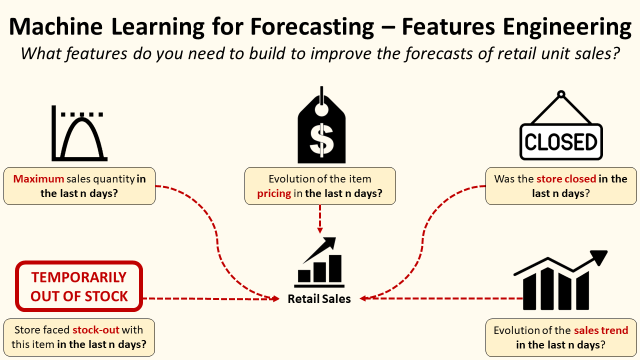
- Feature Engineering: This is perhaps the most critical step. It involves transforming raw data into meaningful features that the ML model can learn from.
- Data Normalization/Scaling: Ensure all features are on a similar scale to prevent certain features from dominating the learning process, especially for algorithms sensitive to feature magnitudes.
- Train-Test Split: Divide your dataset into training, validation, and test sets. The training set is used to train the model, the validation set for hyperparameter tuning, and the test set for an unbiased evaluation of the model's performance on unseen data.
Mastering Feature Engineering for Enhanced Predictability
Feature engineering is an art and a science, turning raw data into predictive signals. It’s about creating new variables that encapsulate information relevant to future sales. Here are key categories of features to consider:
- Historical Sales Data:
- Lagged sales (sales from previous days, weeks, months).
- Rolling averages (e.g., 7-day average sales).
- Sales trends (e.g., slope of sales over a period).
- Temporal Features:
- Day of the week, month, quarter, year.
- Is it a weekend? Is it a holiday? (Public and local holidays).
- Number of days until the next major holiday.
- Week of the year, day of the year.
- Promotional & Pricing Features:
- Presence of a promotion (binary flag).
- Type of promotion (discount, BOGO, bundle).
- Discount percentage.
- Price changes, price elasticity.
- Competitor pricing data.
- Product Attributes:
- Product category, sub-category.
- Brand, color, size, material.
- Product lifecycle stage (new, mature, end-of-life).
- External Factors:
- Economic indicators (GDP growth, inflation, unemployment rates).
- Weather data (temperature, precipitation, specific events).
- Social media trends, search query volumes (retail intelligence).
- Competitor actions (new product launches, marketing campaigns).
Actionable Tip: Experiment extensively with different feature combinations. Use domain expertise to guide your feature engineering process, as a deep understanding of your business and market can reveal highly impactful predictors.
Implementing a Machine Learning Demand Forecasting System: A Step-by-Step Guide
Building and deploying an ML-driven forecasting system requires a structured approach. This isn't just about running an algorithm; it's about integrating it into your operational workflow for continuous value.
Practical Implementation Steps:
- Define the Business Problem & Scope:
- What exactly needs to be predicted (e.g., daily sales per SKU, weekly demand per region)?
- What is the forecast horizon (short-term, medium-term, long-term)?
- What level of accuracy is acceptable?
- Data Acquisition & Preparation: (As detailed above) This phase is iterative and often consumes the most time.
- Model Selection & Training:
- Choose appropriate ML algorithms based on data characteristics and problem complexity.
- Train models on historical data.
- Tune hyperparameters to optimize performance (e.g., number of trees in a Random Forest, learning rate in Gradient Boosting).
- Model Evaluation:
- Assess model performance using metrics like Mean Absolute Error (MAE), Mean Absolute Percentage Error (MAPE), Root Mean Squared Error (RMSE).
- Compare against baseline models (e.g., traditional methods, naive forecasts) to quantify improvement.
- Ensure the model generalizes well to unseen data.
- Deployment & Integration:
- Integrate the trained model into existing business systems (e.g., ERP, inventory management software).
- Automate the data pipeline for continuous input.
- Set up APIs for easy access to forecasts.
- Monitoring & Retraining:
- Continuously monitor model performance against actual sales.
- Implement alerts for significant deviations.
- Periodically retrain the model with new data to maintain its accuracy and adapt to evolving market dynamics. This is crucial for sustained forecasting accuracy.
Best Practice: Start with a Minimum Viable Product (MVP). Begin with a smaller scope or a few key products, validate the approach, and then scale up. This iterative approach allows for learning and refinement.
Beyond Numbers: The Broader Impact of ML in Demand Forecasting
The benefits of machine learning in demand forecasting extend far beyond just precise sales figures. They permeate various aspects of business operations, leading to significant improvements in efficiency and profitability.
- Optimized Inventory Levels: By knowing what will sell and when, businesses can reduce carrying costs, minimize waste from expired or obsolete stock, and avoid stockouts. This directly impacts inventory optimization.
- Streamlined Supply Chains: Accurate forecasts enable better planning for raw material procurement, manufacturing schedules, and logistics, leading to smoother operations and reduced lead times. This is fundamental to a robust supply chain management.
- Enhanced Marketing and Pricing Strategies: Insights into future demand allow for targeted marketing campaigns, dynamic pricing adjustments, and effective promotional planning to maximize revenue and clear excess stock. Understanding future sales trends is key.
- Improved Financial Planning: More reliable sales forecasts lead to better budgeting, cash flow management, and capital allocation, supporting overall financial health and revenue growth.
- Better Customer Satisfaction: Fewer stockouts mean customers can reliably find the products they want, when they want them, leading to increased loyalty and positive brand perception.
Challenges and Considerations in ML-Driven Forecasting
While powerful, implementing machine learning for demand forecasting is not without its challenges.
- Data Quality and Availability: The need for vast, clean, and diverse datasets can be a significant hurdle for many organizations.
- Model Interpretability: Complex models like deep neural networks can be "black boxes," making it difficult to understand why a particular prediction was made. This can be an issue for gaining stakeholder trust and making business adjustments.
- Computational Resources: Training and deploying sophisticated ML models can require substantial computing power and infrastructure.
- Talent Gap: A shortage of skilled data scientists and ML engineers can hinder implementation.
- Dynamic Market Conditions: Unforeseen events (e.g., pandemics, natural disasters, sudden economic shifts) can introduce anomalies that even the best models struggle to predict, requiring constant monitoring and potential retraining.
Frequently Asked Questions
How does machine learning improve demand forecasting accuracy compared to traditional methods?
Machine learning significantly enhances demand forecasting accuracy by its ability to process vast amounts of diverse data, identify complex non-linear patterns, and adapt to changing market conditions. Unlike traditional statistical methods that often rely on assumptions about data distribution or simple historical averages, ML algorithms can incorporate a multitude of internal and external factors—such as promotional activities, competitor actions, economic indicators, and seasonal variations—to create more nuanced and precise predictions. They learn from past errors and can be continuously retrained, leading to more robust and reliable forecasts over time.
What type of data is crucial for building effective ML models for sales prediction?
For effective machine learning sales prediction, a wide array of data types is crucial. This includes comprehensive historical sales data (transaction logs, sales volume, revenue), product-specific attributes (category, brand, price, features), promotional data (discounts, marketing campaigns, ad spend), and critical external factors. External data can encompass economic indicators (GDP, inflation, consumer confidence), weather patterns, holiday schedules, competitor pricing, and even social media trends or search query volumes. The more relevant, clean, and comprehensive the data, the better the model's ability to identify influential factors and make accurate forecasts.
Can machine learning forecasting be used for both short-term and long-term sales predictions?
Yes, machine learning models are highly versatile and can be tailored for both short-term (e.g., daily, weekly) and long-term (e.g., monthly, quarterly, yearly) sales predictions. For short-term forecasts, models like LSTMs or Prophet excel at capturing immediate patterns, daily seasonality, and the impact of recent events. For long-term predictions, algorithms that can identify overarching trends, cyclical patterns, and macroeconomic influences, such as certain time series models or robust ensemble methods, are often employed. The choice of model, feature engineering, and data granularity will vary depending on the forecasting horizon, but ML provides the flexibility to address diverse temporal needs.
Is machine learning demand forecasting accessible to small and medium-sized businesses (SMBs)?
Absolutely. While historically perceived as a tool for large enterprises, machine learning demand forecasting is becoming increasingly accessible to SMBs. The rise of user-friendly ML platforms, cloud-based solutions (e.g., Google Cloud AI Platform, AWS SageMaker, Azure Machine Learning), and open-source libraries (e.g., scikit-learn, Prophet) has significantly lowered the barrier to entry. Many platforms offer automated machine learning (AutoML) capabilities, allowing businesses with limited data science expertise to build and deploy predictive models. Furthermore, the cost-efficiency gained from optimized inventory and improved operational efficiency often provides a compelling return on investment for SMBs.

0 Komentar