
The Power of Machine Learning: Revolutionizing Fraud Prevention in E-commerce
In the dynamic world of online retail, e-commerce businesses face an ever-evolving threat: fraud. As digital transactions surge, so does the sophistication of fraudulent activities, leading to significant financial losses, reputational damage, and eroded customer trust. Traditional rule-based systems, while foundational, often struggle to keep pace with these adaptive threats. This is where the transformative potential of machine learning for fraud prevention comes into play. By leveraging advanced analytical capabilities, machine learning algorithms can detect intricate patterns, predict future risks, and identify fraudulent transactions with unparalleled accuracy, offering a robust shield against financial crime in the digital marketplace. This comprehensive guide delves deep into how this cutting-edge technology is reshaping e-commerce security, providing actionable insights for businesses aiming to fortify their defenses.
Why Traditional Fraud Detection Falls Short in E-commerce
For years, fraud detection relied heavily on static, rule-based systems. These systems operate on predefined rules, such as "block transactions over $1,000 from a new customer in a high-risk country." While effective for known fraud types, their limitations become glaringly obvious when confronted with the sheer volume and complexity of modern e-commerce transactions. They are reactive, not proactive, and easily bypassed by fraudsters who quickly adapt their methods. The result is often a high rate of false positives, where legitimate transactions are flagged and declined, leading to customer frustration and lost revenue, or, conversely, a high rate of false negatives, where actual fraud slips through the cracks.
The Evolving Landscape of E-commerce Fraud
- Account Takeover (ATO): Fraudsters gain unauthorized access to customer accounts, making purchases, redeeming loyalty points, or altering personal information.
- Payment Fraud: Unauthorized credit card usage, stolen credentials, or chargeback fraud where customers dispute legitimate charges.
- Friendly Fraud (Chargeback Fraud): Customers making a purchase and then falsely claiming it was unauthorized to receive a refund while keeping the product.
- Synthetic Identity Fraud: Combining real and fake information to create new, fraudulent identities for making purchases.
- Return Fraud: Returning stolen or counterfeit items for a refund, or claiming non-receipt of items that were delivered.
These diverse and increasingly sophisticated fraud types demand a more intelligent, adaptive approach – one that machine learning readily provides.
How Machine Learning Transforms Fraud Prevention
Machine learning (ML) algorithms possess the unique ability to learn from vast datasets, identify subtle correlations, and recognize patterns that are invisible to the human eye or static rules. Unlike traditional methods, ML models continuously improve as they are exposed to new data, making them incredibly effective at adapting to emerging fraud tactics. This enables real-time fraud detection and prevention, minimizing losses and enhancing the overall customer experience by reducing unnecessary friction.
Key Machine Learning Paradigms for Fraud Detection
Different types of machine learning are employed for specific aspects of fraud detection, each with its own strengths:
- Supervised Learning: This paradigm is used when historical data is labeled as either "fraudulent" or "legitimate." The model learns from these labeled examples to classify new, unseen transactions. Common algorithms include:
- Logistic Regression: A simple yet effective classification algorithm.
- Support Vector Machines (SVM): Ideal for high-dimensional data, finding the optimal hyperplane to separate classes.
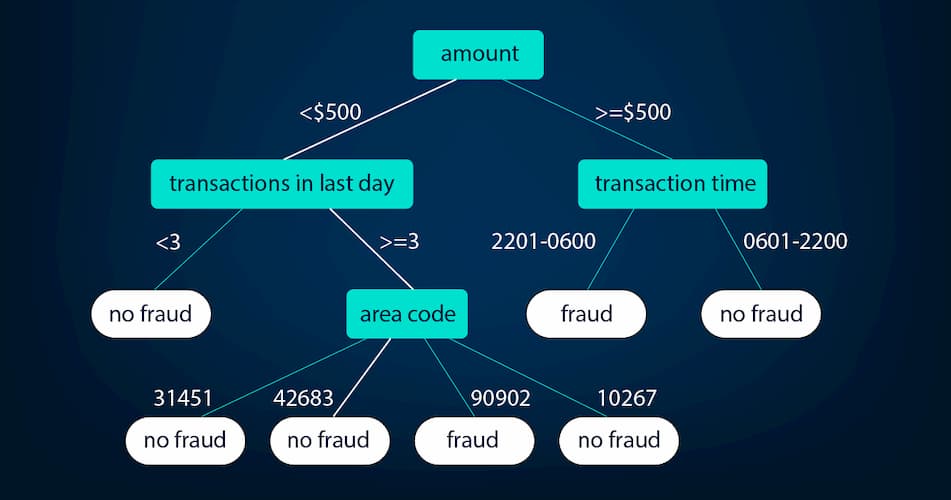
- Decision Trees and Random Forests: Powerful for understanding feature importance and handling complex relationships.
- Gradient Boosting Machines (e.g., XGBoost, LightGBM): Highly accurate and robust for classification tasks, often winning data science competitions.
For example, a supervised model might analyze transaction amount, IP address, device type, and customer history to predict the likelihood of fraud based on patterns learned from past fraudulent transactions.
- Unsupervised Learning: This approach is invaluable when labeled data is scarce or when seeking to identify novel fraud patterns that haven't been seen before. Unsupervised models look for anomalies or outliers in data. Key techniques include:
- Clustering (e.g., K-Means, DBSCAN): Grouping similar transactions together, allowing anomalies that don't fit any cluster to be flagged.
- Anomaly Detection Algorithms (e.g., Isolation Forest, One-Class SVM): Specifically designed to identify rare instances that deviate significantly from the norm.
- Autoencoders: A type of neural network that learns a compressed representation of normal data. Deviations from this representation in new data indicate anomalies.
This is particularly useful for detecting zero-day attacks or sophisticated fraud rings that employ entirely new methods, as the model doesn't need prior examples of that specific fraud type.
- Deep Learning: A subset of machine learning using neural networks with many layers (deep neural networks). Deep learning models excel at processing complex, high-dimensional data such as transaction sequences, images, or raw behavioral data.
- Recurrent Neural Networks (RNNs) and Long Short-Term Memory (LSTM) networks: Excellent for analyzing sequential data, like a customer's series of transactions or browsing history, to detect suspicious sequences.
- Convolutional Neural Networks (CNNs): Can be used for image-based fraud detection or even to identify patterns in structured data by converting it into a 'pseudo-image' format.
Deep learning's ability to automatically learn intricate feature representations from raw data reduces the need for extensive manual feature engineering, making it a powerful tool for complex risk management.
The Machine Learning Fraud Prevention Workflow: A Step-by-Step Guide
Implementing a robust machine learning system for fraud prevention involves several critical stages, from data acquisition to continuous model improvement.
Data Collection and Preprocessing
- Identify Data Sources: Gather all relevant data points. This includes transaction data (amount, items, time, payment method), customer data (account age, purchase history, login frequency), device data (IP address, device ID, browser fingerprint), geographical data, and historical fraud labels.
- Data Cleaning: Remove inconsistencies, handle missing values (e.g., imputation), and correct errors. Clean data is paramount for model accuracy.
- Data Normalization/Scaling: Ensure all features are on a similar scale to prevent certain features from dominating the learning process.
- Data Balancing: Fraudulent transactions are rare compared to legitimate ones (data imbalance). Techniques like oversampling (SMOTE), undersampling, or using specific algorithms (e.g., Weighted Loss Functions) are crucial to prevent models from simply predicting "not fraud" all the time.
Actionable Tip: Invest heavily in data quality. Poor data quality is the single biggest impediment to effective machine learning models. Consider integrating data from various sources like payment gateways, identity verification services, and internal logs for a holistic view.
Feature Engineering
This is often described as an art form in machine learning. It involves transforming raw data into meaningful features that the model can learn from. Effective features capture patterns indicative of fraud. Examples include:
- Transaction Velocity: Number of transactions from an IP address or card in a short period.
- Spending Patterns: Deviation from a customer's usual spending habits.
- Geographical Discrepancies: Mismatch between IP location, billing address, and shipping address.
- Device Fingerprinting: Identifying unique device attributes to spot suspicious device changes or multiple accounts from one device.
- Behavioral Biometrics: Analyzing how a user interacts with the website (e.g., typing speed, mouse movements) to identify anomalies.
Actionable Tip: Collaborate with fraud analysts or domain experts. Their insights into how fraudsters operate are invaluable for creating highly predictive features. Experiment with different feature combinations and transformations.
Model Selection and Training
Choosing the right algorithm depends on the data, the specific problem, and performance requirements. After selecting an algorithm (e.g., Gradient Boosting Classifier for supervised learning, Isolation Forest for anomaly detection), the model is trained on the prepared historical data. This involves splitting data into training, validation, and test sets. Hyperparameter tuning is performed on the validation set to optimize model performance.
Actionable Tip: Don't rely on a single model. Ensemble methods, which combine the predictions of multiple models, often yield superior accuracy and robustness. Techniques like stacking, bagging (Random Forest), and boosting (XGBoost) are highly effective for predictive modeling in fraud detection.
Model Deployment and Monitoring
Once trained and validated, the machine learning model needs to be integrated into the e-commerce platform for real-time decision-making. This often involves API integration where transaction data is fed to the model, and a fraud score or decision is returned almost instantaneously.
- Real-time Integration: Deploying models to production environments for immediate scoring of new transactions.
- Performance Monitoring: Continuously track key metrics like precision, recall, F1-score, and AUC-ROC. Monitor for concept drift, where the relationship between input features and the target variable changes over time, indicating the model is becoming outdated.
- Retraining and Adaptation: Regularly retrain models with new, labeled data to ensure they remain effective against evolving fraud tactics. This continuous learning loop is vital for long-term success in fraud prevention strategies.
Actionable Tip: Implement a robust A/B testing framework to compare the performance of new models against existing ones before full deployment. Establish clear alert systems for when model performance degrades or when unusual patterns are detected during transaction monitoring.
Essential Features and Data Points for Robust ML Models
The efficacy of your machine learning fraud prevention system hinges on the quality and breadth of the data you feed it. Here are some critical data points and features that contribute to highly accurate models:
- Transaction Details: Amount, currency, payment method (credit card, PayPal, digital wallet), number of items, product categories, shipping method, and transaction time.
- Customer Information: Account age, previous purchase history, average order value, number of failed login attempts, associated email address domain, and customer loyalty program status.
- Device and Network Data: IP address, device type (mobile, desktop), operating system, browser type and version, device ID, cookie data, and proxy usage detection. Understanding the digital footprint is crucial for anomaly detection.
- Geographical Data: Billing address, shipping address, IP geolocation, and consistency between these locations.
- Behavioral Data: Time spent on pages, navigation patterns, typing speed, mouse movements, and form-filling behavior. Deviations from normal behavior can signal a bot or a fraudster.
- Historical Fraud Data: Crucial for supervised learning, this includes past transactions explicitly identified as fraudulent or legitimate. This data forms the bedrock for the model's learning process.
By integrating and analyzing these diverse data points, machine learning models can build a comprehensive understanding of normal versus suspicious behavior, significantly improving their ability to pinpoint fraudulent transactions.
Overcoming Challenges in ML-Powered Fraud Prevention
While powerful, implementing machine learning for fraud prevention is not without its challenges. Addressing these effectively is key to maximizing the system's benefits.
Data Imbalance
Fraudulent transactions are inherently rare events. This extreme data imbalance (e.g., 0.1% fraud rate) can cause models to be biased towards the majority class (legitimate transactions), leading to poor fraud detection. Strategies to counter this include oversampling the minority class, undersampling the majority class, or using synthetic data generation techniques like SMOTE (Synthetic Minority Over-sampling Technique). It's also vital to select appropriate evaluation metrics beyond simple accuracy, such as precision, recall, F1-score, and AUC-ROC, which provide a more accurate picture of performance on imbalanced datasets.
Concept Drift
Fraudsters are constantly evolving their methods. What worked yesterday might not work tomorrow. This phenomenon, known as concept drift, means that a model trained on past data can become less effective over time. Continuous monitoring of model performance and regular retraining with fresh, recent data are essential. Adaptive learning systems that can automatically detect concept drift and trigger retraining are an advanced solution for maintaining model efficacy.
Interpretability (Explainable AI - XAI)
Complex machine learning models, particularly deep learning networks, can sometimes act as "black boxes," making it difficult to understand why a particular transaction was flagged as fraudulent. For fraud analysts and compliance teams, understanding the reasoning behind a model's decision is crucial for investigation, customer communication, and regulatory compliance. Techniques like SHAP (SHapley Additive exPlanations) and LIME (Local Interpretable Model-agnostic Explanations) are gaining prominence, allowing businesses to gain insights into model predictions, fostering trust and enabling better human oversight in risk management.
Balancing False Positives vs. False Negatives
Every fraud prevention system faces a trade-off: minimizing false positives (legitimate transactions flagged as fraud) versus minimizing false negatives (actual fraud missed). While missing fraud leads to direct financial loss, excessive false positives can alienate legitimate customers, increase operational costs (manual reviews), and damage brand reputation. Machine learning allows for fine-tuning this balance by adjusting thresholds based on business risk tolerance. For instance, a high-value transaction might warrant a lower fraud score threshold for flagging, while a low-value transaction might tolerate a higher one, optimizing the overall impact on the business and customer experience.
The Future of E-commerce Fraud Prevention with AI
The integration of machine learning is just one facet of the broader application of Artificial Intelligence (AI) in e-commerce fraud prevention. The future promises even more sophisticated solutions, including:
- Reinforcement Learning: Systems that learn through trial and error, optimizing their decision-making process based on the outcomes of their actions. This could lead to highly adaptive fraud prevention systems that learn from every new fraud attempt.
- Federated Learning: Enabling collaborative model training across multiple organizations without sharing raw data, potentially leading to more robust fraud detection models by leveraging a wider pool of insights while maintaining data privacy.
- Behavioral Biometrics: Advanced analysis of user interaction patterns (e.g., how they hold their phone, their typing rhythm) to verify identity and detect anomalies in real-time, adding another layer of security beyond traditional authentication.
- Graph Neural Networks (GNNs): Ideal for uncovering complex relationships within vast networks of data (e.g., connections between users, devices, and transactions), making them highly effective at identifying fraud rings and syndicated attacks.
As these technologies mature, they will continue to empower e-commerce businesses with predictive capabilities that are not only reactive to current threats but also proactive in anticipating future ones, ensuring a safer and more secure online shopping environment for everyone.
Frequently Asked Questions
What is the primary benefit of using machine learning for fraud prevention?
The primary benefit of using machine learning for fraud prevention is its ability to adapt and learn from vast amounts of data, identifying complex and evolving fraud patterns that traditional rule-based systems often miss. This leads to significantly higher accuracy in detecting fraud, fewer false positives, and the capacity for real-time decision-making, thereby reducing financial losses and improving customer experience by minimizing friction for legitimate transactions. It offers superior anomaly detection capabilities for novel fraud schemes.
How does machine learning differ from traditional rule-based systems in fraud detection?
Machine learning systems differ fundamentally from traditional rule-based systems in their learning mechanism. Rule-based systems rely on manually defined rules (e.g., "if transaction amount > $X, flag as suspicious"), which are static and require constant human updates. In contrast, machine learning models learn patterns and relationships from historical data (both legitimate and fraudulent) and can automatically adapt to new fraud tactics without explicit programming. This makes ML far more dynamic, scalable, and effective against sophisticated, evolving fraud, enhancing overall e-commerce security.
What kind of data is crucial for training effective machine learning fraud models?
Training effective machine learning fraud models requires a diverse set of data points. Crucial data includes transaction details (amount, items, payment method), customer information (account history, demographics), device data (IP address, device ID, browser fingerprint), geographical data (billing/shipping addresses, IP location), and importantly, historical labeled data indicating whether past transactions were legitimate or fraudulent. The more comprehensive and clean the data, the more robust and accurate the predictive modeling capabilities of the ML system.
Can machine learning eliminate all fraud?
While machine learning for fraud prevention significantly reduces fraud and enhances detection capabilities, it cannot eliminate all fraud entirely. Fraudsters are constantly innovating, and no system is foolproof. ML models can have false positives (flagging legitimate transactions) and false negatives (missing actual fraud). However, by continuously learning and adapting, machine learning provides the most advanced and dynamic defense available, drastically minimizing the impact of fraud and improving overall risk management in e-commerce.
How often should machine learning models for fraud prevention be updated?
Machine learning models for fraud prevention should be updated and retrained regularly, ideally on an ongoing basis. The frequency depends on the rate of "concept drift" – how quickly fraud patterns evolve in your specific industry or business. For e-commerce, where fraud tactics change rapidly, daily or weekly retraining might be necessary for critical models, while less frequently for others. Continuous monitoring of model performance metrics is essential to determine when retraining is needed to maintain optimal fraud detection accuracy.

0 Komentar