
Complete Guide
Are you ready to explore the next frontier of technological advancement and discover unparalleled quantum computing investment opportunities? As the world stands on the cusp of a profound digital revolution, quantum technology is rapidly emerging from theoretical labs into practical applications, promising to reshape industries from finance and pharmaceuticals to logistics and cybersecurity. This comprehensive guide will illuminate the landscape of quantum investment, offering expert insights into where the most promising prospects lie, how to navigate the inherent risks, and why positioning yourself now could yield extraordinary long-term returns. Dive deep into the nuances of this transformative sector and understand how to strategically participate in the growth of next-generation computing.
The Dawn of the Quantum Era: Why Quantum Computing Matters for Investors
Quantum computing is not merely an incremental improvement over classical computing; it represents a paradigm shift, leveraging the principles of quantum mechanics to solve problems currently intractable for even the most powerful supercomputers. Instead of bits, which represent information as either 0 or 1, quantum computers use qubits, which can exist in multiple states simultaneously due to superposition and entanglement. This fundamental difference unlocks unprecedented computational power, capable of tackling complex challenges in areas such as drug discovery, materials science, financial modeling, and artificial intelligence.
For savvy investors, understanding this foundational difference is crucial. The potential for disruption and value creation is immense, making quantum computing investment opportunities a compelling prospect for those looking beyond conventional markets. We are witnessing the very early stages of a technology that could redefine what's possible, creating entirely new markets and rendering existing solutions obsolete. The race for quantum supremacy is on, and the companies leading this charge are poised for significant growth.
Key Areas Where Quantum Computing Will Create Value
- Drug Discovery and Materials Science: Simulating molecular interactions with unparalleled accuracy, accelerating the development of new drugs, and designing novel materials with specific properties.
- Financial Modeling: Optimizing complex portfolios, pricing derivatives, and detecting fraud with greater precision than classical algorithms.
- Artificial Intelligence and Machine Learning: Enhancing AI capabilities through more efficient training of complex models and unlocking new forms of data analysis.
- Cybersecurity: Developing advanced encryption methods (post-quantum cryptography) resistant to future quantum attacks, while also posing a threat to current encryption standards.
- Logistics and Optimization: Solving complex logistical challenges, such as supply chain optimization and traffic flow management, with greater efficiency.
Navigating the Investment Landscape: Where to Find Quantum Opportunities
The quantum computing sector is still nascent, but it's attracting significant capital from venture capitalists, government initiatives, and forward-thinking corporations. Identifying the right entry points requires a nuanced understanding of the ecosystem.
1. Early-Stage Quantum Computing Startups (Venture Capital & Angel Investing)
Perhaps the highest risk, highest reward avenue lies in early-stage investment in quantum computing startups. These companies are often at the forefront of innovation, developing proprietary hardware, software, or novel quantum algorithms. They typically seek funding through seed rounds, Series A, B, and beyond.
- Hardware Innovators: Companies building the actual quantum processors using various technologies (superconducting circuits, trapped ions, photonic, topological qubits). Examples include IonQ, Rigetti Computing, and PsiQuantum (though the latter two are now public).
- Software and Algorithm Developers: Firms creating the programming languages, operating systems, and specific quantum algorithms that make quantum computers useful. This includes companies focusing on quantum machine learning, optimization, or simulation.
- Quantum as a Service (QaaS): Providers offering access to quantum computing power via the cloud, democratizing access for researchers and businesses.
Actionable Tip: Gaining access to these opportunities often requires connections within the venture capital community or specialized angel investor networks focused on deep tech. Due diligence is paramount; assess the team's expertise, intellectual property, technological roadmap, and potential market adoption.
2. Publicly Traded Companies with Quantum Divisions or Investments
For individual investors or those seeking more liquidity, investing in established tech giants that are heavily investing in quantum computing can be a safer, albeit potentially less explosive, option.
- IBM: A pioneer in quantum computing, offering cloud-based quantum access (IBM Quantum Experience) and actively developing quantum hardware and software. Investing in IBM stock provides exposure to their broader tech portfolio, including their significant quantum R&D.
- Google (Alphabet Inc.): Known for achieving quantum supremacy with their Sycamore processor, Google continues to push boundaries in quantum hardware and algorithms. Their quantum efforts are part of their broader research initiatives.
- Microsoft: Developing a full-stack quantum ecosystem, including their Azure Quantum cloud platform and topological qubit research.
- Honeywell (Quantinuum): Honeywell spun off its quantum division and merged it with Cambridge Quantum Computing to form Quantinuum, a leading integrated quantum computing company. Investing in Honeywell can provide indirect exposure, or you might look for opportunities in Quantinuum if it goes public.
- Pure-Play Public Quantum Companies: A few companies, like IonQ and Rigetti Computing, have gone public via SPACs, offering direct exposure to quantum hardware development. These are high-risk, high-reward plays.
Practical Advice: Research the specific quantum initiatives of these companies. Understand their commitment, patent portfolio, and how their quantum efforts align with their core business strategy. Consider their overall financial health and market position.
3. Exchange-Traded Funds (ETFs) and Thematic Funds
As the quantum sector matures, specialized ETFs may emerge or existing technology ETFs may increase their allocation to quantum-related companies. While currently rare for pure-play quantum, some broader AI or innovation ETFs might offer indirect exposure.
Consideration: Keep an eye on new fund launches specifically targeting quantum technology. This can offer diversification and professional management, but also comes with management fees.
De-Risking Your Quantum Investment: Challenges and Considerations
While the potential is enormous, quantum computing investment opportunities come with significant risks. It's a frontier technology, and the path to widespread commercialization is still being defined.
Technological Hurdles
- Scalability: Building stable, error-corrected quantum computers with a large number of qubits remains a major challenge. Current machines are still prone to errors and require extremely low temperatures or vacuum environments.
- Error Correction: Quantum information is fragile. Developing robust error correction mechanisms is critical for practical applications, and this significantly increases the number of physical qubits required.
- Algorithm Development: While some powerful algorithms exist (e.g., Shor's and Grover's algorithms), developing practical, application-specific quantum algorithms is an ongoing research area.
Market and Commercialization Risks
- Long Time Horizon: Widespread commercial adoption of quantum computing for everyday problems is still likely years, if not decades, away. Investors need a long-term perspective.
- "Quantum Winter" Potential: Similar to AI winters, there's a risk that overhyped expectations could lead to a period of reduced funding if significant breakthroughs don't materialize as quickly as anticipated.
- Competition: The field is highly competitive, with numerous research institutions and companies vying for breakthroughs. The landscape could shift rapidly.
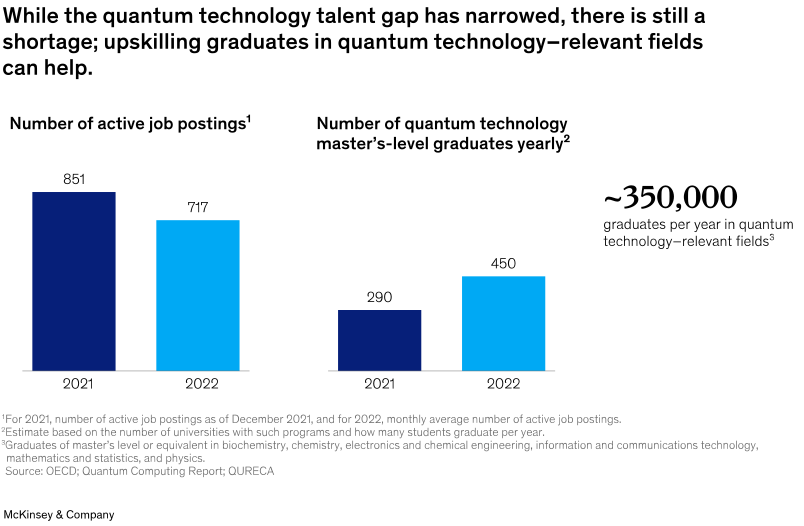
- Talent Scarcity: There's a limited pool of experts in quantum physics, engineering, and computer science, making talent acquisition a challenge for companies.
Expert Insight: Diversify your portfolio. Don't put all your eggs in one quantum basket. Consider a mix of established players and carefully vetted startups. Understand that this is a high-risk, high-reward sector requiring patience.
Future Outlook and Long-Term Potential
Despite the challenges, the trajectory of quantum computing points towards a future of unprecedented computational power. Governments worldwide are pouring billions into quantum R&D, recognizing its strategic importance for national security and economic competitiveness. This sustained funding, coupled with increasing private sector investment, fuels innovation and accelerates progress.
The "quantum advantage" – where quantum computers outperform classical ones for specific, commercially relevant problems – is the holy grail. While full-scale, fault-tolerant quantum computers are still some way off, "noisy intermediate-scale quantum" (NISQ) devices are already proving useful for certain tasks, particularly in research and development. This iterative progress suggests a gradual commercialization rather than a sudden, overnight revolution.
Semantic Keyword Variations for Comprehensive Understanding
When evaluating quantum computing investment opportunities, it's beneficial to consider the broader ecosystem. This includes not just the core quantum hardware and software, but also complementary technologies and services:
- Quantum Sensing: Leveraging quantum principles for highly sensitive measurements, impacting areas like medical imaging, navigation, and geological surveys.
- Quantum Networking: Creating secure communication channels using quantum entanglement, critical for a future quantum internet and enhanced cybersecurity.
- Enabling Technologies: Companies providing specialized components, cryogenic systems, or advanced materials essential for building and operating quantum computers.
- Consulting and Education: Firms that help businesses understand and prepare for the quantum era, offering training and strategic advice.
Call to Action: To stay ahead in this dynamic field, consider subscribing to industry newsletters, attending webinars, and following leading research institutions and companies. Continuous learning is key to identifying emerging trends and refining your investment strategies.
Frequently Asked Questions
What is the biggest challenge facing quantum computing commercialization?
The biggest challenge is arguably scalability and error correction. Current quantum computers are limited in the number of stable qubits they can maintain, and errors are frequent. Achieving fault-tolerant quantum computing with enough stable qubits for practical, complex applications requires significant engineering breakthroughs and robust error correction techniques, which themselves demand a vast number of physical qubits to encode logical ones. This directly impacts the timeline for widespread commercial viability of quantum technology.
How does quantum computing differ from classical computing in terms of investment potential?
Classical computing investments typically involve mature companies with established market shares and predictable growth patterns. Quantum computing investment opportunities, however, are in a nascent, high-risk, high-reward sector. It's a bet on a truly disruptive technology that could create entirely new markets and dramatically alter existing ones. The potential for exponential growth is higher, but so is the risk of technological setbacks or commercialization delays. It requires a greater tolerance for volatility and a longer investment horizon, akin to early internet or biotech investments.
Is now a good time to invest in quantum computing?
For long-term, patient investors with a high-risk tolerance, now could be an opportune time. We are past the initial theoretical stage, with significant progress in hardware development and early applications. However, the market is still in its infancy, meaning volatility is expected. Investing now provides early exposure to potential "moonshot" companies and allows you to participate in the foundational growth of a transformative industry. As with any emerging sector, thorough due diligence and a diversified approach are crucial to mitigate risk assessment.
What specific industries will be most impacted by quantum computing?
Quantum computing is poised to profoundly impact industries that rely heavily on complex calculations, optimization, and data analysis. These include the pharmaceutical and biotechnology sectors (for drug discovery and molecular simulation), financial services (for complex modeling and fraud detection), materials science (for designing new materials), logistics and supply chain management (for optimization), and cybersecurity (for advanced encryption and decryption). The ability of quantum computers to solve currently intractable problems makes them a game-changer for any field demanding immense computational power and novel problem-solving capabilities.

0 Komentar