
Unlocking Quantum Potential: The Variational Quantum Eigensolver (VQE) Explained
Dive into the fascinating world of quantum computing with a comprehensive exploration of the Variational Quantum Eigensolver (VQE). This groundbreaking algorithm stands as a cornerstone in the nascent field of quantum computation, particularly during the Noisy Intermediate-Scale Quantum (NISQ) era. As a powerful hybrid quantum-classical algorithm, VQE offers a pragmatic pathway to tackle complex problems in areas like quantum chemistry, materials science, and optimization, promising to revolutionize how we simulate molecular behavior and discover new substances. Understanding the VQE algorithm is crucial for anyone looking to grasp the practical applications and immense potential of quantum technology, bridging the gap between theoretical quantum mechanics and real-world computational challenges.
Why VQE? Navigating the NISQ Era Landscape
The current state of quantum hardware is characterized by what experts term the NISQ era. This refers to quantum computers that possess a limited number of qubits and are susceptible to noise, meaning quantum errors can easily corrupt computations. Purely quantum algorithms, which require highly fault-tolerant quantum computers, are often beyond the capabilities of today's machines. This is precisely where the variational quantum eigensolver shines.
VQE is designed to be resilient to noise and less demanding on qubit count compared to fully quantum error-corrected algorithms. Its strength lies in its hybrid nature: it leverages the power of quantum processors for specific tasks while offloading computationally intensive optimization to classical computers. This synergy allows us to harness the unique properties of quantum mechanics, such as superposition and entanglement, even with imperfect hardware. For researchers and developers aiming to extract meaningful results from current quantum devices, VQE represents one of the most promising and widely adopted approaches, particularly for calculating ground state energies of molecules.
How the VQE Algorithm Works: A Step-by-Step Breakdown
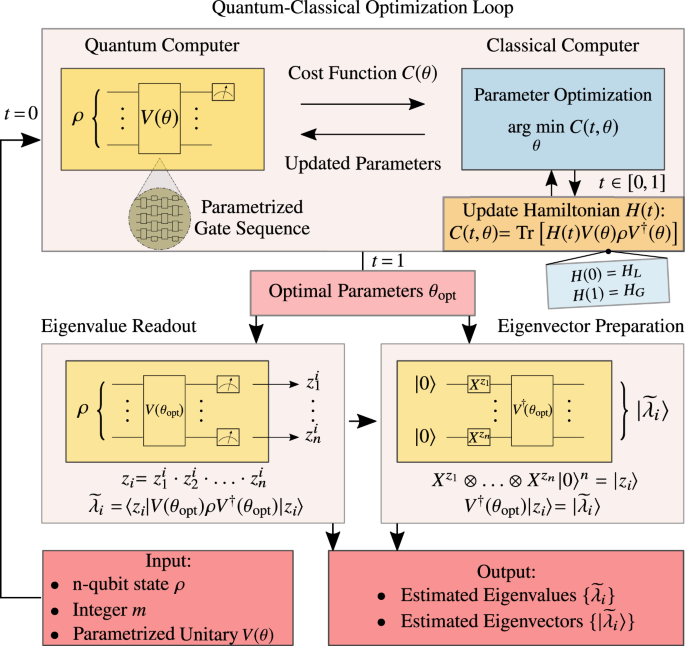
At its core, the Variational Quantum Eigensolver seeks to find the lowest energy state (the ground state) of a quantum system, which is a fundamental problem in quantum chemistry and physics. This is achieved by iteratively optimizing a parameterized quantum circuit (an ansatz) using a classical computer. Let's break down the intricate steps involved:
1. Defining the Hamiltonian of the System
- Problem Formulation: The first step is to translate the problem, often a molecular system, into a quantum mechanical description. This involves constructing the Hamiltonian operator, which mathematically represents the total energy of the system. For chemical systems, this is typically done using methods like the Jordan-Wigner or Bravyi-Kitaev transformations, mapping fermionic operators (electrons) to qubit operators.
- Qubit Mapping: The Hamiltonian, now expressed in terms of Pauli matrices (X, Y, Z), must be mapped onto the qubits of the quantum computer. The number of qubits required depends on the complexity of the molecule.
2. The Variational Ansatz Circuit
- Parameterized Quantum Circuit: This is the quantum component of VQE. An ansatz is a carefully designed quantum circuit with adjustable parameters. These parameters control the rotations and entanglement operations applied to the qubits. The goal is for this circuit, when applied to an initial state (often a simple product state), to prepare a quantum state that approximates the true ground state of the system.
- Variational Principle: The quantum variational principle states that for any normalized trial wave function, the expectation value of the Hamiltonian will always be greater than or equal to the true ground state energy. VQE leverages this principle by minimizing this expectation value.
- Circuit Design: Designing an effective ansatz is critical. It must be expressive enough to represent the ground state but shallow enough to execute on NISQ devices without accumulating excessive noise. Common ansatz types include hardware-efficient ansätze or chemically inspired ones like UCCSD (Unitary Coupled Cluster Singles and Doubles).
3. The Cost Function (Energy Expectation Value)
- Measurement on Quantum Hardware: Once the ansatz circuit is executed on the quantum computer with a given set of parameters, measurements are performed. These measurements allow us to calculate the expectation value of the Hamiltonian, which serves as the cost function (or objective function).
- Calculating Energy: The expectation value <H> = <ψ(θ)|H|ψ(θ)> represents the energy of the quantum state prepared by the ansatz for the current set of parameters θ. The goal is to minimize this energy.
4. Classical Optimization Loop
- Feedback to Classical Optimizer: The calculated energy (cost function value) is then fed back to a classical computer. This classical computer runs an optimization algorithm (e.g., gradient descent, COBYLA, L-BFGS-B).
- Parameter Update: The classical optimizer uses the energy value to determine how to adjust the parameters (θ) of the quantum circuit. It iteratively searches for the parameter set that yields the minimum energy.
- Iteration: This loop – quantum execution, measurement, classical optimization, parameter update – continues until the energy converges to a minimum, ideally the ground state energy. This iterative process is what makes VQE a hybrid quantum-classical algorithm.
Key Components of the VQE Algorithm Ecosystem
The successful implementation of a Variational Quantum Eigensolver relies heavily on the seamless interaction and optimization of several key components:
Quantum Hardware Interaction and Measurement
The quantum processor's role is to execute the parameterized quantum circuit and perform measurements. The quality of this interaction is paramount. Noise in quantum gates and measurement errors can significantly impact the accuracy of the calculated energy. Therefore, techniques like error mitigation are often employed to reduce the impact of these imperfections. These techniques don't correct errors but aim to reduce their effect on the final result, making the VQE more robust on current noisy devices. Efficient measurement strategies are also crucial, as performing all necessary measurements to reconstruct the Hamiltonian's expectation value can be computationally expensive and require many shots on the quantum device.
The Role of the Classical Optimizer
While the quantum computer performs the complex state preparation and measurement, the classical optimizer is the "brain" of the VQE algorithm, guiding the search for the optimal parameters. The choice of classical optimizer is critical. Gradient-based optimizers (which require gradients of the cost function) can be faster but might get stuck in local minima. Gradient-free optimizers are more robust to noise and local minima but can be slower. Researchers are actively exploring and developing specialized classical optimization techniques tailored for VQE, considering the unique landscape of quantum cost functions. The interplay between the classical optimizer and the quantum circuit directly influences the convergence speed and accuracy of the variational quantum eigensolver.
Designing an Effective Ansatz Circuit
The ansatz is arguably the most challenging and crucial component to design. A poorly chosen ansatz might not be able to represent the true ground state, leading to a suboptimal energy result (a phenomenon known as "expressibility deficit"). Conversely, an overly complex ansatz can suffer from "barren plateaus," where the gradients become exponentially small, making optimization extremely difficult. Balancing expressibility with trainability and hardware compatibility is key. Researchers are developing various strategies for ansatz design, from problem-agnostic hardware-efficient ansätze to problem-specific chemically inspired ansätze that leverage domain knowledge. The choice of ansatz directly impacts the overall performance and applicability of the VQE algorithm.
Advantages of the VQE Algorithm
The widespread interest in the Variational Quantum Eigensolver stems from several compelling advantages, particularly for current and near-term quantum hardware:
- Noise Resilience: Its hybrid nature makes VQE more robust against noise compared to purely quantum algorithms, as the classical optimization loop can help mitigate some of the quantum hardware imperfections.
- Resource Efficiency: VQE generally requires fewer qubits and shallower circuits than fully fault-tolerant quantum algorithms, making it suitable for NISQ devices.
- Broad Applicability: While primarily known for quantum chemistry simulations, VQE's underlying principle of minimizing an expectation value can be adapted to various optimization problems and even certain aspects of quantum machine learning.
- Flexibility in Ansatz Design: The modular nature of VQE allows for experimentation with different ansatz circuits, enabling adaptation to specific problems and hardware architectures. This flexibility fosters continuous research and improvement.
- Bridging Quantum and Classical: It provides a clear pathway for demonstrating quantum advantage by leveraging existing classical computational power for the hardest parts of the optimization.
Challenges and Limitations of VQE
Despite its promise, the Variational Quantum Eigensolver faces several significant hurdles that researchers are actively working to overcome:
- Ansatz Design Complexity: As mentioned, designing an optimal ansatz is non-trivial. An inappropriate ansatz can lead to inaccurate results or slow convergence. The "barren plateau" problem, where gradients become vanishingly small for large random ansätze, poses a serious challenge for scalability.
- Classical Optimization Overhead: The iterative classical optimization loop can be computationally expensive, especially for problems requiring many parameters. The number of quantum circuit executions required for each optimization step can be very high.
- Measurement Shot Noise: Estimating the expectation value of the Hamiltonian requires a sufficient number of measurements (shots) on the quantum computer. This can be time-consuming and contribute to statistical noise in the cost function.
- Qubit Scaling: While more resource-efficient than some, VQE still faces challenges as problems scale up. Simulating larger molecules or more complex systems requires more qubits and deeper circuits, pushing the limits of current hardware.
- Local Minima: Classical optimizers can get trapped in local minima, preventing the VQE from finding the true global ground state energy. Advanced optimization strategies are needed to navigate these complex energy landscapes.
Applications of the Variational Quantum Eigensolver
The versatility of the Variational Quantum Eigensolver extends beyond its initial conception, finding potential applications across several high-impact domains:
Quantum Chemistry and Materials Science
This is the flagship application of VQE. By calculating the ground state energy of molecules, VQE can help determine molecular properties, reaction pathways, and material characteristics. This has profound implications for drug discovery, where understanding molecular interactions is key, and for materials science, enabling the design of novel materials with desired properties (e.g., superconductors, catalysts, battery components). Simulating complex electron interactions, which are intractable for classical computers beyond a certain size, is a primary target for VQE.
Optimization Problems
Many real-world problems, such as portfolio optimization, logistics, and resource allocation, can be framed as finding the minimum (or maximum) of a complex function. While traditionally tackled by algorithms like QAOA (Quantum Approximate Optimization Algorithm), VQE can also be adapted to solve these optimization problems by mapping them to finding the ground state of an effective Hamiltonian. This opens doors for applying quantum advantage to a wide array of industrial challenges.
Quantum Machine Learning
VQE's core principle of minimizing a cost function through iterative optimization aligns well with machine learning paradigms. Researchers are exploring its use in training quantum neural networks (QNNs) or as a subroutine within larger quantum machine learning algorithms. For instance, VQE could be used for quantum classification or regression tasks by minimizing a loss function defined on a quantum state.
Future Outlook and Developments in VQE
The field of Variational Quantum Eigensolver research is rapidly evolving. Significant efforts are being directed towards improving its performance and broadening its applicability. Key areas of development include:
- Adaptive Ansatz Generation: Moving beyond fixed ansätze, researchers are developing methods to dynamically construct or adapt the quantum circuit based on the problem and hardware, potentially mitigating barren plateaus and improving expressibility.
- Advanced Error Mitigation: More sophisticated error mitigation techniques are being explored to extract higher-fidelity results from noisy quantum computers, pushing the boundaries of what NISQ devices can achieve.
- Novel Classical Optimizers: Developing classical optimizers specifically tuned for the unique characteristics of VQE's cost landscapes, including those robust to noise and capable of avoiding local minima.
- Hybrid Algorithm Integration: Integrating VQE with other quantum or classical algorithms to form more powerful composite solutions for complex scientific and industrial problems.
- Hardware-Software Co-design: Tailoring VQE implementations to specific quantum hardware architectures to maximize performance and efficiency.
As quantum hardware continues to improve and theoretical understanding deepens, the variational quantum eigensolver is poised to remain a vital tool, bridging the gap between today's noisy machines and the fault-tolerant quantum computers of tomorrow. For those eager to contribute to this exciting field, exploring VQE implementations on platforms like IBM Quantum Experience or Google's Cirq offers invaluable practical experience. Learn more about setting up your quantum development environment here.
Practical Tips for VQE Implementation
Implementing a Variational Quantum Eigensolver effectively requires careful consideration of several practical aspects. Here are some actionable tips for aspiring quantum developers and researchers:
- Start Simple: Begin with small, well-understood molecular systems (e.g., H2, LiH) to gain familiarity with Hamiltonian construction, ansatz design, and optimization workflows. This helps in debugging and understanding the algorithm's behavior.
- Choose Your Ansatz Wisely: The choice of ansatz is paramount. For quantum chemistry, chemically inspired ansätze often perform better for specific problems. For general optimization problems, hardware-efficient ansätze might be a good starting point. Experiment with different ansatz structures and depths.
- Experiment with Classical Optimizers: Different classical optimizers perform better on different problem landscapes. Test various optimizers (e.g., COBYLA, L-BFGS-B, SLSQP) and their parameters (learning rates, max iterations) to see which converges most effectively for your specific VQE setup.
- Understand Measurement Requirements: Be aware of the number of shots required for accurate expectation value estimation. More shots reduce statistical noise but increase execution time on quantum hardware. Consider techniques like measurement reduction or grouping Pauli terms.
- Utilize Error Mitigation: For real quantum hardware, always incorporate error mitigation techniques such as Zero Noise Extrapolation (ZNE) or Probabilistic Error Cancellation (PEC) to improve the fidelity of your results. While these don't eliminate noise, they can significantly reduce its impact.
- Monitor Convergence: Plot the energy values after each optimization iteration to monitor convergence. If the energy fluctuates wildly or gets stuck, it might indicate issues with the ansatz, optimizer, or noise.
- Leverage Quantum Simulators: Before deploying to actual quantum hardware, extensively test your VQE implementation on quantum simulators. Simulators allow for faster iteration and provide a noise-free environment to verify the correctness of your quantum circuit and optimization logic.
- Stay Updated with Research: The field is moving rapidly. Keep abreast of new research papers on VQE, ansatz design, and optimization techniques to leverage the latest advancements.
Frequently Asked Questions
What is the primary goal of the Variational Quantum Eigensolver (VQE)?
The primary goal of the Variational Quantum Eigensolver (VQE) is to find the lowest energy state, also known as the ground state energy, of a given quantum system. This is particularly crucial in fields like quantum chemistry and materials science, where understanding the fundamental energy states of molecules and materials is essential for predicting their properties and behavior. VQE achieves this by iteratively minimizing the expectation value of the system's Hamiltonian using a hybrid approach that combines quantum computation with classical optimization.
How does VQE differ from other quantum algorithms?
VQE stands out due to its hybrid quantum-classical nature, making it uniquely suited for the current NISQ era quantum computers. Unlike fully quantum algorithms that require highly fault-tolerant quantum hardware, VQE leverages classical computers to perform the iterative optimization loop, while the quantum computer is used for specific, less error-prone tasks like state preparation and measurement. This makes VQE more robust against noise and less demanding on qubit coherence times compared to, for example, Shor's algorithm for factoring or Grover's algorithm for search, which typically assume ideal quantum hardware.
What is an "ansatz" in the context of VQE?
In the context of the Variational Quantum Eigensolver, an ansatz refers to a parameterized quantum circuit. It is a "guess" or a "trial wave function" for the quantum state that we want to prepare. This circuit consists of a sequence of quantum gates with adjustable parameters. The purpose of the ansatz is to prepare a quantum state that, when measured, allows us to estimate the energy of the system. The classical optimizer then iteratively adjusts the parameters of this ansatz circuit to find the configuration that yields the minimum energy, thereby approximating the ground state of the system. Designing an effective ansatz is a critical challenge in VQE, balancing expressibility (ability to represent the true state) with trainability and hardware limitations.
Can VQE be used for problems other than quantum chemistry?
Absolutely. While quantum chemistry is its most prominent application, the underlying principle of VQE – minimizing an expectation value through a hybrid optimization loop – makes it adaptable to various other problems. It can be applied to optimization problems by mapping them to an effective Hamiltonian whose ground state corresponds to the optimal solution. Additionally, VQE's framework is being explored in quantum machine learning for tasks such as training quantum neural networks or solving classification problems by minimizing a suitable loss function. This versatility highlights VQE's potential as a general-purpose quantum optimization technique for the NISQ era and beyond.

0 Komentar