
Unlocking Social Media Insights: Machine Learning for Sentiment Analysis Explained
In today's digitally driven world, social media platforms are not just communication channels; they are vast reservoirs of public opinion, customer feedback, and market trends. For businesses, researchers, and policymakers alike, the ability to accurately gauge the collective mood and individual sentiments expressed within this immense data stream is paramount. This is where machine learning for sentiment analysis of social media data emerges as an indispensable tool, transforming raw text into actionable intelligence. By leveraging advanced artificial intelligence techniques, organizations can move beyond anecdotal evidence, gaining a deep, data-driven understanding of how their brand, products, or services are perceived by the global audience.
The Imperative of Understanding Social Media Sentiment
The sheer volume and velocity of social media content make manual analysis an impossible task. Billions of posts, comments, and reviews are generated daily across platforms like Twitter, Facebook, Instagram, Reddit, and LinkedIn. Without a systematic approach, critical insights about customer satisfaction, emerging trends, or potential public relations crises remain buried in the noise. Businesses that ignore this wealth of information risk falling behind competitors who actively listen and adapt.
Understanding social media sentiment allows companies to:
- Monitor Brand Reputation: Instantly detect shifts in public perception, identify negative conversations before they escalate, and highlight positive endorsements.
- Enhance Customer Service: Pinpoint customer pain points, understand common complaints, and identify areas for service improvement by analyzing support-related social mentions.
- Inform Product Development: Gather unfiltered feedback on product features, identify desired improvements, and discover unmet needs directly from user discussions.
- Conduct Market Research: Analyze competitor sentiment, track industry trends, and identify market gaps or opportunities.
- Manage Crises: Rapidly detect and respond to negative sentiment spikes during a crisis, allowing for proactive communication strategies.
The challenge lies in interpreting the nuances of human language, which is often informal, laden with slang, emojis, and sarcasm. This complexity is precisely why traditional rule-based systems fall short and why machine learning algorithms are essential.
What is Machine Learning for Sentiment Analysis?
At its core, sentiment analysis (also known as opinion mining) is the computational study of opinions, sentiments, and emotions expressed in text. When applied to social media data, it aims to classify the polarity of a given text – positive, negative, or neutral – and often extends to identifying specific emotions or even aspect-level sentiments.
Machine learning provides the framework for systems to "learn" from vast amounts of labeled data. Instead of being explicitly programmed with rules like "good means positive," a machine learning model is trained on examples of text that have already been classified by humans (e.g., thousands of positive tweets, negative reviews, neutral comments). Through this training, the model identifies patterns, relationships, and linguistic features associated with different sentiments. This enables it to then accurately predict the sentiment of new, unseen social media posts.
The power of AI-driven sentiment analysis lies in its ability to adapt and improve over time, handling the evolving nature of language on social platforms and providing scalable, automated insights that human analysts simply cannot achieve at scale.
The Machine Learning Toolkit for Sentiment Analysis
Building an effective machine learning system for sentiment analysis involves several interconnected components, primarily rooted in Natural Language Processing (NLP).
Natural Language Processing (NLP) - The Foundation
NLP is a subfield of AI that enables computers to understand, interpret, and generate human language. For sentiment analysis, NLP techniques are crucial for preparing the raw social media text for machine learning algorithms. Key steps include:
- Text Preprocessing: This involves cleaning the data by removing irrelevant characters, URLs, hashtags, and mentions. Techniques like tokenization (breaking text into words/phrases), stemming (reducing words to their root form, e.g., "running" to "run"), lemmatization (reducing words to their dictionary form, e.g., "better" to "good"), and stop word removal (eliminating common words like "the," "is," "a") are vital.
- Feature Engineering: Transforming text into numerical representations that machine learning models can understand. Traditional methods include Bag-of-Words (BoW) and TF-IDF (Term Frequency-Inverse Document Frequency), which count word occurrences.
- Word Embeddings: More advanced techniques like Word2Vec, GloVe, and particularly transformer models like BERT, GPT, and RoBERTa, represent words as dense vectors in a continuous vector space. These embeddings capture semantic relationships and context, significantly improving the performance of sentiment models.
Key Machine Learning Algorithms
Different algorithms are employed depending on the complexity of the task and the nature of the data:
- Supervised Learning Algorithms: These are trained on labeled datasets.
- Naïve Bayes: A probabilistic classifier based on Bayes' theorem, simple yet effective for text classification.
- Support Vector Machines (SVM): Finds the optimal hyperplane to separate data points into different classes.
- Logistic Regression: A statistical model used for binary classification, often a strong baseline.
- Random Forests: An ensemble method that builds multiple decision trees and merges their predictions for higher accuracy.
- Deep Learning Models: A subset of machine learning that uses neural networks with multiple layers, excelling at complex pattern recognition.
- Recurrent Neural Networks (RNNs) and LSTMs (Long Short-Term Memory): Designed to process sequential data like text, capturing long-range dependencies.
- Transformers (e.g., BERT, GPT-3/4): Revolutionized NLP by leveraging attention mechanisms, allowing models to weigh the importance of different words in a sequence. These models are particularly powerful for understanding context and nuances in social media text.
- Unsupervised Learning Algorithms: These work with unlabeled data to discover hidden patterns.
- Latent Dirichlet Allocation (LDA): While not directly for sentiment, LDA can be used for topic modeling, identifying prevalent themes in social media data, which can then be combined with sentiment analysis to understand sentiment per topic.
The Process: From Raw Data to Actionable Insights
Implementing machine learning for sentiment analysis is a multi-step process that requires careful planning and execution.
Data Collection and Preprocessing
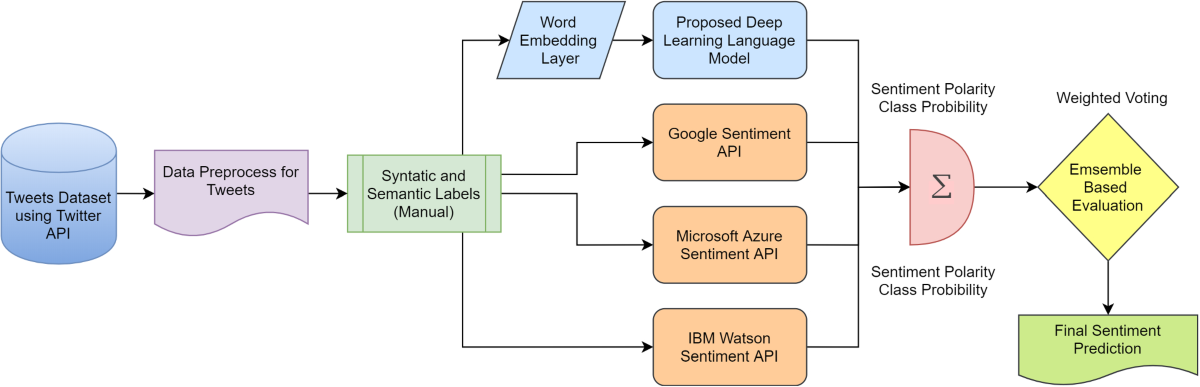
The journey begins with acquiring the raw social media data. This typically involves using platform APIs (e.g., Twitter API, Reddit API) or specialized web scraping tools. Once collected, the data undergoes rigorous preprocessing:
- Noise Reduction: Removing advertisements, duplicate posts, and spam.
- Normalization: Handling variations in spelling, capitalization, and abbreviations.
- Language Detection: Identifying and filtering out non-target languages.
- Emoji and Emoticon Handling: Converting emojis into textual representations or incorporating them as features, as they carry significant sentiment.
- Slang and Acronym Expansion: Addressing informal language common on social media.
Feature Engineering and Representation
After preprocessing, the cleaned text must be converted into numerical features that the machine learning model can process. This step is critical for the model's performance. As mentioned, techniques range from simple word counts (BoW, TF-IDF) to sophisticated word embeddings and contextual embeddings from pre-trained transformer models. The choice depends on the complexity of the sentiment nuances you aim to capture.
Model Training and Validation
This is where the machine learning magic happens. A significant portion of the preprocessed and featurized data is used to train the chosen algorithm. The model learns to map input features to sentiment labels (positive, negative, neutral). A separate portion of the data, the validation set, is used to fine-tune the model's parameters (hyperparameter tuning) and prevent overfitting.
Finally, a test set, unseen by the model during training or validation, is used to evaluate its true performance. Metrics like accuracy, precision, recall, and F1-score are used to assess the model's effectiveness in correctly classifying sentiment. Cross-validation techniques ensure the model's robustness and generalization ability.
Deployment and Monitoring
Once a robust model is trained and validated, it can be deployed into a production environment. This might involve integrating it into a social listening platform, a customer relationship management (CRM) system, or a business intelligence dashboard. Continuous monitoring is crucial to ensure the model maintains its accuracy over time, as language evolves and new social media trends emerge. Regular retraining with fresh, labeled data is often necessary to keep the model relevant and high-performing. This iterative process ensures you're always leveraging the most accurate predictive analytics from your social data.
Beyond Polarity: Advanced Sentiment Analysis Techniques
While classifying sentiment as simply positive, negative, or neutral is valuable, advanced techniques offer deeper, more granular insights into social media conversations.
Aspect-Based Sentiment Analysis (ABSA)
Instead of just determining the overall sentiment of a post, ABSA identifies specific aspects or features of an entity (e.g., a product, service, or brand) and then determines the sentiment expressed towards each of those aspects. For example, a review might say, "The phone's camera is excellent, but the battery life is terrible." ABSA would identify "camera" as positive and "battery life" as negative, providing much more detailed and actionable feedback for product teams. This granular customer feedback is invaluable for targeted improvements.
Emotion Detection
Beyond simple polarity, emotion detection aims to identify specific human emotions like joy, anger, sadness, surprise, fear, and disgust. This provides a richer understanding of user reactions and can be critical for crisis management or understanding the emotional impact of marketing campaigns. Deep learning models, particularly those trained on large emotional datasets, are highly effective here.
Sarcasm and Irony Detection
One of the most significant challenges in sentiment analysis is detecting sarcasm and irony, where the expressed words convey the opposite of the intended meaning (e.g., "Great, just what I needed, more spam calls."). Traditional sentiment models often misclassify sarcastic remarks. Researchers are increasingly using advanced NLP techniques, including contextual embeddings from transformer models and multimodal analysis (incorporating emojis or images), to improve sarcasm detection accuracy. While still a complex area, progress is being made.
Real-World Applications and Benefits
The practical applications of machine learning for sentiment analysis of social media data are vast and impactful across various sectors.
- Brand Monitoring and Reputation Management: Companies can set up real-time alerts for spikes in negative sentiment related to their brand, allowing for rapid response and mitigation of potential PR crises. They can also track the effectiveness of marketing campaigns by measuring changes in positive sentiment. This is critical for maintaining a strong brand reputation.
- Customer Service Improvement: By analyzing sentiment in customer complaints or feedback on social media, businesses can identify recurring issues, prioritize support tickets based on urgency and sentiment, and even route highly negative interactions to senior support agents. This directly leads to improved customer satisfaction.
- Product Development and Innovation: Product teams can gain direct insights from user discussions, identifying features users love, those they dislike, and even new feature ideas. This data-driven approach ensures product roadmaps are aligned with actual user needs.
- Market Research and Competitive Intelligence: Analyze public sentiment towards competitors' products or services, identify their strengths and weaknesses, and discover untapped market segments or unmet customer needs. This provides a significant competitive edge.
- Crisis Management: During unforeseen events (e.g., product recalls, public controversies), sentiment analysis provides a real-time pulse of public opinion, helping organizations craft appropriate responses and understand the emotional impact of the situation.
- Political Discourse Analysis: Researchers and political campaigns use sentiment analysis to gauge public opinion on policies, candidates, and events, informing strategic communication and understanding voter sentiment.
The ability to automatically process and interpret sentiment at scale empowers organizations to make proactive, informed decisions, fostering growth and resilience in a dynamic digital landscape. It's about transforming raw social chatter into sophisticated customer insights.
Challenges and Considerations for Effective Implementation
While powerful, implementing machine learning for sentiment analysis is not without its hurdles. Awareness of these challenges is key to successful deployment.
- Data Quality and Bias: The quality of the training data directly impacts model performance. Biased or unrepresentative training data can lead to skewed results, perpetuating societal biases or misinterpreting niche sentiments. Ensuring diverse and well-labeled datasets is paramount.
- Contextual Understanding: Social media language is highly contextual. A word that is positive in one context might be negative in another. Models struggle with subtle cues, irony, and sarcasm, as discussed.
- Language Nuances: Handling slang, abbreviations, code-switching (mixing languages), and emojis presents ongoing challenges. Models need to be constantly updated and retrained to keep pace with evolving language trends.
- Domain Specificity: A model trained on general movie reviews may not perform well on financial tweets due to different jargon and sentiment expressions. Domain-specific models or fine-tuning general models are often necessary.
- Model Explainability: Deep learning models, while powerful, can often act as "black boxes," making it difficult to understand why they made a particular sentiment classification. For critical applications, understanding the reasoning behind a prediction can be important.
- Ethical Implications: Using sentiment analysis for monitoring individuals or influencing public opinion raises ethical concerns regarding privacy, surveillance, and potential manipulation. Responsible AI practices are crucial.
Practical Tips for Leveraging ML in Sentiment Analysis
To maximize the effectiveness of your machine learning for sentiment analysis initiatives, consider these actionable tips:
- Define Clear Objectives: Before diving into data, clearly articulate what you want to achieve. Are you tracking brand reputation, improving a specific product feature, or identifying customer service issues? Clear objectives guide data collection, model selection, and interpretation.
- Invest in Quality Data: "Garbage in, garbage out" applies strongly here. Prioritize collecting diverse, relevant, and accurately labeled training data. Consider human annotation services for high-quality ground truth.
- Start Simple, Then Scale: Begin with a simpler model (e.g., Naïve Bayes or Logistic Regression) to establish a baseline, then progressively move to more complex deep learning models if necessary. This iterative approach saves time and resources.
- Choose the Right Tools and Frameworks: Leverage powerful open-source NLP libraries like NLTK, spaCy, and Hugging Face Transformers. Frameworks like TensorFlow and PyTorch provide the backbone for building and training deep learning models.
- Regularly Monitor and Retrain Models: Social media language is dynamic. Your models will degrade over time if not regularly updated. Set up a pipeline for continuous monitoring of model performance and periodic retraining with fresh data.
- Combine with Human Oversight: For highly sensitive or ambiguous cases, human review remains invaluable. A hybrid approach, where ML handles the bulk and humans review exceptions or complex cases, often yields the best results.
- Focus on Actionable Insights: Don't just generate sentiment scores. Translate them into meaningful, actionable insights. What specific product change does negative sentiment suggest? What marketing message resonates most positively? Connect sentiment data to business outcomes.
- Consider Aspect-Based Analysis: For product-centric businesses, moving beyond overall sentiment to aspect-based sentiment analysis provides significantly more valuable insights for product development and marketing efforts.
- Address Sarcasm and Nuance: Acknowledge the limitations of current models with sarcasm and irony. For critical applications, consider specialized models or human review for highly ambiguous content.
Frequently Asked Questions
What is the difference between sentiment analysis and opinion mining?
While often used interchangeably, sentiment analysis is a broader term encompassing the computational identification of sentiment polarity (positive, negative, neutral) in text. Opinion mining is a closely related field that focuses specifically on extracting and analyzing people's opinions, attitudes, and emotions towards entities, aspects, and topics. In practice, the terms largely describe the same process of using NLP and machine learning to understand subjective information in text, especially within the context of social media data.
How accurate is machine learning for sentiment analysis?
The accuracy of machine learning for sentiment analysis varies significantly based on factors like data quality, model complexity, the specific domain, and the language's nuances. For general, well-defined sentiment tasks on clean data, accuracy can range from 70% to 90% or even higher. However, for highly informal social media data, or when dealing with sarcasm, irony, or complex contexts, accuracy can drop. Deep learning models, especially transformer-based architectures, have pushed the boundaries of accuracy by better understanding contextual meaning and semantic keyword variations.
Can machine learning detect sarcasm in social media posts?
Detecting sarcasm and irony is one of the most challenging problems in sentiment analysis, even for advanced machine learning algorithms. While significant progress has been made with sophisticated deep learning models that analyze contextual cues, word embeddings, and even emojis, no model achieves perfect accuracy. Sarcasm often relies on shared cultural understanding, tone of voice (which is absent in text), and subtle linguistic twists that are difficult for machines to fully grasp. It remains an active area of research in Natural Language Processing.
What are the ethical considerations when using ML for sentiment analysis?
Ethical considerations for machine learning for sentiment analysis include potential biases in training data leading to unfair or discriminatory analyses, privacy concerns related to analyzing individual opinions without explicit consent, and the potential for misuse in surveillance or manipulation of public discourse. Responsible AI development emphasizes transparency, fairness, accountability, and respecting user privacy, especially when dealing with sensitive social media data and customer insights.
How can businesses get started with sentiment analysis?
Businesses can start with sentiment analysis by first defining their specific goals (e.g., brand monitoring, customer service improvement). They can then explore existing AI-powered sentiment analysis APIs and tools (e.g., from cloud providers like Google, AWS, Azure) which offer out-of-the-box solutions. For more customized or sensitive needs, consider engaging with data science consultants or building in-house capabilities, focusing on collecting relevant social media data, labeling it accurately, and training or fine-tuning machine learning models. Start with a pilot project to demonstrate value before scaling up.

0 Komentar