
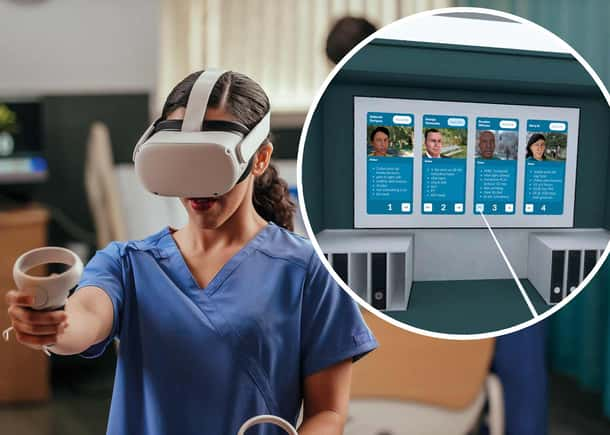
Virtual Reality for Simulation and Training: Revolutionizing Skill Development and Performance
Embark on a journey into the future of learning and professional development. Virtual reality for simulation and training is rapidly transforming how individuals acquire new skills, refine existing ones, and prepare for real-world challenges. This cutting-edge technology offers an unparalleled opportunity to create immersive learning experiences, making complex subjects accessible and dangerous scenarios safe for practice. From honing intricate surgical procedures to navigating high-stakes combat situations, VR training delivers a powerful, engaging, and highly effective alternative to traditional methods. Discover how simulated environments are setting new benchmarks for efficiency, engagement, and retention across diverse industries.
The Transformative Power of Virtual Reality in Training
The integration of virtual reality into training methodologies marks a significant paradigm shift. Unlike passive learning, VR demands active participation, placing learners directly within a realistic scenario that mirrors their future work environment. This active engagement significantly boosts comprehension and retention, leading to measurable improvements in performance.
Unparalleled Realism and Immersion
At the core of VR's effectiveness is its ability to create profoundly realistic and immersive environments. Learners are transported into a virtual environment where they can interact with objects, tools, and even virtual characters as if they were physically present. This deep immersion facilitates a stronger cognitive connection to the material, making the training feel less like a lesson and more like a genuine experience. The brain processes these simulated events much like real ones, leading to more robust memory formation and practical application of learned skills.
Enhancing Skill Development and Performance Improvement
VR provides a safe and repeatable sandbox for intensive skill development. Whether it's operating heavy machinery, performing delicate surgical procedures, or practicing complex communication strategies, learners can repeat tasks countless times without incurring real-world costs or risks. This iterative practice is crucial for muscle memory development and fine-tuning motor skills. Organizations report significant performance improvement among employees trained using VR, noting increased confidence, reduced errors, and faster task completion times. The immediate feedback loops within VR simulations allow for instant correction and reinforcement, accelerating the learning curve.
Safety and Risk Mitigation
Perhaps one of the most compelling advantages of VR is its capacity for safety training. Industries where high-risk operations are common, such as manufacturing, construction, and emergency services, benefit immensely. Trainees can practice responding to critical incidents, equipment failures, or hazardous material spills in a controlled, virtual setting. This eliminates the danger to personnel, the risk of equipment damage, and the high costs associated with real-world drills. It's an invaluable tool for preparing workers for unexpected challenges and ensuring compliance with stringent safety protocols.
Cost-Effectiveness and Accessibility
While the initial investment in VR technology might seem substantial, it often proves to be remarkably cost-effective in the long run. VR training reduces the need for expensive physical prototypes, specialized equipment, travel expenses for trainers and trainees, and downtime associated with traditional on-site training. Furthermore, VR content can be easily distributed globally, making high-quality training accessible to a dispersed workforce. This scalability allows organizations to train a large number of employees consistently and efficiently, regardless of their geographical location.
Key Applications of VR Simulation Across Industries
The versatility of virtual reality for simulation and training extends across a multitude of sectors, each leveraging its unique capabilities to address specific training needs and challenges.
Healthcare and Medical Training
In the realm of healthcare education, VR is a game-changer. Surgeons can practice intricate operations, nurses can refine patient care procedures, and medical students can explore human anatomy in 3D. The inclusion of haptic feedback technology allows trainees to "feel" textures, resistance, and pressure, adding another layer of realism to surgical simulations or palpation exercises. This leads to greater precision and reduced errors when moving to real-world patient care. For more detailed insights, explore how VR is revolutionizing medical education.
Military and Defense Simulations
The military has been an early adopter of advanced simulation technologies, and VR continues to push boundaries in military simulations. Soldiers can engage in highly realistic combat scenarios, practice tactical maneuvers, operate complex vehicles, and conduct mission rehearsals. This enables extensive preparation for diverse operational environments, enhances decision-making under pressure, and fosters team cohesion without exposing personnel to actual danger or incurring the immense costs of live drills.
Aviation and Aerospace
From commercial pilots to air traffic controllers and maintenance crews, the aviation industry relies heavily on simulation. VR provides hyper-realistic cockpits for pilot training, allowing them to practice emergency procedures, navigate challenging weather conditions, and master complex flight systems. For ground crews, VR offers detailed walkthroughs of aircraft maintenance, enabling hands-on learning without needing actual aircraft parts, significantly reducing training costs and improving safety.
Industrial and Manufacturing
In industrial training, VR is used to train workers on operating heavy machinery, assembling complex products, and performing maintenance tasks. This is particularly valuable for training on equipment that is expensive, dangerous, or not readily available for hands-on practice. For instance, a technician can learn to troubleshoot a sophisticated industrial robot in VR, identifying issues and practicing repairs before ever touching the real machine. This reduces equipment downtime, enhances worker safety, and improves overall operational efficiency.
Corporate and Soft Skills Training
Beyond technical skills, VR is proving highly effective for developing soft skills critical in the corporate world. Scenarios can be designed to train employees in leadership, public speaking, customer service, conflict resolution, and diversity and inclusion. By placing learners in simulated social interactions, they can practice difficult conversations, receive immediate feedback on their communication style, and learn to navigate complex interpersonal dynamics in a safe, judgment-free space.
Designing Effective VR Training Programs
To truly harness the power of virtual reality for simulation and training, a strategic approach to program design is essential. It's not enough to simply put on a headset; the content and methodology must be meticulously crafted.
Defining Clear Learning Objectives
The first and most critical step is to clearly define what learners should be able to do after completing the VR training. Are they expected to operate a specific machine, perform a particular surgical step, or respond effectively to a customer complaint? Clear, measurable objectives will guide the entire development process and ensure the VR experience directly addresses the desired learning outcomes. Without well-defined goals, even the most technologically advanced VR simulation will lack purpose and efficacy.
Content Creation and Scenario Development
The quality of the experiential training hinges on the realism and relevance of the virtual content. This involves meticulous scenario planning, scripting interactions, and accurately modeling environments and objects. Developers must work closely with subject matter experts to ensure technical accuracy and instructional designers to ensure pedagogical effectiveness. High-fidelity graphics and realistic physics simulations contribute significantly to the immersive experience, making the training more believable and impactful.
Hardware and Software Considerations
Choosing the right VR hardware (headsets, controllers, haptic suits) and software platforms is crucial. Considerations include portability, graphical fidelity, user comfort, and integration capabilities with existing learning management systems (LMS). For complex simulations, high-end PC-tethered headsets might be necessary, while for simpler, scalable training, standalone headsets could be more appropriate. The software platform should allow for easy content updates, performance tracking, and user management.
Integration and Evaluation
VR training should ideally be integrated into a broader blended learning strategy, complementing classroom instruction or e-learning modules. Post-training evaluation is vital to measure effectiveness. This includes tracking learner performance within the VR environment (e.g., time to complete tasks, error rates, decision accuracy), as well as assessing real-world application of learned skills. Pilot programs with a small group of users can provide invaluable feedback for refinement before a wider rollout. Organizations should establish clear KPIs (Key Performance Indicators) to measure the return on investment (ROI) of their VR training initiatives.
The Future Landscape: Innovations and Trends
The field of virtual reality for simulation and training is dynamic, with continuous innovation promising even more sophisticated and effective learning experiences.
Haptic Feedback and Multi-Sensory Integration
The future will see increasingly advanced haptic feedback systems that provide a more realistic sense of touch, weight, and resistance. Beyond haptics, multi-sensory integration will incorporate realistic smells, temperatures, and even wind effects, creating truly indistinguishable virtual environments. This will be particularly impactful for highly tactile professions like surgery, mechanical engineering, and emergency response.
AI-Powered Adaptive Learning
Artificial intelligence will play a crucial role in creating adaptive VR training programs. AI algorithms will analyze learner performance in real-time, identify areas of weakness, and dynamically adjust the difficulty, content, and pacing of the simulation to provide a personalized learning path. This ensures each trainee receives targeted instruction precisely where they need it most, optimizing learning efficiency.
Collaborative VR Environments
While much VR training is currently individual, the trend is moving towards collaborative multi-user environments. This will enable teams to train together in virtual spaces, practicing communication, coordination, and collective problem-solving. Imagine a medical team rehearsing a complex surgery or a construction crew planning a delicate lift, all within a shared virtual reality simulation, regardless of their physical locations.
Integration with Augmented Reality (AR)
The lines between VR and augmented reality (AR) will continue to blur. Hybrid training solutions, often referred to as mixed reality, will allow learners to interact with virtual objects superimposed onto their real-world environment. This could involve an AR overlay providing real-time instructions for assembling a physical product or virtual diagnostic information appearing alongside a real patient during medical training, bridging the gap between simulation and practical application.
Actionable Tips for Implementing VR in Your Training Strategy
Ready to explore the potential of virtual reality for your organization's training needs? Here are some practical tips to guide your implementation:
- Start Small, Scale Up: Don't try to overhaul all your training at once. Begin with a pilot program for a specific, high-impact training area. This allows you to test the waters, gather feedback, and demonstrate ROI before a wider rollout.
- Partner with Experts: Developing high-quality VR content requires specialized skills. Collaborate with experienced VR development studios or consultants who understand both instructional design and immersive technology.
- Focus on ROI: Identify training areas where VR can deliver clear, measurable benefits, such as reducing travel costs, improving safety records, or accelerating skill acquisition for critical roles. Quantify these benefits to justify your investment.
- Gather User Feedback: Continuously solicit feedback from trainees. What did they find engaging? What was challenging? Use this input to iterate and improve your VR training modules, ensuring they meet user needs and learning objectives.
- Ensure Accessibility and Comfort: Consider the physical comfort of VR headsets for prolonged use and ensure your VR training is accessible to a diverse workforce, addressing potential motion sickness or other user experience concerns.
Frequently Asked Questions About VR for Simulation and Training
What are the primary benefits of using virtual reality for training?
The primary benefits of using virtual reality for simulation and training include enhanced realism and immersion, leading to deeper engagement and better retention of information. It allows for safe practice of high-risk procedures, significant cost savings by reducing the need for physical resources and travel, and the ability to scale training to a global workforce. VR also provides immediate feedback, accelerating skill development and improving overall performance improvement.
How does VR training compare to traditional training methods?
VR training offers several distinct advantages over traditional methods like classroom lectures or manual simulations. Unlike passive learning, VR provides hands-on, experiential training in a highly engaging and interactive environment. It allows for unlimited, risk-free repetition of tasks, which is often impractical or too costly in real-world settings. While traditional methods have their place, VR excels in delivering practical, application-based learning that directly translates to real-world competency, often with higher retention rates and faster learning curves.
Is VR training cost-effective for small businesses?
Yes, VR training can be highly cost-effective even for small businesses, especially when considering long-term benefits. While there's an initial setup cost for hardware and content development, it can significantly reduce recurring expenses associated with traditional training, such as travel, instructor fees, facility rentals, and material waste. For small businesses, focusing on specific, high-value training needs (e.g., complex equipment operation or critical safety protocols) can yield a strong ROI, making VR a viable and valuable investment.
What kind of content is best suited for VR simulation?
Content best suited for VR simulation typically involves tasks that are complex, dangerous, expensive to replicate in real life, or require significant spatial awareness and motor skills. This includes training for operating heavy machinery, medical procedures, emergency response protocols, technical maintenance, military tactics, and even soft skills like public speaking or conflict resolution where realistic human interaction is key. Any scenario where hands-on practice in a safe, repeatable environment is beneficial is an excellent candidate for VR.
What hardware is needed for VR training?
The basic hardware needed for VR training typically includes a VR headset (such as Oculus Quest, HTC Vive, or Valve Index), and often motion controllers for interacting within the virtual environment. Depending on the complexity and fidelity of the simulation, a powerful gaming PC might be required for PC-tethered headsets, while standalone headsets offer more portability. For advanced simulations, additional peripherals like haptic gloves or full-body tracking suits might be incorporated to enhance the immersive experience and provide more realistic feedback.
Explore how virtual reality can revolutionize your organization's training programs and elevate your workforce's capabilities. Contact us today to discuss bespoke VR simulation and training solutions tailored to your specific needs.

0 Komentar